
THE LIGHT RETURNS
BOOK CREATOR AS A TEACHING TOOL
The Book Creator book The Light Returns is a student’s book associated with the podcast The Light Returns. The duration of the podcast is 3:49. The activities have been designed to focus on the students’ investigative, experimental and creative approach to learning. The process consists of three steps: Preparation before listening to the podcast. Listening to and working with the podcast. Further work with topics and insights from the podcast. We recommend that you listen to the podcast before presenting it to the students.
We recommend that students work in pairs or individually. Depending on what suits each student best and the competences to be developed. Keep in mind that your best friend is not necessarily the one you collaborate best with. Working together is about working together and not just being together.
Nature/culture/technology
Cross-curricular – languages, religion, art and science.
- The students acquire fundamental knowledge about the importance of the Sun to the people living by the Icefjord.
- The students acquire knowledge about the importance of the light for life around the Icefjord and in general for life north of the Arctic Circle.
- The students work problem-solving-oriented based on creative and critical thinking.
- The students practise their skills in communication and cooperation.
The students meet the Icefjord Centre in two pictures, showing summer and winter respectively.
In class you can talk about:
- What the Icefjord Centre is.
- What the surroundings around the centre look like.
- The difference between summer and winter.
- How summer and winter differ where you live.
The students see a map of Greenland. There is a marker that shows where Ilulissat is situated.
In class you can discuss:
- What you see on the map.
- How many people live in Ilulissat.
- What else do you know about Greenland and Ilulissat?
- Do you know the names of other places on the map?
The students see a map of Ilulissat. There is a marker that shows where Holms Bakke is situated. The red line shows a route from the Icefjord Centre to Holms Bakke.
In class you can talk about:
- How far is the distance from Holms Bakke to the Icefjord Centre?
- Why do you go up on a hill in order to see the return of the Sun?
- Please give the students the experience of standing on the roof of the Icefjord Centre looking down on Holms Bakke (you could use the pictures on pages 4-7)
The students see part of a world map.
The task now is to move the red marker down into the map in order to show where each student lives.
The marker is found in the white box and can be drawn into the map.
In class you can talk about:
- Where is your town or settlement situated?
- How many people live in the town or settlement where you live?
- Do you know the name of other places on the map?
Now it is time for the students to listen to the podcast The Light Returns.
They start the podcast by clicking on the icon in the middle of page 14.
It is recommended that the students listen in pairs or small groups.
Let the students spend a few minutes discussing what they have heard in the podcast
with the student sitting next to them. On page 15 the students are to make small sound recordings where they tell about the podcast. The pictures on the page will help them remember what they have heard.
Insertion of sound see instruction 1 here
The recording will now be represented by a small sound icon. This icon can be placed wherever you wish on the page. You can listen to the recording over and over again.
Review in class
It is recommended to have a joint discussion in class when the work with pages 14-15 is done. This is to make a visible review so that the students can inspire each other and can fetch/borrow words and sentences for their work with the task.
We suggest that you support the discussion by writing and maybe illustrating concepts and keywords on the board.
In class you could talk about:
- What surprised the students when listening to the podcast.
- Concepts and keywords that the students encountered in the podcast.
In the Book Creator book there are some pages with tasks connected to some of the concepts. You can add more pages yourself for other topics you discuss, other concepts and other keywords. In the text below you can find inspiration for the class discussion.
Concepts and keywords
- January – 13 January
It is the day where the light returns to Ilulissat. It is the most important day of the year. Lisa tells us that they all look forward to enjoying nature and to sailing. In the schools the children create suns and display them in the windows. From 29 November till 13 January there is no sun. Everyone, who is able to and wants to, goes to welcome the Sun on Seqinniarfik/Holms Bakke. Afterwards they celebrate with singing, eating cake and drinking coffee. 13 January is a very important day for the Greenlanders in Ilulissat.
Why is 13 January important to the Greenlanders in Ilulissat?
What day/which days are important to you?
- Christmas and Easter – two holidays from Christianity that Lisa mentions.
Even though 13 January is important to the Greenlanders in Ilulissat, the Christian holidays are also of great importance to them.
Are there other holidays that you know of?
Do you know anything about holidays from other religions than Christianity?
- Traditions – everyone, who is able to and wants to, goes to Seqinniarfik/Holms Bakke. To sing a welcome song to the Sun.
13 January is quite a special and significant day for the Greenlanders in Ilulissat, because they have a tradition where they welcome the Sun. Afterwards they celebrate with singing, eating cake and drinking coffee. The song they sing is called ”Seqernup qungululluni nunarput nuilaaraa” / ”When the Sun with a smile looks a bit over our country”. They can now look forward to light and warm days.
What is a tradition and which other traditions do you know?
Do you know other traditions where you celebrate with singing, eating cake and drinking coffee?
When do the light and warm days come to the place where you live?
On pages 16-17 the students insert their own important days or traditions. You could ask them to bring pictures from home that they can photograph and insert. They can also make a drawing of their important days/traditions. It is a good idea to talk about the pictures/drawings in class so that everyone gets a chance to tell about their own important days/traditions.
If you have a class calendar, you can write all the students’ important days/traditions in it.
Insertion of sound see instruction 2 here
Here comes the rest of the concepts.
- The midnight sun – a phenomenon of nature you can find north of the Arctic Circle, where the Sun does not set for several weeks in a row. Lisa tells us that there are no set hours to relate to; you eat when you are hungry and go to bed when you are tired. You live the way that nature dictates.
What would you do, if you were not to relate to certain set hours in your daily life?
- The Sun – the star in our solar system. Without it, life on Earth, as we know it, would not be able to exist. The students in Ilulissat create suns of paper and display them in the classroom to celebrate the return of the Sun 13 January.
Do you know any planets in our solar system?
What would the Earth look like if the Sun did not exist?
Could we exist without the Sun?
Now the students are to cut out suns and display them in the classroom, maybe in the windows. Please talk about the Greenlandic children in Ilulissat that cut out suns and display them on 13 January as a part of the celebration of the return of the light. On pages 18-19 they can take a picture of the window filled with suns and insert the photo in the book.
Insertion of sound see instruction 2 here
On pages 20 and 21 the students can write sentences or small stories using the keywords that you have talked about. They can write them, record them as a sound recording or make a drawing and insert the picture. Their products will be part of the further work with the podcast.
Insertion of sound, pictures & text see instructions 1, 2 & 3 here
Use the picture in the Book Creator book to talk about the Earth and the Sun.
Here are some suggestions as to what you can talk about in class:
- How does the Earth orbit the Sun? Notice the arrow around the Earth that shows the direction.
- Does the Sun hide and why do you say that “the Sun rises” when it actually is the Earth that is moving?
- How the dark period of the year and the midnight sun occur because of the inclination of the Earth. Notice the axis that goes through the Earth.
- If it fits with your class, have a talk about northern lights.
Experiment with globe and lamp
The students can try making an experiment with a globe and a lamp that shows how the light hits the Earth when it orbits around its own axis and around the Sun.
This experiment is to show how the rotation and inclination of the Earth is connected to the light. See the picture underneath the experiment guide.
They will need:
- a globe
- a strong lamp (alternatively a normal lamp or a flashlight)
- a stand to hold the lamp, unless you can hold it by yourself (perhaps you can organise the students in groups so they can take turns at holding the lamp/Sun)
- Place the globe on a table and the lamp straight across from the globe.
- Switch on the lamp so that it shines directly on the globe.
- Talk about what the lamp and the globe symbolise.
- Try to turn the globe and let the students share their thoughts about what this shows.
- Please talk about how the picture on pages 22-23 fits with what they can observe themselves with the globe and the lamp. Perhaps have a talk about how the globe is to be turned to show the days before and after 13 January in Ilulissat.
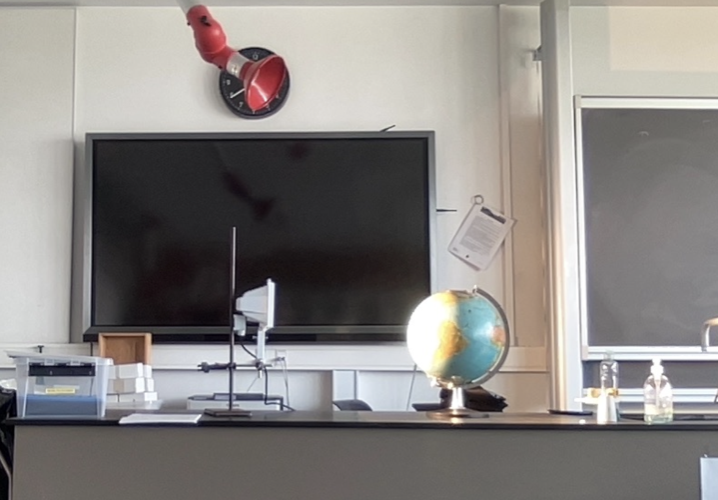
Picture of the experiment
Now the students have worked with “The Light Returns”, traditions and the Earth’s orbit around the Sun. To conclude this work they are to make a product in the form of a comic strip where we follow two Greenlandic children from Ilulissat through their day on 13 January.
On pages 24-29 there are three different pages with inserted frames. These pages are meant as suggestions as to how the students can build up their own comic strip. They can delete and add pages so that it fits with exactly their personal comic strip. (Speech) balloons, thought bubbles and statements are also inserted on the pages. These can also be deleted or altered so they fit in with the student’s product.
Here are some suggestions to elements that the students might include:
- The breakfast table conversation, maybe they talk about the big celebration that is taking place later that day.
- In school they cut out suns and display them.
- The trip to Holms Bakke, wonder what they talk about while on their way?
- The joy of being able to go outside at last and e.g. spend the night in a tent and pick berries.
- The difference between the weeks before and after 13 January.
- Here the students could include the Sun, the stars, northern lights, the Moon
- The celebration after having welcomed the Sun. What kind of cakes do they eat?
The students can choose to make their own drawings and insert them in Book Creator, use the characters that are already in Book Creator or mix the two. If it fits with their comic strip, they can choose to add sound recordings.
When the students have finished creating their product, they are to present it later – in class and maybe for other students in the school, parents etc.
Insertion of sound, pictures and speech bubble see instructions 1,2 & 6 here
The students present their comic strips to the class.
Make sure that the framework for feedback is positive criticism. The students should be supported in assessing what is good – and what might be done better. Find more inspiration her.
Not specifically with a view to making new visual stories, but foremost to let the students discover and work with this kind of constructive and positive criticism.
If you wish to let the students make use of the feedback they have received from the class, you could reserve time for them to continue their work with their products. So that they can use the feedback they have received from each other to change things in their product.
If you intend to work with some of the other podcasts from the Icefjord Centre, it might make sense to save the students’ Book Creator book so the work they have done with it can be used again.
The podcast The Light Returns has been created for the Icefjord Centre in Ilulissat by Katrine Nyland. The included graphics are developed by Oncotype.
Teaching material for the podcast The Light Returns has been developed by Lotte Brinkmann and Daniella Maria Manuel, Anholt Læringsværksted, with feedback from Leg med It.
The student’s book in Book Creator has been developed as part of the project Nutaaliorta from Kivitsisa.
The template was designed by Rikke Falkenberg Kofoed and Daniella Maria Manuel, Leg med It.
The teaching material The Light Returns is published under a Creative Commons crediting licence CC:BY.
The texts, assignments and pictures can be shared, reproduced and adapted, with the proviso that “The Light Returns” by The Icefjord Centre Ilulissat is credited as the source.
The students meet the Icefjord Centre in two pictures, showing summer and winter respectively.
In class you can talk about:
- What the Icefjord Centre is.
- What the surroundings around the centre look like.
- The difference between summer and winter.
- How summer and winter differ where you live.
The students see a map of Greenland. There is a marker that shows where Ilulissat is situated.
In class you can discuss:
- What you see on the map.
- How many people live in Ilulissat.
- What else do you know about Greenland and Ilulissat?
- Do you know the names of other places on the map?
The students see a map of Ilulissat. There is a marker that shows where Holms Bakke is situated. The red line shows a route from the Icefjord Centre to Holms Bakke.
In class you can talk about:
- How far is the distance from Holms Bakke to the Icefjord Centre?
- Why do you go up on a hill in order to see the return of the Sun?
- Please give the students the experience of standing on the roof of the Icefjord Centre looking down on Holms Bakke (you could use the pictures on pages 4-7)
The students see part of a world map.
The task now is to move the red marker down into the map in order to show where each student lives.
The marker is found in the white box and can be drawn into the map.
In class you can talk about:
- Where is your town or settlement situated?
- How many people live in the town or settlement where you live?
- Do you know the name of other places on the map?
Now it is time for the students to listen to the podcast The Light Returns.
They start the podcast by clicking on the icon in the middle of page 14.
It is recommended that the students listen in pairs or small groups.
Let the students spend a few minutes discussing what they have heard in the podcast
with the student sitting next to them. On page 15 the students are to make small sound recordings where they tell about the podcast. The pictures on the page will support their memory of what they have heard.
Insertion of sound see instruction 1 here
Review in class
It is recommended to have a joint discussion in class when the work with pages 14-15 is done.
We suggest that you support the discussion by writing and maybe illustrating concepts and keywords on the board.
In class you could talk about:
- What surprised the students when listening to the podcast.
- Concepts and keywords that the students encountered in the podcast.
In the text below you can find inspiration for the class discussion.
- January – 13 January
It is the day where the light returns to Ilulissat. It is the most important day of the year. Lisa tells us that they all look forward to enjoying nature and to sailing. In the schools the children create suns and display them in the windows. From 29 November till 13 January there is no sun. Everyone, who is able to and wants to, goes to welcome the Sun on Seqinniarfik/Holms Bakke. Afterwards they celebrate with singing, eating cake and drinking coffee. 13 January is a very important day for the Greenlanders in Ilulissat.
Why is 13 January important to the Greenlanders in Ilulissat?
What day/which days are important to you?
- Christmas and Easter – two holidays from Christianity that Lisa mentions.
Even though 13 January is important to the Greenlanders in Ilulissat, the Christian holidays are also of great importance to them.
Are there other holidays that you know of?
Do you know anything about holidays from other religions than Christianity?
- Traditions – everyone, who is able to and wants to, goes to Seqinniarfik/Holms Bakke. To sing a welcome to the Sun.
13 January is quite a special and significant day for the Greenlanders in Ilulissat, because they have a tradition where they welcome the Sun. Afterwards they celebrate with singing, eating cake and drinking coffee. The song they sing is called ”Seqernup qungululluni nunarput nuilaaraa” / ”When the Sun with a smile looks a bit over our country”. They can now look forward to light and warm days.
What is a tradition and which other traditions do you know?
Do you know about other traditions, where phenomena of nature are celebrated?
Now the students will listen to the song that is sung at Holms Bakke. Click on the sun to play the song. The text is written in Greenlandic and in an English translation. The students can try singing along in Greenlandic while they listen to the song. Subsequently they must discuss the importance of the light to the Greenlanders in Ilulissat using the text of the song and what they have heard about in the podcast.
These are the last two concepts that relate to the podcast.
- The midnight sun – a phenomenon of nature you can find north of the northern polar circle, where the Sun does not set for several weeks in a row. Lisa tells us that there are no set hours to relate to; you eat when you are hungry and go to bed when you are tired. You live the way that Nature dictates.
What would you do, if you were not to relate to certain set hours in your daily life?
How does it fit with the daily life you live at present?
- The Sun – the star in our solar system. Without it, life on Earth, as we know it, would not be able to exist. The students in Ilulissat create suns of paper and display them in the classroom to celebrate the return of the Sun 13 January.
Do you know any planets in our solar system? Name them.
What would the Earth look like if the Sun did not exist?
Could we exist without the Sun?
Now the students will search for pictures in Book Creator. On page 18 they are to find pictures of the midnight sun and insert them. On page 19 they are to find pictures of the solar system and insert them.
Insertion of pictures see instruction 2 here
On pages 20 and 21 the students can write short sentences or small stories using the keywords that you have talked about. They can write them, record them as a sound recording or draw a drawing and insert the picture. Their products will be part of the further work with the podcast.
Insertion of sound, pictures & text see instructions 1, 2 & 3 here
Now the students will search for knowledge. On pages 22-23 there is a link to this homepage from Visit Greenland and a picture of the midnight sun in Ilulissat. They will be using the homepage to find the answers to the four questions on pages 24 and 25. Their answers to the questions they insert in the (speech) balloons as small sound recordings.
Here are some suggestions to other questions you can work with:
- Are there other countries where they also welcome the return of the Sun?
- What is the difference between the northern and the southern polar circle?
Insertion of sound see instruction 1 here
Use the picture in the Book Creator book to talk about the Earth and the Sun.
Here are some suggestions to what you can talk about in class:
- How does the Earth orbit around the Sun? Notice the arrow around the Earth that shows the direction.
- Why do you say that “the Sun rises” when it actually is the Earth that rotates around its own axis and orbits around the Sun?
- What influence does the inclination of the Earth have on the dark period of the year and the midnight sun? Notice the axis that goes through the Earth.
- What are northern lights?
- Does this light phenomenon only occur north of the Arctic Circle?
Now the students have worked with the return of the light, northern lights and the Earth’s orbit around the Sun.
To conclude their work with these topics, the students are to work with their obtained knowledge and make a product using this knowledge. The students can choose between three different types of products.
- Interview about the invention of a new tradition to celebrate the light.
- Here the students are to imagine that they have invented a new tradition that celebrates the return of the light.
- They have to imagine that they are being interviewed by the news where they tell about their new tradition that celebrates the return of the light.
- They get interviewed by the news and tell about their new tradition.
- A podcast that explains the return of the Sun on the horizon in Ilulissat.
- Here the students are to explain the return of the Sun and why it happens on a certain day. They can make use of knowledge from the book.
- They decide themselves whether their podcast has a scientific angle or whether it tells about what it feels like to live in a country where the Sun is gone for several months.
- Production of their own welcoming song to the Sun.
- Here the students make their own welcoming song to the Sun. They decide themselves whether they will make use of a known tune or whether they want to make a tune of their own.
Pages 28-29 can be adjusted so they fit with the students’ choice of product. They can also add more pages if necessary.
Their product must be recorded as a sound recording and inserted in the Book Creator book. They can support the sound recording with drawings, pictures etc.
Organise the students in pairs, in groups or singly. Depending on what suits each student best and the competences to be developed.
Insertion of sound and pictures see instructions 1 & 2 here
To conclude the whole process, the students must present their work to the rest of the class. The focus here is the students’ communicative skills and competences.
The students present their products to the class.
Take care that the feedback consists of positive criticism. The students must be supported in judging: what is good – what could be better. Gather more inspiration here.
This is not necessarily because the students should make new picture stories, but more to let the students discover and work with this positive criticism.
If you want to work with some of the other podcasts from the Icefjord Centre, it would be a good idea to save the students’ Book Creator books so that the work they have done in it can be used again.
If you wish to let the students make use of the feedback they have received from the class, you can set time off for them to continue their work with their products. So that they can use the feedback they have received from each other to change things in their product.
The podcast The Light Returns has been created by the Icefjord Centre in Ilulissat.
Teaching material for the podcast The Light Returns has been developed by Lotte Brinkmann from Anholt Læringsværksted, with feedback from Leg med It.
The student’s book in Book Creator has been developed as part of the project Nutaaliorta from Kivitsisa.
The template was designed by Rikke Falkenberg Kofoed and Daniella Maria Manuel, Leg med It.
The teaching material The Light Returns is published under a Creative Commons crediting licence CC:BY.
The texts, assignments and pictures can be shared, reproduced and adapted, with the proviso that “The Light Returns” by The Icefjord Centre Ilulissat is credited as the source.
The students meet the Icefjord Centre in two pictures, showing summer and winter respectively.
In the classroom you can talk about:
- What the Icefjord Centre is.
- What it looks like around the centre.
- The difference between summer and winter.
- How summer and winter differ where you live.
Talk about the map and about how many people live in Ilulissat. Also talk about how many people live in the town or settlement that you live in.
The students see a map of Ilulissat. There is a marker that shows where Holms Bakke is situated. The red line shows a route from the Icefjord Centre to Holms Bakke.
In the classroom you can talk about:
- How far is the distance from Holms Bakke to the Icefjord Centre?
- Why do you go up on a hill in order to see the return of the Sun?
- Please give the students the experience of standing on the roof of the Icefjord Centre looking down on Holms Bakke (you could use the pictures on pages 4-7)
The students see part of a world map.
The task now is to move the red marker down to the map in order to show where each student lives.
The marker is found in the white box and can be drawn into the map.
In class you can talk about:
- Differences and similarities between Ilulissat and your own town or settlement
Now it is time for the students to listen to the podcast The Light Returns.
They start the podcast by clicking on the icon in the middle of page 14.
It is recommended that the students listen in pairs or small groups.
Let the students have a Walk and Talk, where they talk with each other about the podcast.
On page 15 the students are to tell about what they think is important to remember from the podcast. In the (speech) balloons the students can choose to put text, pictures or recordings.
Insertion of sound, pictures & text see instructions 1,2 & 3 here
Review in class
It is recommended to have a joint discussion in class when the work with pages 14-15 is finished.
We suggest that you support this with writing and maybe illustrating concepts and keywords on the board.
In class you could talk about:
- What surprised the students when listening to the podcast.
- Concepts and keywords that the students encountered in the podcast.
In the text below you can find inspiration for the class discussion.
- January – 13 January
It is the day where the light returns to Ilulissat. It is the most important day of the year. Lisa tells us that they all look forward to enjoying nature and to sailing. In the schools the children create suns and display them in the windows. From 29 November till 13 January there is no sun. Everyone, who is able to and wants to, goes to welcome the Sun on Seqinniarfik/Holms Bakke. Afterwards they celebrate with singing, eating cake and drinking coffee. 13 January is a very important day for the Greenlanders in Ilulissat.
Why does the light return to Ilulissat on 13 January?
What day/which days are important to you?
- Christmas and Easter – two holidays from Christianity that Lisa mentions.
Even though 13 January is important to the Greenlanders in Ilulissat, the Christian holidays are also of great importance to them.
Are there other holidays that you know of?
Do you know anything about holidays from other religions than Christianity?
- Traditions – everyone, who is able to and wants to, goes to Seqinniarfik/Holms Bakke. To sing a welcome to the Sun.
13 January is quite a special and significant day for the Greenlanders in Ilulissat, because they have a tradition where they welcome the Sun. Afterwards they celebrate with singing, eating cake and drinking coffee. The song they sing is called ”Seqernup qungululluni nunarput nuilaaraa” / ”When the Sun with a smile looks a bit over our country”. They can now look forward to light and warm days.
What is a tradition and which other traditions do you know?
Do you know about other traditions, where phenomena of nature are celebrated?
- The Sun – the star in our solar system. Without it, life on Earth, as we know it, would not be able to exist. The students in Ilulissat create suns of paper and hang them up in the classroom to celebrate the return of the Sun 13 January.
What would the Earth look like if the Sun did not exist?
Could we exist without the Sun?
Do you think the Sun will ever burn out?
- The midnight sun – a phenomenon of nature you can find north of the northern polar circle, where the Sun does not set for several weeks in a row. Lisa tells us that there are no set hours to relate to; you eat when you are hungry and go to bed when you are tired. You live the way that Nature dictates.
What would you do, if you were not to relate to certain set hours in your daily life?
How does it fit with the daily life you live at present?
Now the students will make their own reference book containing the knowledge they have acquired from their work with the podcast.
Assist the students by writing the technical terms from the review on the board.
The students can work with sound, pictures and text.
Insertion of sound, pictures & text see instructions 1,2 & 3 here
The students can draw pictures and insert them on the pages as described above.
The Reference Book can be revisited at any time during the process.
The students will now work with light. On page 18 there is a short text about the difference between polar darkness and the return of the light. There is also a short description of what light consists of.
On page 19 there are four pictures respectively of midnight sun, northern lights, night sky and polar darkness. Let the students read and discuss the text and the pictures with the student sitting next to them.
On page 20 you will find 5 homepages inserted that inform about the Sun, the Moon, the stars, midnight sun, northern lights and polar darkness.
Let the students read the homepages and see the video. Then let them answer the questions on page 21. They can write keywords in the box called “write keywords here”.
We recommend a joint review over pages 18-21 in class. This process is meant to give the students a possibility of finding knowledge and of adding new knowledge about the concepts.
The students will now work with the Earth’s orbit around the Sun. This is to obtain an understanding of why there is polar darkness in the wintertime and midnight sun in the summertime north of the Arctic Circle.
On page 22 there is a short introduction text about the YouTube video on page 23. Let the students read the text first and then subsequently watch the video.
In the black (speech) balloons there are two questions that you can discuss in class.
- Here are some suggestions for more questions to discuss:
- Have we always known that the Earth orbits the Sun?
- How does the “inclination” of the Earth influence on:
- the difference between day/night?
- different seasons?
Now the students will imagine that they meet on the roof of the Icefjord Centre. It is 13 January and they are headed for Holms Bakke to celebrate the return of the Sun.
The students can choose between making two products:
- They must make a welcoming speech or a tribute song with music. No matter which product they choose, it must be appropriate for the celebration of the return of the Light on Holms Bakke.
- They can get inspiration on pages 26-29 where the song from the podcast is texted in Greenlandic and English. On page 27 you can listen to the song by clicking on the image of the Sun.
In their welcoming speech or tribute song they must include:
- Why does the light return on 13 January? How is this connected to Earth’s rotation around its own axis and orbit around the Sun?
- What is midnight sun and polar darkness?
- Which natural sources of light are there during the period of polar darkness?
Pages 24-25 can be adjusted so that they fit with the student’s choice of product. They can also choose to add more pages if they need more space.
They can record their product and insert the sound recording in their Book Creator book. They can add drawings, pictures etc.
On these pages the students can find the text to the tribute song that is sung in the podcast. They can find the text in Greenlandic and in English and they can listen to the song by clicking on the Sun on page 27. They can use the text as inspiration for their own welcoming speech or tribute song.
The podcast The Light Returns has been created by the Icefjord Centre in Ilulissat.
Teaching material for the podcast The Light Returns has been developed by Lotte Brinkmann and Daniella Maria Manuel, Anholt Læringsværksted, with feedback from Leg med It.
The student’s book in Book Creator has been developed as part of the project Nutaaliorta from Kivitsisa.
The template was designed by Rikke Falkenberg Kofoed and Daniella Maria Manuel, Leg med It.
The teaching material The Light Returns is published under a Creative Commons crediting licence CC:BY.
The texts, assignments and pictures can be shared, reproduced and adapted, with the proviso that “The Light Returns” by The Icefjord Centre Ilulissat is credited as the source.
The students meet the Icefjord Centre in four pictures: summer and winter, the Kangia glacier front and the framework of the building. On page 6-7 there is a text and three videos showing the erection of the Icefjord Centre.
In class you can talk about:
- What the Icefjord Centre is.
- What the purpose of an institution like the Icefjord Centre is.
- What it looks like around the centre.
- The difference between summer and winter, where you live as well as in Greenland.
The students should clarify what they already know about Greenland before starting work on the podcast. In this podcast focus is on light and darkness in Greenland but you may have worked with some of the other podcasts or in other ways acquired knowledge that can be activated in advance.
On page 8 there is a link to Google Maps. Here the students can try to locate the Icefjord Centre on the map.
You can also experiment with letting them find the places mentioned in the podcast, so that they get an idea of where they are situated. These are the places:
- Ilulissat
- Seqinniarfik/Holms Bakke
Furthermore, on page 8 there are four questions to help the students get going. Here are suggestions for a few more:
- What do we know about polar darkness and midnight sun?
- What do we know about natural sources of light?
- Which language is spoken in Greenland?
And a couple of tasks in connection with the map:
- Give the students time to try to calculate the distance from the Icefjord Centre to Holms Bakke
- Talk about the height of Holms Bakke, and let the students think about and give reasons for why the return of the light is celebrated at exactly that spot.
Page 9 is intended for answers. The students are free to use whatever form of expression they prefer. Some possibilities in Book Creator:
- make a model/a drawing by hand, take a picture of it and insert
- find pictures in Book Creator about Greenland and insert them. The pictures can be complemented with explanations in words.
- record an audio file telling what you know
- – or a combination of the above
On page 10-11 you find a map of Greenland, with six red markers. Let the students place the markers where they know towns or settlements in Greenland. They can write the name of the town or settlement in the field next to the marker.
Sound recording, insertion of pictures and text: see instructions 1, 2 and 3 here.
Now it is time for the students to listen to the podcast The light returns. On page 12 an introduction to the podcast is given followed by a short instruction. Clicking the picture on page 13 will start the podcast.
It is recommended that the students listen in pairs or small groups. After listening to the podcast, the students could spend some minutes talking about what they just heard.
On page 14-15 the students are to make a summary of what they heard in the podcast. They may do this in various ways:
- write a text
- record an audio file
- make a model/drawing
- something completely different that they are used to with note taking methods and summaries
- – or a combination of the above
Sound recording, insertion of pictures and text: see instructions 1, 2 and 3 here.
Now it is time for a joint review in class where the students’ work on pages 14 and 15 is discussed. The aim is to prepare the students for making their own reference books that they can revisit during work with the podcast. In this reference book the students should explain the meaning of the concepts and keywords from your discussion – by means of text, sound, pictures, drawings or a combination of these.
You could begin by asking the students to name the concepts and keywords they heard in the podcast. Then you can add those mentioned below, central to the podcast and important for further work.
- Traditions – January 13 is a very special and important day to Greenlanders in Ilulissat, as they have a tradition of welcoming the Sun. Everyone who can and wants goes to Holms Bakke to greet the Sun with this song: “Seqernup qungujulluni ninarput nuilaaraa”/ “The Sun rises, smiles towards our country”. Afterwards the celebration continues with coffee and cake. They can now look forward to bright and warm days.
What is a tradition, and what other traditions do you know?
Do you know other traditions where natural phenomena are celebrated?
- Holidays – Christmas and Easter are holidays from Christianity mentioned by Lisa. Although January 13 is important to Greenlanders in Ilulissat, the Christian holidays mean a lot too.
Which other holidays do you know?
Do you know of holidays from other religions than Christianity?
- The Sun – the star in our solar system. Without it life as we know it on Earth, would not exist.
In Ilulissat students make suns out of paper, which they hang up in the classroom to celebrate the return of the Sun on January 13.
How do you imagine the Earth would look like if there was no sun?
Would we be able to exist without the Sun?
Will the Sun ever burn out?
- The midnight sun – a natural phenomenon found at both the Arctic and the Antarctic Circle where the Sun for weeks does not go down.
Lisa tells that there is no time of day to consider; you eat when you are hungry, and go to bed when you are tired. You live as nature prescribes.
What would you do if you did not have to live by the clock in your everyday life?
How would that fit into the life you are living now?
The following concepts are not taken from the podcast but are necessary to solve the tasks.
- Prose – a written form of expression that does not use rhyme, verse or a fixed rhythm. Prose thus is not tied to a definite form or style. The opposite is poetry that often follows a certain rhythm or uses rhyme.
- The solar system – has the Sun as its star. The solar system consists of eight planets: Mercury, Venus, Earth, Mars, Jupiter, Saturn, Uranus and Neptune. They all circle the Sun in their own orbits. At the same time as they circle the Sun, they also rotate on their own axis. Every time the Earth has rotated once on its axis, a day has passed.
- Equidistance – the distance in height between the contour lines on a map. Orienteering maps usually have 2.5 or 5 m contour intervals depending on how hilly the country is. If the contour lines are close to each other, the area is steep, while it is less steep if they are farther apart.
Sound recording, insertion of pictures and text: see instructions 1, 2 and 3 here.
The students work with the Earth’s orbit around the Sun, in order to gain an understanding of why there is polar darkness in winter and midnight sun in summer north of the Arctic Circle.
On page 18 an introduction to the video on page 19 is given. Let the students read this first, and then watch the video.
The two questions in the black speech bubbles you can talk about in class. Here suggestions for a few more:
- Has it been known always that the Earth circles the Sun?
- What is the effect of the inclination of the Earth’s axis on
- day and night?
- the seasons of the year?
Find more information about the solar system here.
Now the students work with light. On page 20 the difference between when polar darkness reigns and when the light returns, is described. Also, the nature of light is explained.
On page 21 four pictures show midnight sun, northern lights, night sky and polar darkness. Let the students read the text and talk with their neighbour about it and the pictures.
On page 22 links are given to four home pages dealing with the Sun, midnight sun, northern lights and polar darkness. Let the students visit these pages, and then answer the questions on page 23. Three boxes are meant for keywords.
We recommend a joint review in class over pages 20-23. This process gives the students the opportunity to let information emerge and to add new knowledge of the concepts.
The task here is to make an instructional video, intended for the intermediate level. The video shall explain why the Sun peeps out on January 13 in Ilulissat, and why people meet at Holms Bakke. In solving this task the students will use what they learned from working with the previous pages of the book.
Requirements for the video:
- It should last between three and five minutes.
- It must contain information about the Earth’s orbit around the Sun.
- It must contain information about why the Sun appears on January 13 in Ilulissat.
The task is explained on page 24, and on the next page a frame is ready for the video.
Insertion of video, see instruction 5 here.
The students work with the song Seqernup Qungujulluni, which they find in Greenlandic and English on page 28-31. They are to analyse the song and retell it in prose form. The resulting version is inserted on page 26-27. It is up to the students whether they use pictures, record the song as an audio file or something completely different.
The retelling is presented to the rest of the class. Afterwards time should be spent on feedback in the form of positive criticism. See the section Evaluation for more information about this.
The song in Greenlandic and English
Make sure that the settings for feedback are positive criticism. The students should be supported in assessing: what is good – and what might be done better. Find more inspiration in Austin’s Butterfly.
The idea with this is not necessarily to make new products but for the students to discover and work with this positive criticism. You could, though, choose to allocate time for further work with the products, so that the students might use the feedback for changes and improvements.
If you intend to work with some of the other podcasts from the Icefjord Centre it would make sense to save the students’ Book Creator books so that they may be reused.
The podcast The light returns was made for the Icefjord Centre in Ilulissat by Katrine Nyland.
Graphics by Oncotype.
Teaching material for the podcast has been produced by Lotte Brinkmann and Daniella Maria Manuel, Anholt Læringsværksted.
The teaching material The light returns is published under a Creative Commons crediting licence CC:BY. The texts, assignments and pictures can be shared, reproduced and adapted, with the proviso that “The light returns by the Icefjord Centre Ilulissat” is credited as the source.
Partners


