BOOK CREATOR AS A TEACHING TOOL
The Book Creator book Freedom and Dangers is a student’s book associated with the podcast Freedom and Dangers. The duration of the podcast is 3:48. The activities have been designed to focus on the students’ investigative, experimental and creative approach to learning. The process consists of three steps: Preparation before listening to the podcast Listening to and working with the podcast Further work with topics and insights from the podcast We recommend that you listen to the podcast before presenting it to the students.
We recommend that students work in pairs or individually. Depending on what suits each student best and the competences to be developed. Keep in mind that your best friend is not necessarily the one you collaborate best with. Working together is about working together and not just being together.
Cross-curricular – nature/culture and technology
- The students acquire knowledge about climate changes with warmer weather that makes the ice melt.
- The students acquire knowledge about the importance of the ice for life around the Icefjord.
- The students practise their skills in communication and cooperation.
The students meet the Icefjord Centre in two pictures, showing summer and winter respectively.
In class you can talk about:
- What the Icefjord Centre is.
- What the surroundings around the centre look like.
- The difference between summer and winter.
- How summer and winter differ where you live.
The students see a map of Greenland. There is a marker that shows where Ilulissat is situated.
In class you can discuss:
- What you see on the map.
- How many people live in Ilulissat.
- What else do you know about Greenland and Ilulissat?
- Do you know the names of other places on the map?
The students see part of a world map.
The task now is to move the red marker down into the map in order to show where each student lives.
The marker is found in the white box and can be drawn into the map.
In class you can talk about:
- Where is your town or settlement situated?
- How many people live in the town or settlement where you live.
- Do you know the name of other places on the map?
Now it is time for the students to listen to the podcast Freedom and Dangers.
They start the podcast by clicking on the icon in the middle of page 12.
It is recommended that the students listen in pairs or small groups.
Before listening to the podcast, you could give a short introduction to the contents of the podcast.
- Ane Sofie tells about
- the special feeling of freedom by driving a dog sledge in the middle of nature.
- that the season for dog sledding becomes shorter and shorter.
- Flemming tells about
- the perils that exist on the ice and how important it is to listen to your dogs.
- that the normal route out to the hunting cabin and the fishing grounds are 10-15 km.
- that unpredictable ice now makes you drive a new 40 km route over the mountains.
- Klaus tells about
- an episode where his dog team is so eager to get out on the ice that they run before he gets them fastened to the sledge. He tells how he is picked up by Villy Siegstad and about how another dog handler gets hold of the dogs.
- that it is the former Greenlandic champion in dog sledding that picks him up.
- that the dogs are full of pranks and mischief on short trips, but that they on the long trips, e.g. 1400-1500 km over the ice sheet, find a rhythm as if they are dependent on each other.
- about how the dogs, after a long trip over the ice sheet (1½ months), “had other plans” and right away sought towards the dog lot at the Icefjord Centre.
Let the students spend a few minutes discussing what they have heard in the podcast with the student sitting next to them.
On page 13 the students are to make small sound recordings where they tell about the podcast. The pictures on the page will help them remember what they have heard.
Insertion of sound see instruction 1 here
The recording will now be represented by a small sound icon. This icon can be placed wherever you wish on the page. You can listen to the recording over and over again.
Review in class
As a joint review you have a discussion in class. Let the students inspire each other and focus on the words and sentences they make use of.
We recommend that you support the discussion by writing and maybe illustrating concepts and keywords on the board.
In class you could talk about:
- What surprised the students when listening to the podcast.
- Concepts and keywords that the students encountered in the podcast.
Below you can find inspiration for the class discussion.
In the Book Creator book there are some pages with tasks connected to some of the concepts.
You can add more pages yourself for other topics, concepts and keywords you discuss.
Concepts and keywords
- Freedom – Ane Sofie is in the middle of the nature she loves.
For Ane Sofie freedom means that she can be herself and proud of her working dogs. The nature Ane Sofie is in, is the landscape around the Icefjord.
When do you feel free?
When do you become proud?
What does the nature surrounding you look like?
- Dangers – the ice is an unpredictable partner.
The ice and nature offer freedom, but they can also mean dangers. Since the ice melts faster than it used to, it becomes more unpredictable. This means that you have to be very aware of where you ride the dog sledge.
How do the dogs help discover dangers on the ice?
Do you meet dangers in your everyday life?
How do you realise that something is dangerous?
- The dog handler – the driver of the dog sledge.
Ane Sofie and Flemming are dog handlers and sledge drivers.
Can you be a driver with something else than sled dogs?
What do you think is important when you are a dog handler?
- Dog teams and traces – the sled dogs are joined in a team. They are fastened to the sled by harnesses and traces.
When you put together a dog team, you have to think about the relationship the dogs have to each other. There have to be both strong dogs and good lead dogs.
When you have found the dogs that you want in your dog team, the dogs have to be fastened to the dog sledge. This you do with harnesses and traces. The harness is on the sled dog, the traces connect the harnesses to the dog sledge. The traces are often arranged in the form of a fan.
Why is it important to assemble all the sled dogs in a dog team?
Why is it important to be aware of the relationship between the dogs when you assemble a dog team?
- Hunting cabin – a cabin used by hunters and fishermen.
Close to Ilulissat there are two hunting cabins. Both of them are municipal. The cabins are placed where there are good hunting grounds. These are situated at some distance from the town, so the hunters spend the night in the cabins. And the route out to the hunting grounds has become quite a bit longer, now that the ice has receded. The cabins are very primitive. You sleep on a big shelf (sometimes many at the same time), so if it gets too warm, you lie down on the floor.
What kind of fish are caught in the Icefjord?
Now the students are to try and make their own dog team. They can imagine that they are about to drive the trip from Ilulissat to the hunting cabin at Aattartoq, which is about 40 km away.
They need to put a dog team together, that can bring them there and back again safe and sound.
On pages 14-15 there is a picture of a dog team with red traces. Talk about the picture in class. The students can use the picture as inspiration for their work on the following pages.
On pages 16-17 the students are to make their own dog team.
They can search for dog “shapes” in Book Creator. They can choose dogs of different breeds. The students give their dogs names.
On the page there is a dog and a line inserted. The line is the first trace of the dog sled. The students are to make more lines so that their dogs can be fastened to the sled while they construct their own dog team.
They should consider the following:
- How many dogs should their dog team consist of?
- Which qualities should their dogs have? E.g. lead dog, strong dog, team dog etc.
- Should some of the dogs have a shorter or longer trace than the other dogs, so they can run in the front or in the back?
Insertion of shapes see instruction 7 here
The students are to make their own model of a dog sledge; they can use the dog team that they made on pages 16-17, or make a new dog team.
You can find a template here

When the dog sledge is finished, the students take a picture of it and insert the photo in the book on pages 18-19.
Have a look at the model for inspiration.
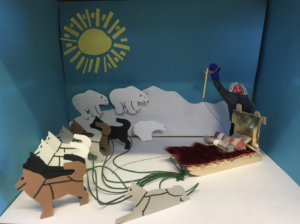
Model made by students from the settlement school in Qassiarsuk, using the template in Papirklip / Kalaallit Numaat, Qiortakkat by Søren Thaae
Insertion of pictures see instruction 2 here
Here are the rest of the concepts and keywords:
- Rescue operation – rescuers go out to help people in distress, either by helicopter, ambulance or boat.
When the ice becomes insecure, fishermen and dogs sometimes need to be rescued out on the ice.
Who can help you when you get hurt?
Have you been in an ambulance or do you know someone who has experienced it?
- Global – the global climate is becoming warmer and warmer.
The word “global” comprises the whole planet Earth. This means that it is getting warmer and warmer everywhere on Earth.
What is the difference between “global” and “local”?
- Climate changes – the weather becomes warmer and the ice melts.
When we talk about climate changes, we often also mention global warming and the greenhouse effect. The greenhouse effect arises when we emit greenhouse gases that make the Earth become warmer and warmer – like in a greenhouse. One example of a greenhouse gas is CO2. In Greenland, the consequences of the climate changes are that the ice melts faster and earlier than it used to.
How does it influence Ane Sofie and Flemming that the ice melts faster and earlier?
In which connection have you heard about climate changes?
- Season – the season for dog sledding is becoming shorter and shorter.
The snow melts quicker, with the result that the season for dog sledding is changing. Formerly you could drive from the middle of October till May/June. Now you can drive from November/December till the end of April. Because there is not that much ice on the water, it is difficult and dangerous to get out on the Icefjord with a dog sledge.
In what way do you meet the “season” in your everyday life?
Why has the season for dog sledding become shorter?
- The inland ice – an ice sheet that covers an area with ice.
The ice sheet in Greenland is the next largest in the world, the ice sheet on Antarctica is the largest.
What would the rest of the Earth look like if all of the inland ice melted?
Are there some countries that would be flooded if all of the inland ice melted?
On pages 20-21 there is a map over the area around Ilulissat, where the two hunting cabins that Ane Sofies husband, Flemming, mentions in the podcast, are marked. Flemming tells us that they have been forced to change their route to get out to the ice and fish. Formerly the shortest route out to the ice was to drive the dog sledge out to a hunting cabin placed at Aallaaniarfik. That route was about 10-15 km.
But now there is not much ice on that route any longer, therefore it is not passable. Now they have to drive over the high mountains to a hunting cabin near Aattartoq and that route is about 40 km long.
Apart from the map with the two hunting cabins on it, there is another map that shows how the line of the ice has changed from 1880 to 2018.
The students can use pages 20-21 to talk about the altered route that Flemming and his sled dogs are forced to use and how the climate changes have affected this. They must record their discussion and insert it as a sound file.
On pages 22 and 23 the students can write sentences or small stories using the keywords that you have talked about. They can write them, record them as an audio file or make a drawing and insert the picture. Their products will be part of the further work with the podcast.
Use the three pictures on page 24 for a joint discussion about climate changes. Let the students read the text and talk about the pictures with the student sitting next to them before you have the joint discussion with the whole class.
Here are some ideas for the discussion:
- What are climate changes?
- Who do the climate changes affect?
- What is a greenhouse gas?
- What does it mean that it becomes like a greenhouse on Earth?
- Is it only the ice that melts as a result of the climate changes?
You can acquire more knowledge about climate changes here.
Now the students have worked with the Freedom and Dangers podcast, a dog team and a dog sledge, a hunting cabin and climate changes. To conclude this work they now make a drawing. They must insert audial files that tell what they have been drawing
The drawing should refer to the podcast and to what they have worked with in Book Creator.
Focus for the drawing is:
- Climate changes that result in the ice becoming thinner and thinner.
- The dogs sensing that the ice becomes insecure and warning the sledge driver.
- Sled dogs that have to run very far to get to the hunting grounds.
When the students have finished their product, they are to present it – to the rest of the class and perhaps to other students in school, parents etc.
The students present their drawings to the class.
Make sure that the framework for feedback is positive criticism. The students should be supported in assessing what is good – and what might be done better. Find more inspiration here.
Not specifically with a view to making new visual stories, but foremost to let the students discover and work with this kind of constructive and positive criticism.
If you intend to work with some of the other podcasts from the Icefjord Centre, it might make sense to save the students’ Book Creator book so that the work they have done with it can be used again.
If you wish to let the students make use of the feedback they have received from the class, you could reserve time for them to continue their work with their products. So that they can use the feedback they have received from each other to change things in their product.
The podcast Freedom and Dangers has been created by the Icefjord Centre in Ilulissat.
The teaching material for the podcast Freedom and Dangers has been developed by Lotte Brinkmann from Anholt Læringsværksted with feedback from Leg med IT.
The student’s book in Book Creator has been developed as part of the project Nutaaliorta from Kivitsisa.
The template was designed by Rikke Falkenberg Kofoed and Daniella Maria Manuel, Leg med IT.
The teaching material Freedom and Dangers is published under a Creative Commons crediting licence CC:BY.
The texts, assignments and pictures can be shared, reproduced and adapted, with the proviso that “Freedom and Dangers by The Icefjord Centre Ilulissat” is credited as the source.
The students meet the Icefjord Centre in two pictures, showing summer and winter respectively.
In class you can talk about:
- What the Icefjord Centre is.
- What the surroundings around the centre look like.
- The difference between summer and winter.
- How summer and winter differ where you live.
The students see a map of Greenland. There is a marker that shows where Ilulissat is situated.
In class you can discuss:
- What you see on the map.
- How many people live in Ilulissat.
- What else do you know about Greenland and Ilulissat?
- Do you know the names of other places on the map?
The students see part of a world map.
The task now is to move the red marker down into the map in order to show where each student lives.
The marker is found in the white box and can be drawn into the map.
In class you can talk about:
- Where is your town or settlement situated?
- How many people live in the town or settlement where you live.
- Do you know the name of other places on the map?
Now it is time for the students to listen to the podcast Freedom and Dangers.
They start the podcast by clicking on the icon in the middle of page 12.
It is recommended that the students listen in pairs or small groups.
Before listening to the podcast, you could give a short introduction to the contents of the podcast.
- Ane Sofie tells about
- the special feeling of freedom in the middle of nature
- the season for dog sledding becoming shorter and shorter
- Flemming tells about
- perils on the ice – ”listen to your dogs”
- the normal route out to the hunting cabin and the fishing grounds of 10-15 km
- unpredictable ice/a new 40 km route over the mountains
- Klaus tells about
- the episode where his dog team is so eager to get out on the ice that they run before he gets them fastened to the sledge. He tells how he gets picked up by Villy Siegstad (former Greenlandic champion in dog sledding – let the students find information about this).
- the dogs that are full of pranks and mischief on short trips, but on the long trips, e.g. 1400-1500 km over the ice sheet, find a rhythm as if they are dependent on each other.
- about how the dogs, after a long trip over the ice sheet (1½ months), “had other plans” and right away sought towards the dog lot at the Icefjord Centre.
Let the students spend a few minutes discussing what they have heard in the podcast with the student sitting next to them.
On page 13 the students are to make small sound recordings where they tell about the podcast. The pictures on the page will help them remember what they have heard.
Insertion of sound see instruction 1 here
Review in class
We recommend that you have a joint discussion in class when the work with pages 14-15 is finished.
We recommend that you support the discussion by writing and maybe illustrating concepts and keywords on the board.
In class you could talk about:
- What surprised the students when listening to the podcast.
- Concepts and keywords that the students encountered in the podcast.
In the text below you can find inspiration for the class discussion.
In the Book Creator book there are some pages with tasks connected to some of the concepts. You can add more pages yourself for other topics, concepts and keywords you discuss.
Concepts and keywords
- Freedom – Ane Sofie is in the middle of the nature she loves.
For Ane Sofie freedom means that she can be herself and proud of her working dogs. The nature Ane Sofie is in, is the landscape around the Icefjord.
When do you feel free?
When do you become proud?
What does the nature surrounding you look like?
- Dangers – the ice is an unpredictable partner.
The ice and nature offer freedom, but they can also mean dangers. Rising temperatures make the ice melt faster than just 10-20 years ago, so that it becomes more unpredictable. This means that you have to be very aware of where you drive the dog sledge.
Do you meet dangers in your everyday life?
How do the dogs help discover dangers on the ice?
- The dog handler – the driver of the dog sledge.
Ane Sofie and Flemming are dog handlers and sledge drivers
Can you be a driver with something else than sled dogs?
What do you think is important when you are a sledge driver?
- Dog teams and traces – the sled dogs are joined in a team. They are fastened to the sled by harnesses and traces.
When you put together a dog team, you have to think about the relationship the dogs have to each other. There have to be both strong dogs and good lead dogs.
When you have found the dogs that you want in your dog team, the dogs have to be fastened to the dog sledge. This you do with harnesses and traces. The harness is on the sled dog, the traces connect the harnesses to the dog sledge. The lines are often arranged in the form of a fan.
Why is it important to assemble all the sled dogs in a dog team?
Why is it important to be aware of the relationship between the dogs when you assemble a dog team?
- Hunting cabin – a cabin used by hunters and fishermen.
Close to Ilulissat there are two hunting cabins. Both of them are municipal. The cabins are placed where there are good hunting grounds. These are situated between 15 and 40 km from the town, so the fishermen spend the night in the cabins when they go ice fishing. The cabins are very primitive. You sleep on a big shelf (sometimes many at the same time), so if it gets too warm, you lie down on the floor.
What kind of fish are caught in the Icefjord?
- Rescue operation – rescuers go out to help people in distress, either by helicopter, ambulance or boat.
When the ice becomes insecure, fishermen and dogs sometimes need to be rescued out on the ice.
Have you been in an ambulance, or do you know someone who has?
Do you think there is any difference between rescue operations in Denmark and Greenland?
On pages 14-15 there is a map over the area around Ilulissat, where the two hunting cabins, that Ane Sofies husband, Flemming, mentions in the podcast, are marked. Flemming tells us that they have been forced to change their route to get out to the ice and fish. Earlier the shortest route out to the ice was to drive the dog sledge out to a hunting cabin placed at Aallaaniarfik. That route was about 10-15 km.
But now there is not much ice on that route any longer, and therefore it is not passable. Now they have to drive over the high mountains to a hunting cabin near Aattartoq and that route is about 40 km long.
In addition to the map with the two hunting cabins on it, there is another map that shows how the line of the ice has changed from 1880 to 2018.
The students can use pages 14-15 to talk about the altered route that Flemming and his sled dogs are forced to use and how the climate changes have affected this. They must record their discussion and insert it as a sound recording.
Insertion of sound see instruction 1 here
Here are the rest of the concepts and keywords:
- Global – the global climate is becoming warmer and warmer.
The word “global” comprises the whole planet Earth. This means that it is getting warmer and warmer everywhere on Earth.
What is the difference between “global” and “local”?
- Climate changes – the weather becomes warmer and the ice melts.
When we talk about climate changes, we often also mention global warming and the greenhouse effect. The greenhouse effect arises when greenhouse gases are emitted, which happens in larger and larger amounts. The greenhouse gases work in a way that lets the light of the Sun pass through the Earth’s atmosphere, and on the other hand they absorb the heat radiation from the Earth and send part of this heat back to Earth. So, the Earth becomes warmer and warmer. One example of a greenhouse gas is CO2. In Greenland, the consequences of the climate changes are that the ice melts faster and earlier than it used to.
How does it influence Ane Sofie and Flemming that the ice melts faster and earlier?
In which connection have you heard about climate changes?
- Season – the season for dog sledding is becoming shorter and shorter.
The snow melts quicker, with the result that the season for dog sledding is changing. Formerly you could drive from the middle of October till May/June. Now you can drive from November/December till the end of April.
When there is not that much ice on the fjord, it is very dangerous to venture out on the Icefjord with a dog sledge.
In what way do you meet the word “season” in your everyday life?
Why has the season for dog sledding become shorter?
- The inland ice – an ice sheet that covers an area with ice.
The ice sheet in Greenland is the next largest in the world, the ice sheet on Antarctica is the largest.
What would the rest of the Earth look like if all of the inland ice melted?
Are there some countries that would be flooded if all of the inland ice melted?
On pages 16-19 the students work with climate changes.
On pages 16-17 there are three different pictures about climate changes.
On page 18 there is a short introductory text about the concept of climate changes.
Let the students read the text and talk about the pictures with the student sitting next to them. After that you have a joint discussion with the whole class about what they have read and talked about.
Now the students are to find knowledge from a video. On page 18 there is a link to this English video:
video from the European Space Agency. The students use the video or search the Internet, to answer the questions on page 19. They insert the answer as a sound recording that fits the appropriate speech balloon.
Here are some proposals for more questions:
- What is the difference between natural and man-made climate changes?
- Who do the climate changes affect?
- What does it mean that it becomes like a greenhouse on Earth?
- Please use the word greenhouse effect.
You can acquire more knowledge about climate changes here
Insertion of sound see instruction 1 here
On pages 20 and 21 the students can write sentences or small stories using the keywords that you have talked about. They can write them, record them as an audio file or make a drawing and insert the picture. Their products will be part of the further work with the podcast.
Here you can read or listen to the book Qimmeq, either in Greenlandic or in English, about the Greenland sled dog. Pages 34-37 in the book deals with the dog team and communication. These pages give the students the knowledge that they need in order to solve the next tasks.
Now the students are to make their own dog team. They must imagine that they are about to drive the trip from Ilulissat to the hunting cabin at Aattartoq, which is about 40 km away.
They need to put a dog team together, that can bring them there and back again safe and sound.
On pages 24-25 there is a picture of a dog team with red traces. Talk about the picture in class or just let the students use the picture as inspiration.
They can search for dog “shapes” in Book Creator and they can choose dogs of different breeds, and they can give their dogs names.
On pages 26-27 there is a dog and a line inserted, that symbolises a trace. These figures can be removed and adjusted freely when the students assemble their own dog team.
They should consider the following:
- How many dogs should their dog team consist of?
- Which qualities should their dogs have? E.g. lead dog, strong dog, team dog etc.
- Should some of the dogs have a shorter or longer trace than the other dogs, so that they can run in front or at the back?
Now the students have worked with the Freedom and Dangers podcast, a dog team, a hunting cabin and climate changes. To conclude this work they will make a model of a dog sledge with a dog team and a sledge driver (it could be Ane Sofie, Flemming or the student him/herself).
You can find a template here
Have a look at this model for inspiration.
Model made by students from the settlement school in Qassiarsuk, using the template in Papirklip / Kalaallit Numaat, Qiortakkat by Søren Thaae
When the students have made their model of a dog sledge with a dog team and a sledge driver they make a stop motion film.
For this they will need the app Stop Motion Studio. The app is free to download and use in its most basic form. This is fine for creating stop-motion films, with audio in high definition.
The students’ motion film should tell about:
- How you drive a dog sledge
- How you get out to the hunting grounds when the ice is not secure.
Organise the students in pairs, groups or individually. Depending on what suits the student best and which competences are to be developed.
When the students have made their stop motion film in Stop Motion Studio, it is saved in the camera roll and inserted on pages 28-29.
Insertion of video see instruction 5 here
The students see each other´s films and talk about the contents and about what they have learned through their work with the podcast Freedom and Dangers.
The focus is on the students´ communicative skills and competences in presenting.
Make sure that the framework for feedback is positive criticism. The students should be supported in assessing what is good – and what might be done better. Find more inspiration here.
Not specifically with a view to making new visual stories, but foremost to let the students discover and work with this kind of constructive and positive criticism.
If you intend to work with some of the other podcasts from the Icefjord Centre, it might make sense to save the students’ Book Creator book, so the work with it can be used again.
If you wish to let the students make use of the feedback from the class, you could reserve time for them to continue their work with their products. So that they can use the feedback from each other to make changes to their product.
The podcast Freedom and Dangers has been created by the Icefjord Centre in Ilulissat.
The teaching material for the podcast Freedom and Dangers has been developed by Lotte Brinkmann from Anholt Læringsværksted with feedback from Leg med IT.
The student’s book in Book Creator has been developed as part of the project Nutaaliorta from Kivitsisa.
The template was designed by Rikke Falkenberg Kofoed and Daniella Maria Manuel, Leg med IT.
The Qimmeq project has been developed by Ilisimatusarfik and the University of Copenhagen. The children’s non-fiction book “Qimmeq – kalaallit qimmiat qimuttoq – the Greenland sled dog” was produced by Anne Katrine Gjerløff, Ilisimatusarfik and the Natural History Museum of Denmark.
The teaching material Freedom and Dangers is published under a Creative Commons crediting licence CC:BY.
The texts, assignments and pictures can be shared, reproduced and adapted, with the proviso that “Freedom and Dangers by The Icefjord Centre Ilulissat” is credited as the source.
The students meet the Icefjord Centre in two pictures, showing summer and winter respectively.
In class you can talk about:
- What the Icefjord Centre is.
- What the surroundings around the Centre look like.
- The difference between summer and winter.
- How summer and winter differ where you live.
The students see a map of Greenland. There is a marker that shows where Ilulissat is situated.
In class you can discuss:
- What you see on the map.
- How many people live in Ilulissat.
- What else do you know about Greenland and Ilulissat?
- Do you know the names of other places on the map?
The students see part of a world map.
The task now is to move the red marker down into the map in order to show where each student lives.
The marker is found in the white box and can be drawn into the map.
In class you can talk about:
- Where is your town or settlement situated?
- How many people live in the town or settlement where you live?
- Do you know the name of other places on the map?
In order to activate the students’ preconception of climate changes, they are now to make a visual story where they make use of the knowledge they already have about climate changes.
They can search for pictures in Book Creator or make drawings and insert them on pages 12-13. The pictures should illustrate what the students already know about climate changes.
The students should insert sound recordings where they explain what the picture shows.
When the students have made their visual story, they present it to the rest of the class. In their presentation they have to give reasons for their choice of pictures and point out how these pictures illustrate climate changes.
Insertion of sound and pictures see instructions 1 & 2 here
Now it is time for the students to listen to the podcast Freedom and Dangers.
They start the podcast by clicking on the icon in the middle of page 14.
It is recommended that the students listen in pairs or small groups.
Before listening to the podcast, you could give a short introduction to the contents of the podcast.
- Ane Sofie tells about
- the special feeling of freedom in the middle of nature.
- the season for dog sledding becoming shorter and shorter.
- Flemming tells about
- perils on the ice – ”listen to your dogs”
- the normal route out to the hunting cabin and the fishing grounds of 10 -15 km.
- unpredictable ice/a new 40 km route over the mountains.
- Klaus tells about
- the episode where his dog team is so eager to get out on the ice that they run before he gets them fastened to the sledge. He tells how they get picked up by Villy Siegstad (former Greenlandic champion in dog sledding/let the students find information about this).
- the dogs that are full of pranks and mischief on short trips, but on the long trips, e.g. 1400-1500 km over the ice sheet, find a rhythm as if they are dependent on each other.
- About how the dogs, after a long trip over the ice sheet (1½ months), right away sought directly towards the dog lot at the Icefjord Centre.
After having heard the podcast, let the students spend a few minutes discussing what they have heard in the podcast with the student sitting next to them.
On page 15 the students are to make small sound recordings where they tell about the podcast. The pictures on the page will help them remember what they have heard.
Insertion of sound see instruction 1 here
Review in class
We recommend that you have a joint discussion in class when the work with pages 14-15 is finished.
We recommend that you support the discussion by writing and maybe illustrating concepts and keywords on the board.
In class you could talk about:
- What surprised the students when listening to the podcast.
- Concepts and keywords that the students encountered in the podcast.
Below you can find inspiration for the class discussion.
In the Book Creator book there are some pages with tasks connected to some of the concepts.
You can add more pages yourself for other topics, concepts and keywords.
- Sledge driver and sled dogs – the dog handler drives the dog sledge that is pulled by the sled dogs.
Ane Sofie and Flemming are sledge drivers. The sled dogs are persevering and can sense when the ice is thin.
How are you a good sledge driver?
How do you think the dogs can sense when the ice is thin?
- Dog teams and traces – the sled dogs are joined in a team. They are fastened to the sled by harnesses and traces.
When you put together a dog team, you have to think about the relationship the dogs have to each other. There have to be both strong dogs and good lead dogs.
When you have found the dogs that you want in your dog team, the dogs have to be fastened to the dog sledge. This you do with harnesses and traces. The harness is on the sled dog, the traces connect the harnesses to the dog sledge. The traces are often arranged in the form of a fan. Sometimes it happens that the dogs run away from you, so you are left with a sledge and no dogs.
Why is it important to assemble all the sled dogs in a dog team?
Why is it important to be aware of the relationship between the dogs when you assemble a dog team?
- Global – the global climate is becoming warmer and warmer.
The word “global” comprises the whole planet Earth. This means that it is getting warmer and warmer everywhere on Earth.
What is the difference between “global” and “local”?
- Climate changes – the weather becomes warmer and the ice melts.
When we talk about climate changes, we often also mention global warming and the greenhouse effect.
The greenhouse effect is a result of humans emitting greenhouse gases, which makes the Earth warmer and warmer. The most well-known example of a greenhouse gas is CO2. But there are many other greenhouse gases.
In Greenland, the consequences of the climate changes are that the ice melts faster and earlier than it used to.
How do climate changes affect Ane Sofie and Flemming?
What do we know about climate changes?
Is it possible to reduce our emission of greenhouse gases?
- The inland ice – an ice sheet that covers an area with ice.
The ice sheet in Greenland is the next largest in the world, the ice sheet on Antarctica is the largest. An ice sheet is a glacier that is over 50.000 km2.
What would the rest of the Earth look like if all of the inland ice melted?
What happens to the water level when the inland ice melts?
- Glacier – a massive body of slowly moving ice.
When new snow falls upon a body of ice, the layers will be pressed so heavily together that they eventually start moving. It happens because the weight of the upper layers press and twist the layers underneath, that then will start moving. A glacier can “calve”. This happens when large chunks of the glacier break off and float into the water.
Which materials can a glacier transport?
- Meltwater – the water that melts in connection with big masses of ice.
Under the glacier runs a stream of meltwater that enables the glacier to move. The meltwater can press itself deep into the landscape and even mould the landscape.
Do you know of any places where meltwater and glaciers have moulded the landscape during an ice age?
Is it only under the glacier that the water can melt?
On pages 16 and 17 the students can write sentences or small stories using the keywords that you have talked about. They can write them, record them as an audio file or make a drawing and insert the picture. Their products will be part of the further work with the podcast.
The students are now going to work with glaciers.
On pages 18-19 there is a picture of a glacier foot at Ilulissat, showing the development from the middle of the 19thcentury to 2018.
On pages 20-21 there is a short text, a picture of a glacier calving, a link to a homepage with information about glaciers and two questions in black speech balloons.
The students are to discuss both pictures, read the short text and answer the questions in the black speech balloons. They can search for information on the homepage linked to on page 21.
They insert their answers in the speech balloons, in the form of a sound recording corresponds to the speech balloon.
Insertion of sound see instruction 1 here
You can find more information about glaciers and ice age landscapes here.
Here are some proposals to additional questions:
- What is meltwater?
- What happens to the water level when an ice sheet begins to melt?
Here the students are to work with climate changes and the greenhouse effect.
On pages 22-23 there is a text about the climate changes, the greenhouse effect and greenhouse gases. This text the students must read. After that they watch the video on page 23. There is also a link to this homepage where the students can search for more knowledge about the questions, they have to answer on pages 24-25.
On pages 24-25 there is a model of the greenhouse effect by the greenhouse gases CO2, H2O and CH4. The students may use the model and the information on pages 22-23 to answer the questions in the four speech balloons. They insert their answers as a sound recording that corresponds to each speech balloon.
Here are some suggestions for additional questions:
- What is the difference between fossil and renewable energy sources?
- Is it possible to diminish our emission of greenhouse gases?
You can acquire more knowledge about climate changes here
In groups the students are now to investigate climate changes and the effects of these in two scientific experiments. If there is not enough time for both, you can choose to do just one of the experiments.
On pages 26-27 there is an introductory text to the two experiments.
The students are reminded that they have to take pictures of their experiments. These pictures they will need to fill out the experiment reports on pages 28-39.
The pages 28-39 can be altered and adjusted according to what you require in an experiment report. There are additional ideas as to what you could include on these homepages here and there.
Experiment 1 is called CO2 is a greenhouse gas. Here the students are to try to create their own greenhouse effect. Here is the link to the experiment.
They need the following materials:
- 2 containers of about 1 litre – preferably of glass (beakers or conical flasks)
- 1 lamp with a strong lightbulb – preferably incandescent light bulb
- 2 thermometers
- vinegar
- baking powder
When the students click on the link there is a short introductory text and a description of how to perform the experiment.
On pages 28-31 suggestions for an experiment report are inserted. The students can fill out the report directly in Book Creator. Also inserted are frames for pictures of the experiments. The pages can be adjusted as you wish.
On pages 32-33 three speech balloons are placed with questions that connect the work with the podcast and the experiment. You can choose whether the students should record their answers and insert them in the speech balloons or whether you discuss the results of the experiment in class as a review of the experiment.
Experiment 2 is called The ice melts – does the water level rise? Here the students are to try to create their own greenhouse effect. Here is a link to the experiment.
They need the following materials:
- 2 glasses of water
- ice cubes
- chicken net (or something else you can place the ice cubes on where they can melt through).
When the students click on the link there is a short introductory text and a description of how to do the experiment.
On pages 34-37 suggestions are placed for an experiment report. The students can fill out the report directly in Book Creator. Also inserted are frames for pictures of the experiments. The pages can be adjusted as you wish.
On pages 38-39 there are inserted three speech balloons with questions that connect the work with the podcast and the experiment. You can choose whether the students should record their answers and insert them in the speech balloons or whether you discuss the results of the experiment in class as a review of the experiment.
The podcast Freedom and Dangers has been created by the Icefjord Centre in Ilulissat.
The teaching material for the podcast Freedom and Dangers has been developed by Lotte Brinkmann and Daniella Maria Manuel from Anholt Læringsværksted with feedback from Leg med IT.
The student’s book in Book Creator has been developed as part of the project Nutaaliorta from Kivitsisa.
The template was designed by Rikke Falkenberg Kofoed and Daniella Maria Manuel, Leg med IT.
The teaching material Freedom and Dangers is published under a Creative Commons crediting licence CC:BY.
The texts, assignments and pictures can be shared, reproduced and adapted, with the proviso that “Freedom and Dangers by The Icefjord Centre Ilulissat” is credited as the source.
The students meet the Icefjord Centre in two pictures, showing summer and winter respectively.
In class you can talk about:
- What the Icefjord Centre is.
- What the surroundings around the centre look like.
- The difference between summer and winter.
- How summer and winter differ where you live.
The students should clarify what they already know about Greenland before starting work on the podcast. In this podcast focus is on sled dogs and climate changes but you may have worked with some of the other podcasts or in other ways acquired knowledge that can be activated in advance.
On page 8 there is a link to Google Maps. Here the students can try to locate the Icefjord Centre on the map.
You can also experiment with letting them find the places mentioned in the podcast, so that they get an idea of where they are situated. These are the places:
- Ilulissat
- The Icefjord
- The inland ice
- The dog lot at the Icefjord Centre
Furthermore, on page 8 there are four questions to help the students get going. Here are suggestions for a few more:
- What do you know about the inland ice?
- Which language is spoken in Greenland?
Page 9 is intended for answers. The students are free to use whatever form of expression they prefer. Some possibilities in Book Creator:
- make a model/a drawing by hand, take a picture of it and insert
- find pictures in Book Creator about Greenland and insert them. The pictures can be complemented with explanations in words.
- record an audio file telling what you know about Greenland
- – or a combination of the above
On page 10-11 you find a map of Greenland, with six red markers. Let the students place the markers where they know towns or settlements in Greenland. They can write the name of the town or settlement in the field next to the marker.
Sound recording, insertion of pictures and text: see instructions 1, 2 and 3 here.
Now it is time for the students to listen to the podcast Freedom and dangers. On page 12 an introduction to the podcast is given followed by a short instruction. Clicking the picture on page 13 will start the podcast.
It is recommended that the students listen in pairs or small groups. After listening to the podcast, the students could spend some minutes talking about what they just heard.
On page 14-15 the students are to make a summary of what they heard in the podcast. They may do this in various ways:
- write a text
- record an audio file
- make a model/drawing
- something completely different that they are used to with note taking methods and summaries
Now it is time for a joint review in class where the students’ work on pages 14 and 15 is discussed. The aim is to prepare the students for making their own reference books that they can revisit during work with the podcast. In this reference book the students should explain the meaning of the concepts and keywords from your discussion – by means of text, sound, pictures, drawings or a combination of these.
You could begin by asking the students to name the concepts and keywords they heard in the podcast. Then you can add those mentioned below, central to the podcast and important for further work.
- Sled driver and sled dogs – the sled driver is in charge of the sled being pulled by sled dogs.
Ane Sofie and Flemming are sled drivers. The sled dogs are enduring and able to sense when the ice is thin.
How are you a good sled driver?
How do you think, can the dogs sense when the ice is thin?
- Dog team – the dogs are united in a team. When putting together a dog team you have to consider the relations between the dogs. Strong dogs as well as good lead dogs must be included.
When the dogs have been selected, they must be fastened to the sledge. This is done with harness and traces. The harness is on the body of the dog, and traces link the harness to the sledge. Often the traces are arranged in a fan shape.
It happens that the dogs in their excitement start running before being tied up – and the driver is left with a sledge, but no dogs.
Why is it important to unite the dogs in a team?
Why is it important to consider the relations between the dogs when a team is put together?
- Inland ice – is an ice cap permanently covering a large area, an ice sheet.
Terminology: an ice sheet is an ice cap that exceeds 50,000 km². The ice sheet in Greenland is the second largest in the world, the one on the Antarctic being by far the largest; these today are the only two existing ice sheets.
What would the rest of the Earth look like if all of the inland ice melted?
What happens to the sea level when the inland ice is melting?
The following concepts are not taken from the podcast but are necessary to solve the tasks.
- Climate change, the greenhouse effect, greenhouse gases – the weather is getting warmer, and the ice is melting.
The greenhouse effect occurs when humans and animals emit greenhouse gases, causing the Earth to get warmer and warmer. The best known greenhouse gas is CO₂, but there are others.
In Greenland climate changes result in the ice melting faster and earlier year by year.
What do climate changes mean to Ane Sofie and Flemming?
What do we know about climate changes?
Is it possible to reduce human emission of greenhouse gases?
- Glacier – a mass of slowly moving ice.
When new snow keeps piling on top of the ice mass, the pressure increases on the layers below, sheer gravity. This pressure will cause the lowest levels to be squeezed from under the middle of the ice sheet towards the edge, producing the flow of ice that is called a glacier.
A glacier will eventually “calve”: pieces of the glacier break off and float into the water – icebergs.
What kind of material can a glacier transport?
- Albedo effect – is an expression of the ability of objects or materials to reflect sunlight. If the object or material does not reflect sunlight at all, it has an albedo of 0. If all of the sunlight is reflected, the albedo is 1.
Do you notice any difference to how warm you feel, wearing respectively a black or a white t-shirt?
Taking Ane Sofie’s story of freedom as a starting point the students are to describe what freedom means to them, and when they feel they can be themselves. On page 18-19 some means of expression are suggested in the form of a text box, a picture frame and icons, freely to be used, altered or removed.
Let the students present their story of freedom to each other, either in groups or to their neighbour.
The subject now is some of the consequences of the greenhouse effect. On these pages five boxes are stating facts about the greenhouse effect, and in five speech bubbles questions are asked relating to these facts.
After reading the texts in the fact boxes, the students answer the questions. Their answers to each question are to be recorded.
Here some suggestions for what you could talk about in connection with the questions:
What happens to Greenland if the inland ice melts?
- If the inland ice no longer weighs down Greenland, the land will rise. This is already taking place; from 2004 it has been measured that Greenland rises about 4 cm each year.
- This indicates how much ice melts annually.
If the sun’s rays are not reflected, what happens?
- Talk about the albedo effect.
- If the sun’s rays are not reflected, this would contribute to a rise in temperature, to global warming.
- If all of the ice and snow would melt, to be replaced with vegetation and water, the sun’s rays would be absorbed.
What will happen if oil is found under the ice?
- The area would become of political interest for exploitation of the oil.
- If oil is being extracted, it will contribute to the emission of greenhouse gases.
What will happen to the vegetation if all of the ice melts in summer?
- The vegetation might gain ground on the ice. Plants absorb the light of the sun and utilizes this to perform photosynthesis; CO₂ from the atmosphere is consumed in this process.
What will happen if the sea level rises 7 meters?
- Many countries will become flooded and uninhabitable.
- Ocean currents will be affected too and thus the global climatic system.
Make a joint review over those questions, and let the students add new knowledge to their reference book on page 16-17.
Science concepts now will be used to explain a model or representation. Two models on page 22-23 illustrate climate changes in Greenland. Find more models for this, if you wish, or let the students search the Internet.
- The first picture shows how greenhouse gases create the greenhouse effect, causing global warming by the rays of the sun. CO₂, H₂O and CH₄ are examples of greenhouse gases.
Source: https://en.wikipedia.org/wiki/Greenhouse_gas#/media/File:Greenhouse-effect-t2.svg - The second is of the glacier Sermeq Kujalleq, shrinking since 1850.
Source: https://www.geocenter.dk/sermeq-kujalleq-gletsjeren/

In small groups the students are to explain these models, using the concepts they wrote down in their reference books:
- climate changes, greenhouse effect, greenhouse gas, glacier, albedo effect
- The students of course are at liberty to apply other concepts as well.
They record their talk about the models and insert the audio file on page 22-23. Give the students the opportunity to add knew knowledge to their reference book on page 16-17.
The students work with asking questions that can be used for a problem statement.
Page 24-25
This Q-matrix should help and guide the students in formulating questions. Focus for the questions is climate changes in Greenland as described in the podcast
The Q-matrix is divided into four sections, representing four taxonomic levels:
- orange – factual
- yellow – explaining
- green – analysing
- blue – putting into perspective
Let the students work with the q-matrix in small groups. They should produce at least one question for each section.
Here are some suggestions to help the students get going:
- what is a greenhouse gas?
- why has the season for driving dog sledges become shorter?
- how could you (who?) put a stop to the season getting shorter?
- why and how do climate changes affect us?
- how do climate changes arise?
- when could the season for driving dog sledges vanish completely?
- is it possible to reduce the emission of greenhouse gases?
Page 26-27
All the questions are to be written down on page 26-27. A box is ready for images, if the students wish to use a model/drawing to support their questions.
When the groups have formulated questions for all four sections of the Q-matrix, you hold a joint review so that the students may receive inspiration from the other groups.
When you have discussed the questions, the students in groups and in cooperation with the teacher must select the question they find most challenging. This question will be used as a problem statement.
Page 28-29
When the students in the group have agreed on their problem statement, they write it down on page 28-29. Another box is intended for a description of how they intend to approach the problem. Space is assigned for a model/drawing and for feedback so far.
When the boxes have been filled, it is time for giving and receiving feedback with another group. Make sure that the settings for feedback is positive, see the section Evaluation. After this you may assist adjusting the problem statements.
And now work can begin, answering the questions.
Side 30-31
This is where the answer is placed. The length of the answer should match the time allocated to the process. In another box a model/drawing or something else could be inserted, and there is room for an audio file too. The students decide what they will use for their answer and may add or delete boxes as they see fit. And, if necessary, add more pages.
They are supposed to use their reference book, plus they can look for information on the Internet. A few useful home pages:
- Visit Greenland – guide to climate changes in Greenland
- Climate Encyclopedia – facts and issues concerning climate
- GEUS – Geological Survey of Denmark and Greenland
The answers are presented to the rest of the class.
Sound recording, insertion of pictures, text and video: see instructions 1, 2, 3 and 5 here.
Suggestions for further work:
- Focus has been on climate changes and consequences related to emission of CO₂. You might choose to delve into where the emissions come from and work with energy sources.
- You could also study how consumer choices are connected to emission of CO₂.
Make sure that the settings for feedback are positive criticism. The students should be supported in assessing: what is good – and what might be done better. Find more inspiration in Austin’s Butterfly. The idea with this is not necessarily to make new products but rather for the students to discover and work with this positive criticism. You could, though, choose to allocate time for further work with the products, so that the students might use the feedback for changes and improvements.
If you intend to work with some of the other podcasts from the Icefjord Centre it would make sense to save the students’ Book Creator books so that they may be reused.
The podcast Freedom and dangers was made for the Icefjord Centre in Ilulissat by Katrine Nyland.
Graphics by Oncotype.
Teaching material for the podcast has been produced by Lotte Brinkmann and Daniella Maria Manuel, Anholt Læringsværksted.
The teaching material Freedom and dangers is published under a Creative Commons crediting licence CC:BY. The texts, assignments and pictures can be shared, reproduced and adapted, with the proviso that “Freedom and dangers by the Icefjord Centre Ilulissat” is credited as the source.
Partners


