
LIFE AS A HUNTER
BOOK CREATOR AS A TEACHING TOOL
The Book Creator book Life as a Hunter is a student’s book associated with the podcast Life as a Hunter. The duration of the podcast is 4:40. The activities have been designed to focus on the students’ investigative, experimental and creative approach to learning. The process consists of three steps: Preparation before listening to the podcast. Listening to and working with the podcast. Further work with topics and insights from the podcast. We recommend that you listen to the podcast before presenting it to the students.
We recommend that students work in pairs or individually. Depending on what suits each student best and the competences to be developed. Keep in mind that your best friend is not necessarily the one you collaborate best with. Working together is about working together and not just being together.
Cross-curricular – history, home economics and nature/culture.
- The students acquire knowledge about daily life in a hunting and fishing family in the 1950s/1960s in Ilulissat.
- The students acquire special knowledge about the importance of the Icefjord to the children growing up at that time.
- The students practise their skills in communication and cooperation.
The students meet the Icefjord Centre in two pictures, showing summer and winter respectively.
In class you can talk about:
- What the Icefjord Centre is.
- What the surroundings around the Centre look like.
- The difference between summer and winter.
- How summer and winter differ where you live.
Look at the map and talk about where Ilulissat is situated. Talk about how many people live in Ilulissat. Also talk about how many people live in the town or the settlement where you live.
The students see part of a world map.
The task now is to move the red marker down into the map in order to show where each student lives.
The marker is found in the white box and can be drawn into the map.
In class you can talk about:
- Differences and similarities between Ilulissat and your own town or settlement.
On page 12 the students see a picture from 1925 that shows fishing at the ice edge.
In class you can talk about what you see in the picture. Let the students go into details. For example:
- How many people are there?
- What are the men doing and what are the women doing?
- How is the catch brought home?
- A mother is carrying a child on her arm. Where is she in the picture?
- Two dogs at a dinghy. Where are they in the picture?
On page 13 the students see two pictures showing how fishing is done nowadays.
In class you can talk about the significant differences between fishing at the Icefjord then and now.
It would be a good idea to write the keywords, that you talk about, on the board.
On both pages there is a facts box. Here the students are to write the keywords that you talk about in class. The students can make use of the facts boxes in the task My reference book on pages 22-23.
Now it is time for the students to listen to the podcast Life as a Hunter. They find the podcast by clicking on the picture on page 14.
Before listening to the podcast, you can give a short introduction to the contents of the podcast.
The contents of the podcast
Mikkel tells:
- that he was born in 1940 and grew up in a hunting and fishing family in Ilulissat.
- that since he was 12 years old, he has worked as a fisherman and therefore he has a special connection to the Icefjord.
- that his father was both hunter and fisherman and that there was no doubt that Mikkel also would be a hunter or fisherman or both. These were his only options.
- that the dogs, who in those days moved around freely, were the most important. From the age of 10, he looked after the family’s dogs in the summer.
- about being close to his father and about how his father taught him and his brothers that life as a fisherman on the Icefjord can be dangerous. His father also taught him how to fish by hand, remove the entrails and cut out the fish.
- about the ice that in all kinds of weather slowly moves out towards the sea. At full moon, where the current is stronger, the ice moves faster.
- about how the fishermen used to estimate how far the ice on the Icefjord moved per day. This is called the “movement” of the ice.
- about the importance of keeping an eye on the “movement”, so that they can remove their equipment (hunting and fishing gear) in time, before the current took it.
- about the Ilulissat fjord (the Icefjord) having a deep place in his heart.
It is recommended that the students listen in pairs or small groups.
Let the students spend a few minutes discussing what they have heard in the podcast.
On page 15 the students are to make small sound recordings where they tell about the podcast. The pictures on the page will help them remember what they have heard.
Sound recording, see instruction 1 here.
The recording will now be represented by a small sound icon. This icon can be placed wherever you wish on the page. You can listen to the recording over and over again.
Review in class
We recommend that you have a joint discussion in class when the work with pages 14-15 is finished.
In class you could talk about:
- the picture or pictures that they chose for their audio story and the reason why they chose it/them.
- concepts and keywords the students have encountered in the podcast.
In the text below you can find inspiration for the class discussion.
In the Book Creator book there are tasks working with some of the concepts.
You can add more pages for other topics, concepts and keywords that you discuss.
Concepts and keywords
- Hunter/fisherman – a hunter/fisherman is a person who makes a living hunting and fishing in Greenland. They both hunt and fish. Mostly they fish and they especially fish a certain species, the Greenland halibut. In the podcast Mikkel tells about growing up in a hunting and fishing family. Find inspiration here. Choose English by clicking on the Danish flag.
There was no doubt that when Mikkel grew up, he would become a hunter/fisherman. Why?
How old was he when he started fishing together with his father and brothers?
What fish did they especially catch?
- The dogs – when getting out to the fishing grounds and bringing home the catch, the sledge dogs were the most important. Nowadays all the dogs are tethered and their fodder is often ready-made dry feed, but in Mikkel’s childhood the dogs moved around freely and were fed with fresh fish at the harbour.
Where and with what kind of fodder were Mikkel’s sledge dogs fed?
Since 1954 the dogs has to be tethered. Why?
- Calving – when blocks of ice break off the glacier front and fall into the sea because of gravitation, it is called calving. You could say that the glacier is “giving birth” to icebergs and ice floes. When Semeq Kujalleq calves and the ice is pressed out into the Icefjord the fishermen must take special precautions.
Which precautions must the fishermen take, especially at full moon?
- Full moon – there is a full moon approximately once a month. The Moon’s phases are determined from the Moon’s position between the Earth and the Sun. When the Earth is between the Sun and the Moon, the Moon is fully illuminated by the Sun. Then you say that the moon is At full moon the tide is especially strong and therefore there is a stronger current that makes the icebergs drift out to the sea more quickly.
What is the opposite of a full moon?
Now it is time to have a closer look at the job that Mikkel had all of his life.
Together with the students you are now to clean and cut out a fish. Let the students take pictures of the process. The pictures are to be inserted in the book.
Afterwards the students record small audio files where they tell about the process.
The students read the following text on page 18:
When you have dogs, you are also responsible for taking care of them and making sure that they are well and doing fine. The dogs need a lot of food to be able to work and pull the sledge and at the same time stay warm in the arctic climate. In the summer the dogs need food to recover from the injuries of the winter and to shed old fur and grow new fur.
The students are also to read pages 38 and 39 in Qimmeq. They can choose to get the pages read out loud by clicking read it for me. They open the book by clicking on the Book Creator icon.
On page 19 the students answer the questions in the speech balloons. You might let the students answer orally. Write the answers on the board and let the students write them down or record them as audio files in the book.
Now the students are to imagine what it is like for Mikkel and his family to live as hunters and fishermen. They make a drawing of Mikkel fishing in the Icefjord together with his father and brothers.
The students take a picture of their drawing and insert it in the frame.
Subsequently they record an audio file where they tell about their drawing.
Sound recording and insertion of pictures, see instruction 2 og 3 here.
On the pages the students make sentences or small stories using the concepts and keywords that you have gone through. They can write them, record them as an audio file or make a drawing and insert the picture.
Sound recording and insertion of pictures, see instruction 2 og 3 here.
In his story the students hear that Mikkel has always dreamt of becoming a fisherman/hunter.
As a conclusion the students are now to tell about their own dreams. They are to tell about what they dream of working with, when they grow up.
The students find pictures or make drawings of their dreams here on the page.
Subsequently they record audio files where they tell about their dreams.
Sound recording and insertion of pictures, see instruction 2 og 3 here.
The students show their products to the class.
Make sure that the framework for feedback is positive criticism.The students should be supported in assessing what is good – and what might be done better. Find more inspiration here.
Not specifically with a view to making new products, but foremost to let the students discover and work with this kind of constructive and positive criticism.
If you intend to work with some of the other podcasts from the Icefjord Centre, it might make sense to save the students’ Book Creator book, so the work they have done with it, can be used again.
If you wish to let the students make use of the feedback, they have received from the class, you could reserve time for them to continue their work with their products. So that they can use the feedback they have received from each other to change things in their product.
The podcast Life as a Hunter has been created by the Icefjord Centre in Ilulissat.
The teaching material for the podcast Life as a Hunter has been developed by Lotte Brinkmann and Daniella Maria Manuel, Anholt Læringsværksted with feedback from Leg med IT.
The student’s book in Book Creator has been developed by Rikke Falkenberg Kofoed from Leg med IT.
The Qimmeq project has been developed by Ilisimatusarfik and the University of Copenhagen. The children’s non-fiction book “Qimmeq – kalaallit qimmiat qimuttoq – the Greenland sled dog” was produced by Anne Katrine Gjerløff, Ilisimatusarfik and the Natural History Museum of Denmark.
The teaching material Life as a Hunter is published under a Creative Commons crediting licence CC:BY.
The texts, assignments and pictures can be shared, reproduced and adapted, with the proviso that “Life as a Hunter by The Icefjord Centre Ilulissat” is credited as the source.
The students meet the Icefjord Centre in two pictures, showing summer and winter respectively.
In class you can talk about:
- What the Icefjord Centre is.
- What the surroundings around the Centre look like.
- The difference between summer and winter.
- How summer and winter differ where you live.
Talk about the map:
- How many people live in Ilulissat, and how many people live in the town or the settlement where you live?
Which other towns and settlements in Greenland do you know?
Place a red marker and write the name of the town/settlement.
The students see part of a world map.
The task now is to move the red marker down into the map in order to show where each student lives. The marker is found in the white box and can be drawn into the map.
In class you can talk about:
- Differences and similarities between Ilulissat and your own town or settlement.
On page 14 the students see a picture from 1925 that shows fishing going on at the ice edge, in technical language called the ice front.
In class you can talk about what you see in the picture. Let the students go into details. For example:
- How many people are there?
- What are the men doing and what are the women doing?
- How is the catch brought home?
- A mother is carrying a child on her arm. Where is she in the picture?
- Two dogs at a dinghy. Where are they in the picture?
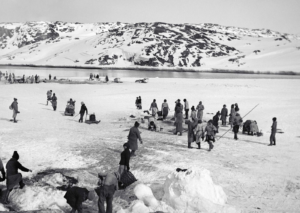
Fishing at the ice edge, Ilulissat, 1925
On page 15 the students are to search for pictures showing how fishing is done nowadays with dinghy, ships or trawlers. They insert the pictures in the frame.
Search for and insert pictures see instruction 1 here.
In class you can discuss the significant differences between then and now.
Now it is time for the students to listen to the podcast Life as a Hunter. They find the podcast by clicking on the picture on page 16.
Before listening to the podcast, you can give a short introduction to the contents of the podcast.
Be aware that Mikkel tells his story in Greenlandic. The story is then retold in English.
The contents of the podcast
Mikkel tells:
- that he was born in 1940 and grew up in a hunting and fishing family in Ilulissat.
- that since he was 12 years old, he has worked as a fisherman and therefore he has a special connection to the Icefjord.
- that his father was both hunter and fisherman and that there was no doubt that Mikkel also would be a hunter or fisherman or both. These were his only options.
- that the dogs, who in those days moved around freely, were the most important. From the age of 10, he looked after the family’s dogs in the summer.
- about being close to his father and about how his father taught him and his brothers that life as a fisherman on the Icefjord can be dangerous. His father also taught him how to fish by hand, remove the entrails and cut out the fish.
- about the ice that in all kinds of weather slowly moves out towards the sea. At full moon, when the current is stronger, the ice moves faster.
- about how the fishermen used to estimate how far the ice on the Icefjord moved per day. This is called the “movement” of the ice.
- about the importance of keeping an eye on the “movement”, so that they could remove their equipment (hunting and fishing gear) in time, before the current took it.
- about the Ilulissat fjord (the Icefjord) having a deep place in his heart.
It is recommended that the students listen in pairs or small groups.
Let the students spend a few minutes discussing what they have heard in the podcast.
On page 17 the students are to make small sound recordings where they tell about the podcast. The pictures on the page will help them remember what they have heard.
Sound recording, see instruction 1 here.
The recording will now be represented by a small sound icon. This icon can be placed wherever you wish on the page. You can listen to the recording over and over again.
Review in class
We recommend that you have a joint discussion in class when the work with pages 16-17 is finished.
While doing this, it would be a good idea to support the discussion by writing concepts and keywords on the board. Let the students take notes – these will be useful in the task “My reference book” on pages 20-21.
In class you could talk about:
- What it was like, growing up in a hunting and fishing family
- An example: the children were working from the age of 10-12.
- What kind of jobs do you have (the students)?
- Dangers lurking on the Icefjord.
- The special connection Mikkel has to the Icefjord.
- Is there a certain place that you (the students) have a special connection to?
- Mikkel was to become a hunter and fisherman just like his father. There were no other options unless you went to a boarding school in Aasiaat. (Mikkel mentions this in the podcast in Greenlandic.)
- An example: the children were working from the age of 10-12.
In the text below you can find inspiration for the class discussion.
In the Book Creator book there are tasks associated with some of the concepts.
You can add more pages in the book for other topics, concepts and keywords that you discuss.
Concepts and keywords
- Hunter/fisherman – a hunter/fisherman is a person who makes a living hunting and fishing in Greenland. They both hunt and fish. Mostly they fish and they especially fish a certain species, the Greenland halibut. In the podcast Mikkel tells about growing up in a hunting and fishing family. Find inspiration her. Choose English by clicking on the Danish flag.
Mention some of the animals and fish that are hunted/caught in and around the Icefjord.
- The dogs – when getting out to the fishing grounds and bringing home the catch, the sledge dogs were the most important. Nowadays all the dogs are tethered, but in the past they moved around freely and were fed with fresh fish at the harbour. From the age of 10, the children were taught how to take care of the dogs. Find more knowledge in Qimmeq on pages 36-37.
Since 1954 the dogs have to be tethered. Why?
- Calving – when blocks of ice break off the glacier front and fall into the sea because of gravitation, it is called calving. You could say that the glacier is “giving birth” to icebergs and ice floes. When Sermeq Kujalleq calves and the ice is pressed out into the Icefjord, the fishermen must take special precautions.
Which precautions must the fishermen take, especially at full moon?
- Full moon – there is a full moon approximately once a month. The Moon’s phases are determined from the Moon’s position between the Earth and the Sun. When the Earth is between the Sun and the Moon, the Moon is fully illuminated by the Sun. Then you say that the moon is At full moon the tide is especially strong and therefore there is a stronger current that makes the icebergs drift faster out to the sea.
What do you know about the phases of the Moon?
On page 18 the students are to read the following text:
When the glacier calved and the inland ice was pushed out into the Icefjord, the fishermen called it the “movement”.
The ”movement” was measured by placing a marker one day and returning the next day to estimate how many steps the ice had moved.
In one day it used to move 28 steps. At full moon it moved 31.5 steps.
On page 19 the students are to estimate how far the ice moves in one day and in two weeks respectively.
Find a suitable place for the measurements, for example the schoolyard. Mark where the measurement begins with a line. Let each student walk 28 steps. Place a marker. Measure the distance between the two markers.
The result of the measurement is inserted in the top box on page 19.
Hereafter the students are to estimate how far the glacier moves in two weeks by multiplying their result with 14.
In class you can talk about the small differences there are between the student’s measurements.
On pages 20 and 21 the students make sentences or small stories using the concepts and keywords that you have gone through. They can write them, record them as an audio file or make a drawing and insert the picture. Their products will be used in the further work with the podcast.
Sound recording and insertion of pictures, see instruction 1 and 3 here.
As a completion of the task, the students now make an audio story/podcast in the form of an interview about life in a hunting/fishing family. Two by two the students plan an interview and interview each other.
The audio file is recorded directly in the book.
As an illustration to accompany the audio story, the students create a picture.
They can find inspiration in the podcast graphics on page 16. To create the picture the students can make use of photos, drawings, linoleum print or collage. The illustration is inserted on page 25.
Sound recording and insertion of pictures, see instruction 1 and 3 here.
The students show their products to the class.
Make sure that the framework for feedback is positive criticism. The students should be supported in assessing what is good – and what might be done better. Find more inspiration here.
Not specifically with a view to making new visual stories, but foremost to let the students discover and work with this kind of constructive and positive criticism.
If you intend to work with some of the other podcasts from the Icefjord Centre, it might make sense to save the students’ Book Creator book, so the work they have done with it can be used again.
If you wish to let the students make use of the feedback, they have received from the class, you could reserve time for them to continue their work with their products. So that they can use the feedback they have received from each other to change things in their product.
The podcast Life as a Hunter has been created by the Icefjord Centre in Ilulissat.The teaching material for the podcast has been developed by Lotte Brinkmann and Daniella Maria Manuel, Anholt Læringsværksted with feedback from Leg med IT.
The Qimmeq project has been developed by Ilisimatusarfik and the University of Copenhagen. The children’s non-fiction book “Qimmeq – kalaallit qimmiat qimuttoq – the Greenland sled dog” was produced by Anne Katrine Gjerløff, Ilisimatusarfik and the Natural History Museum of Denmark.
The student’s book in Book Creator has been developed as part of the project Nutaaliorta from Kivitsisa.The template was designed by Rikke Falkenberg Kofoed and Daniella Maria Manuel, Leg med IT.
The teaching material Life as a Hunter is published under a Creative Commons crediting licence CC:BY.
The texts, assignments and pictures can be shared, reproduced and adapted, with the proviso that “Life as a Hunter by The Icefjord Centre Ilulissat” is credited as the source.
The students meet the Icefjord Centre in two pictures, showing summer and winter respectively.
In class you can talk about:
- What the Icefjord Centre is.
- What the surroundings around the Centre look like.
- The difference between summer and winter.
- How summer and winter differ where you live.
Talk about the map and about how many people live in Ilulissat. And about how many people live in the town or the settlement where you live.
The students see part of a world map.
The task now is to move the red marker down into the map in order to show where each student lives.
The marker is found in the white box and can be drawn into the map.
In class you can talk about:
- Differences and similarities between Ilulissat and your own town or settlement.
Now it is time for the students to listen to the podcast Life as a Hunter. They find the podcast by clicking on the picture on page 12.
Before listening to the podcast, you can give a short introduction to the contents of the podcast.
Be aware that Mikkel tells his story in Greenlandic. The story is then retold in English.
The contents of the podcast
Mikkel tells:
- that he was born in 1940 and grew up in a hunting and fishing family in Ilulissat.
- that since he was 12 years old, he has worked as a fisherman and therefore he has a special connection to the Icefjord.
- that his father was both hunter and fisherman and that there was no doubt that Mikkel also would be a hunter or fisherman or both. These were his only options.
- that the dogs, who in those days moved around freely, were the most important. From the age of 10, he looked after the family’s dogs in the summer.
- about being close to his father and about how his father taught him that life as a fisherman on the Icefjord can be dangerous. His father also taught him how to fish by hand, remove the entrails and cut out the fish.
- about the ice that in all kinds of weather slowly moves out towards the sea. At full moon, when the current is stronger, the ice moves faster.
- about how the fishermen used to estimate how far the ice on the Icefjord moved per day. This is called the “movement” of the ice.
- about the importance of keeping an eye on the “movement”, so they could remove their equipment (hunting and fishing gear) in time, before the current took it.
- about the Ilulissat fjord (the Icefjord) having a deep place in his heart.
It is recommended that the students listen in pairs or small groups.
Let the students spend a few minutes discussing what they have heard in the podcast.
On page 13 the students are to make small sound recordings where they tell about the podcast. The pictures on the page will help them remember what they have heard.
Sound recording, see instruction 1 here.
The recording will now be represented by a small sound icon. This icon can be placed wherever you wish on the page. You can listen to the recording over and over again.
Review in class
We recommend that you have a joint discussion in class when the work with pages 12-13 is finished.
While doing this, it would be a good idea to support the discussion by writing concepts and keywords on the board.
In class you could talk about:
- What surprised the students while listening to the podcast.
- Concepts and keywords that the students encountered in the podcast.
In the text below you can find inspiration for the class discussion.
In the book creator book you can add more pages for other topics, concepts and keywords that you discuss.
Concepts and keywords
- Hunting family/fishing family – the podcast is about Mikkel who is from a fishing family. In those days you did not dream of anything else than what you were born to do and you were quite satisfied with that.
Would you be satisfied if you were told to have the same job as your parents have?
- High level education – when you have finished the general education in primary school, you can choose between a number of high level educations. It could be a short, a medium long or long higher education. This is where you specialize in the field you would like to work with in your adult life.
Which education do you know about?
Which education interests you?
- Glacier – the word glacier means ”a river of ice”. A glacier is a large mass of slowly moving ice. When the weight of new snow becomes sufficiently heavy on the inland ice, the lowest section of ice is pressed out towards the coast. The stream of ice that is caused by this, you call a glacier.
How is life by the Icefjord influenced by the glacier?
- Movement and calving – when blocks of ice break off the glacier front and fall into the sea because of gravitation, it is called calving. You could say that the glacier is “giving birth” to icebergs and ice floes. The great calvings, where large parts of the glacier front are loosened, only happen during the summer, but smaller bits of ice break off the edge all of the time and can be seen the whole year round.
When the glacier calves and pushes the inland ice out into the Icefjord, Mikkel and the other fishermen call it the movement. They estimated the movement by placing a marker one day and coming back the next day to measure how many steps the glacier had moved. This is the way they estimate how far the glacier has moved in e.g. a day.
Why was it important to keep an eye on the movement?
- The inland ice – an ice sheet that covers a large area with ice.
The ice sheet in Greenland is the next largest in the world, the ice sheet on Antarctica is the largest. An ice sheet is a glacier that is over 50.000 km2.
What would the rest of the Earth look like if all of the inland ice melted?
What happens to the water level when the inland ice melts?
- Full moon – is one of the phases of the Moon. The Moon has four phases: full moon, new moon, first quarter and last quarter. The phase is determined by how big an area of the Moon is illuminated by the Sun. Full moon is when all of the Moon is illuminated by the Sun.
Have you observed all four phases of the Moon?
When do you think the Moon is most beautiful and why?
The students are now to research educational options in Greenland today and compare them to Mikkel’s story about educational options in the 1940s. They answer the questions in the black speech balloons by recording their answers.
They can search for knowledge in the podcast and listen to Mikkel’s story once again. They can also search for knowledge on this website https://www.norden.org/da/info-norden/ungdomsuddannelser-i-groenland.
You can review in class and assess pros and cons of growing up in Greenland in the 1940s compared to today.
Sound recording, see instruction 1 here.
On pages 16 and 17 the students can describe the keywords and concepts that you have gone through. They can write them, record them as an audio file or make a drawing and insert the picture. Let the students elaborate on keywords and concepts that you have gone through together.
Sound recording, see instruction 1 here.
The students are now to find out which high level education they themselves think could be interesting. If the students cannot find an appropriate Educational Guide, we recommend you to assist them. They are to investigate which high level education they find interesting. They are to answer the questions in the four boxes on page 19 after having researched on high level education.
Here are some suggestions to further questions you could ask the students about their research:
- Why do you think this exact high level education sounds interesting?
- Are there other educations that sound equally interesting?
- In what kind of a study environment do you think you would feel best (reading a lot, physical work or other things)?
- Who can help you obtain what you would like to do?
As a completion of the task, the students now make an audio story/podcast in the form of an interview about life in a hunting/fishing family. Two by two the students plan an interview and interview each other.
The audio file is recorded directly in the book.
As an illustration to accompany the audio story, the students create a picture.
They can find inspiration in the podcast graphics on page 16. To create the picture the students can make use of photos, drawings, linoleum print or collage. The illustration is inserted on page 25.
Sound recording and insertion of pictures, see instruction 1 and 3 here.
The students discuss their research in class. It is important to emphasise that this is not about assessing each other’s choices and fields of interest, but on the contrary to help each other find out which possibilities there are. It is therefore important to support the students in listening to the other students’ research so that they can ask clarifying questions and research together.
If you intend to work with some of the other podcasts from the Icefjord Centre, it might make sense to save the students’ Book Creator book so that the work, they have done with it, can be used again.
The podcast Life as a Hunter has been created by the Icefjord Centre in Ilulissat.The teaching material for the podcast Life as a Hunter has been developed by Lotte Brinkmann and Daniella Maria Manuel, Anholt Læringsværksted with feedback from Leg med IT.
The student’s book in Book Creator has been developed as part of the project Nutaaliorta from Kivitsisa.The template was designed by Rikke Falkenberg Kofoed and Daniella Maria Manuel, Leg med IT.
The teaching material Life as a Hunter is published under a Creative Commons crediting licence CC:BY.
The texts, assignments and pictures can be shared, reproduced and adapted, with the proviso that “Life as a Hunter by The Icefjord Centre Ilulissat” is credited as the source.
The students meet the Icefjord Centre in four pictures: summer and winter, the Kangia glacier front and the framework of the building. On page 6-7 there is a text and three videos (in Danish) showing the erection of the Icefjord Centre.
In class you can talk about:
- What the Icefjord Centre is.
- What the purpose of an institution like the Icefjord Centre is.
- What it looks like around the centre.
- The difference between summer and winter, where you live as well as in Greenland.
The students should clarify what they already know about Greenland before starting work on the podcast. In this podcast focus is on life as a hunter but you may have worked with some of the other podcasts or in other ways acquired knowledge that can be activated in advance.
On page 8 there is a link to Google Maps. Here the students can try to locate the Icefjord Centre on the map.
You can also experiment with letting them find the places mentioned in the podcast, so that they get an idea of where they are situated. These are the places:
- Ilulissat
- The Sermeq Kujalleq glacier
- The Icefjord
Furthermore, on page 8 there are four questions to help the students get going. Here are suggestions for a few more:
- What do you know about the inland ice?
- Which languages are spoken in Greenland?
- What do you know about educations in Greenland?
- What is characteristic of a hunting or fishing family?
Page 9 is intended for answers. The students are free to use whatever form of expression they prefer. Some possibilities in Book Creator:
- make a model/a drawing by hand, take a picture of it and insert
- find pictures in Book Creator about Greenland and insert them. The pictures can be complemented with explanations in words.
- record an audio file telling what you know about Greenland
- – or a combination of the above
On page 10-11 you find a map of Greenland, with six red markers. Let the students place the markers where they know towns or settlements in Greenland. They can write the name of the town or settlement in the field next to the marker.
Sound recording, insertion of pictures and text: see instructions 1, 2 and 3 here.
Now it is time for the students to listen to the podcast Life as a hunter. On page 12 an introduction to the podcast is given followed by a short instruction. Clicking the picture on page 13 will start the podcast.
It is recommended that the students listen in pairs or small groups. After listening to the podcast, the students could spend some minutes talking about what they just heard.
On page 14-15 the students are to make a summary of what they heard in the podcast. They may do this in various ways:
- write a text
- record an audio file
- make a model/drawing
- something completely different that they are used to with note taking methods and summaries
- – or a combination of the above
Sound recording, insertion of pictures and text: see instructions 1, 2 and 3 here.
Now it is time for a joint review in class where the students’ work on pages 14 and 15 is discussed. The aim is to prepare the students for making their own reference books that they can revisit during work with the podcast. In this reference book the students should explain the meaning of the concepts and keywords from your discussion – by means of text, sound, pictures, drawings or a combination of these.
You could begin by asking the students to name the concepts and keywords they heard in the podcast. Then you can add those mentioned below, central to the podcast and important for further work.
- Hunting/fishing family – the podcast is about Mikkel who was born in 1940 as son of a fisherman. At that time, you did not dream of anything else than what you were born into, and with that you were happy.
Would you be happy if you were told that you were to have the same job as your parents have?
- Glacier – the word means “stream of ice”. A glacier is a mass of slowly moving ice.
When new snow keeps piling on top of the inland ice, the pressure increases on the layers below, sheer gravity. This pressure will cause the lowest levels to be squeezed from under the middle of the ice sheet towards the coast, producing the flow of ice that is called a glacier.
How is life at the Icefjord affected by the glacier?
- Movement and calving – when blocks of ice at the glacier front fall into the sea due to gravity, this is called calving. You could say that the glacier “gives birth” to icebergs and ice floes. The big calvings when massive parts of the glacier front break off, only happen a few times during summer, but smaller pieces fall off the edge all the time.
When the glacier moves, Mikkel and the other fishermen call this the movement. The movement was measured by setting up a mark one day and coming back the next to register how many steps the ice had progressed.
Why was it important to keep an eye on the movement?
- Full moon – one of the phases of the Moon. The Moon has four main phases: full moon, new moon, waxing and waning. The phases are determined by how much of the Moon is lighted by the Sun. Full moon is when all of the Moon is lighted by the Sun.
When do you find the Moon most fascinating – and why?
Sound recording, insertion of pictures and text: see instructions 1, 2 and 3 here.
In the podcast Mikkel describes how the Moon affects the movement when they are working on the ice. The subject now is the phases of the Moon and their effect on the water masses of the Earth.
On page 18 the task is defined. The students are to write a text intended for students in a fictitious 5B where they must explain the following:
- what is the Moon, and what phases does it have?
- how do these phases affect water on Earth and in particular the ice in Greenland?
On page 20-23 information about the Moon is given in text and models. This material should be studied before embarking on the task.
Room is allocated for a picture or a model on page 18, and the text for 5B goes on page 19. It is important that the students bear in mind that a fifth class should be able to understand their exposition.
If possible, you could visit a fifth class and read the text to them. If not, the students can present their product in class. If anyone has siblings in a fifth class, they could, at home, read the text to them and report back in class.
Insertion of pictures and text: see instructions 2 and 3 here.
Mikkel states that the sled dog is the most important thing in a hunting or fishing family. The students now will work with the sled dog and its energy requirements.
Open the book “Qimmeq” by clicking on the picture on page 24 and read pages 40-43. Alternatively, click on the pdf icon below the picture. On page 25 three speech bubbles hold questions for the students to answer by recording one audio file for each question.
On page 26 a team of sled dogs is enjoying a rest. When at work they need a lot of energy. Four kinds of dog food are shown on page 27 with information about energy content and composition. This shall be used to compose a suitable menu for a sled dog on pages 28-29. Based on the described conditions the students should write down how much of each kind of feed is needed. In doing this, they should bear in mind what they learnt from the book “Qimmeq” about distribution of energy.
When the students have finished their task, hold a joint review in class and discuss the answers given.
Sound recording and insertion of text: see instructions 1 and 3 here.
In the podcast we hear about Mikkel’s life in a hunting family; he describes how he and his brothers never dreamed about anything else.
The students now should try to imagine that they had no other options than choosing the same job as their mother, father or someone else in their family has.
On page 31 they describe what job that would be, and how they would feel about not having any other possibilities. In the frame on page 30 a picture could illustrate the text.
The students could discuss their reflections in small groups.
Insertion of pictures and text: see instructions 2 and 3 here.
The students perform and record on video a role play where Mikkel has a talk with his children. Mikkel would like to pass on his knowledge of fishing and the movement to his children. But the children would rather fish with modern boats and use modern equipment.
Groups of four to five students are suitable.
The task is defined on page 32, and the video can be inserted in the frame on page 33.
These links provide further information about fishing in Greenland: Royal Greenland and Visit Greenland
The students choose how to design the video, and what the script should look like. The outcome they decide, too: does Mikkel succeed in passing on the tradition?
Let the students show their videos in class.
Insertion of video: see instruction 5 here.
Make sure that the settings for feedback are positive criticism. The students should be supported in assessing: what is good – and what might be done better. Find more inspiration in Austin’s Butterfly. The idea with this is not necessarily to make new products but rather for the students to discover and work with this positive criticism. You could, though, choose to allocate time for further work with the products, so that the students might use the feedback for changes and improvements.
If you intend to work with some of the other podcasts from the Icefjord Centre it would make sense to save the students’ Book Creator books so that they may be reused
The podcast Life as a hunter was made for the Icefjord Centre in Ilulissat by Katrine Nyland.
Graphics by Oncotype.
Teaching material for the podcast has been produced by Lotte Brinkmann and Daniella Maria Manuel, Anholt Læringsværksted.
The Qimmeq project has been developed by Ilisimatusarfik and the University of Copenhagen. The children’s non-fiction book “Qimmeq – kalaallit qimmiat qimuttoq – the Greenland sled dog” was produced by Anne Katrine Gjerløff, Ilisimatusarfik and the Natural History Museum of Denmark.
The teaching material Life as a hunter is published under a Creative Commons crediting licence CC:BY. The texts, assignments and pictures can be shared, reproduced and adapted, with the proviso that “Life as a hunter by the Icefjord Centre Ilulissat” is credited as the source.
Partners


