BOOK CREATOR AS A TEACHING TOOL
The Book Creator book The Life-giving Glacier is a student’s book associated with the podcast The Life-giving Glacier. The duration of the podcast is 3:57. The activities have been designed to focus on the students’ investigative, experimental and creative approach to learning. The process consists of three steps: Preparation before listening to the podcast. Listening to and working with the podcast. Further work with topics and insights from the podcast. We recommend that you listen to the podcast before presenting it to the students.
We recommend that students work in pairs or individually. Depending on what suits each student best and the competences to be developed. Keep in mind that your best friend is not necessarily the one you collaborate best with. Working together is about working together and not just being together.
Cross-curricular – mathematics and nature/culture
- The students acquire fundamental knowledge about glaciers.
- The students acquire special knowledge about the Sermeq Kujallec glacier and the life that it brings with it.
- The students practise their skills in communication and cooperation.
The students meet the Icefjord Centre in two pictures, showing summer and winter respectively.
In class you can talk about:
- What is the Icefjord Centre.
- What the surroundings around the Centre look like.
- The difference between summer and winter.
- How summer and winter differ where you live.
Have a look at the map and talk about where Ilulissat is situated. Talk about how many people live in Ilulissat. Talk about how many people live in the town or settlement where you live.
The students see part of a world map.
The task now is to move the red marker down into the map in order to show where each student lives.
The marker is found in the white box and can be drawn into the map.
In class you can talk about:
- Differences and similarities between Ilulissat and your own town or settlement.
In the book the students see a map of Ilulissat Icefjord/Kangia: the area that is inscribed on the UNESCO World Heritage List is marked with red dots.
The students are to draw up the area by drawing a line from dot to dot. The need to use the pencil tool in Book Creator.
Drawing with the pencil tool see instruction 4 here.
In class you can talk about:
- What is UNESCO? (United Nations Educational, Scientific and Cultural Organization is UN´s organisation for education, culture, communication and science)
- That the Icefjord and the Sermeq Kujalleq glacier are a unique site and therefore on the UNESCO World Heritage List.
- What is required to make it possible for a site to be inscribed on the World Heritage List?
Find knowledge in this example here.
Now it is time for the students to listen to the podcast The Life-giving Glacier.
They start the podcast by clicking on the picture on page 14.
Before listening to the podcast, you can give a short introduction to the contents of the podcast.
Contents of the podcast
- It starts with the sound of the glacier calving.
- Katrine Nyland tells about
- The Icefjord (in Greenlandic called Kangia) that has been inscribed on the UNESCO World Heritage List.
- The enormous icebergs that float towards the mouth of the fjord and constantly change colours.
- The glacier that grows smaller in the winter. It almost stops moving, but then gets active again in the summer and pushes the great icebergs out into the Icefjord.
- Malik who is a helicopter pilot and for periods at a time flies over the glacier on a daily basis.
- Malik tells about
- How the tourists have difficulties quite grasping how gigantic the Icefjord and the glacier are. At first they think it is a long white line, until they land three kilometers from the edge of the glacier, then they understand how enormous it is.
- The edge of the glacier that rises from 100 to 300 meters. When the glacier is preparing to calve, it becomes high because the ice is pushed upwards. Then, when the ice breaks off further in, it becomes lower again. A repeated cycle.
- That he is still surprised by the dazzling sight that meets him, even though he has been out at the glacier more than 1000 times.
It is recommended that the students listen in pairs or small groups.
Let the students spend a few minutes discussing what they have heard in the podcast.
On page 15 the students are to make small sound recordings where they tell about the podcast. The pictures on the page can help them remember what they have heard.
Sound recording: see instruction 1 here.
The recording will now be represented by a small sound icon. This icon can be placed wherever you wish on the page. You can listen to the recording over and over again.
Review in class
We recommend that you have a joint discussion in class when the work with pages 14-15 is finished.
We recommend that you support the discussion by writing concepts and keywords on the board.
In class you could talk about:
- What surprised the students when listening to the podcast.
For example you could wonder why the title of the podcast is The lifegiving glacier, when life-giving aspects are not mentioned in the podcast. Find knowledge here.
- Concepts and keywords that the students encountered in the podcast.
In the text below you can find inspiration for the class discussion.
In the Book Creator book there are some pages with tasks connected to some of the concepts.
You can add more pages yourself for other topics, concepts and keywords you discuss.
Concepts and keywords
- Glacier – the word glacier means ”a river of ice”. A glacier is a large mass of slowly moving ice. When the weight of new snow becomes sufficiently heavy on the inland ice, the lowest section of ice is pressed out towards the coast. The stream of ice that is caused by this, is called a glacier.
What do the tourists think the glacier looks like when they see it from the helicopter? The attentive listener will hear Malik talk about this.
Why does Malik land three kilometers from the edge of the glacier?
- Calving – when blocks of ice break off the edge of the glacier and fall into the sea because of gravitation, it is called calving. You could say that the glacier is “giving birth” to icebergs and ice floes. The great calvings, where large parts of the edge of the glacier is loosened, only happen a few times during the summer, but smaller bits of ice break off the edge all the time and can be seen the whole year round.
Why does the glacier front vary from being 100 to 300 meters high? The attentive listener will hear Malik talk about this.
- A cycle – is characterised by something, that more or less regularly returns, repeating itself. The ice has a cycle. The movements of the ice are influenced by the seasons´ cold and heat.
When is the glacier active?
When does the glacier almost stop moving?
- MALIK – even though he has been out by the glacier over 1000 times, he still gets surprised and dazzled every time he is there. He is still fascinated by the enormous forces that are out there.
What could it be that fascinates Malik out by the glacier?
- Wildlife – in the spring the growth of plant plankton explodes in the Icefjord. This plankton is the most important for the wildlife. You call the world that emerges under the ice “the grazing fields” of the Arctic area. Among others, the animals that live in the Icefjord are:
- copepod, krill, Greenlandic crab, halibut, polar cod, Greenlandic shark, Greenlandic seal, ringed seal, humpback whale and the narwhale.
On page 16 the students will read the text about glaciers.
Find more knowledge here.
On page 17 the students create a glacier using the snow flakes and lines. The lines illustrate how the snow is being pressed together before new snow falls.
The students continue the pattern that has already been started.
Follow up in class.
On pages 18-19 the students read the text about calving.
After reading, they can watch a film about a large piece of ice breaking off near Ilulissat.
Talk about the film in class. You could see the film again when working on the task on pages 22-23.
On page 20 the students will read the text about the wildlife by the Icefjord.
On page 21 the students will find pictures of the animals they have read about in the text or talked about in class. Under concepts and keywords (pages 14-15) there is a list of the animals that live in the Icefjord.
They can search for pictures by clicking on + inside each of the six frames.
The students can search for pictures of seals, whales, halibut and shrimp.
Now the students are to make a drawing based on the knowledge they until now have acquired about glaciers. When the drawing is finished, they take a photo of the drawing and insert it in the frame on pages 22-23.
On these pages the students make short sentences or small stories using the keywords and concepts that you have gone through. They can write them, record them as an audio file or make a drawing and insert the picture. Their products will be part of the further work with the podcast.
Sound recording and insertion of pictures see instruction 2 and 3 here.
Now the students make believe that they have been on a helicopter trip with Malik.
On pages 26 and 27 they tell about their experiences. The students can use pictures, drawings, text and sound recordings in their story.
Now the students will calculate how long Malik´s flying route is.
On the map the route is marked by blue dots. Between the dots there are 10 km.
The students calculate the distance between the airport and the landing site and back again. The result is inserted in the box on page 29.
As a completion of the task the students make a collage.
You can make use of pamphlets, magazines and bits of paper and cardboard. Take a photo of the collage and insert it on the page.
The students can also choose to find inspiration in different pictures they find on Google.

The students present their products to the class.
Make sure that the framework for feedback is positive criticism. The students should be supported in assessing what is good – and what might be done better. Find more inspiration her.
Not specifically with a view to making new products, but foremost to let the students discover and work with this kind of constructive and positive criticism.
If you intend to work with some of the other podcasts from the Icefjord Centre, it might make sense to save the students’ Book Creator book so that the work, they have done with it, can be used again.
If you wish to let the students make use of the feedback they have received from the class, you could reserve time for them to continue their work with their products. So that they can use the feedback they have received from each other to change things in their product.
The podcast The Life-giving Glacier has been created by the Icefjord Centre in Ilulissat.
The teaching material for the podcast has been developed by Lotte Brinkmann and Daniella Maria Manuel, Anholt Læringsværksted with feedback from Leg med IT.
The student’s book in Book Creator has been developed by Rikke Falkenberg Kofoed from Leg med IT.
The teaching material The Life-giving Glacier is published under a Creative Commons crediting licence CC:BY.
The texts, assignments and pictures can be shared, reproduced and adapted, with the proviso that “The Life-giving Glacier by The Icefjord Centre Ilulissat” is credited as the source.
The students meet the Icefjord Centre in two pictures, showing summer and winter respectively.
In class you can talk about:
- The Icefjord Centre – a very special building in a very special place.
- What the surroundings around the Centre look like.
- The difference between summer and winter.
- How summer and winter differ where you live.
Talk about the map:
- How many people live in Ilulissat and how many people live in the town or the settlement where you live?
- Which other towns do you know of in Greenland and where are they situated?
The students see part of a world map.
The task now is to move the red marker down into the map in order to show where each student lives.
The marker is found in the white box and can be drawn into the map.
In class you can talk about:
- Differences and similarities between Ilulissat and your own town or settlement.
The students see a map of Ilulissat Icefjord/Kangia: It is the area marked with a red line that is inscribed on the UNESCO World Heritage List.
The students are to estimate approximately how large an area this section covers. They insert their result in the blue box on the map.
Note: at the bottom of the map there is a scale.

Source: GEUS.dk
In class you can talk about:
- What is UNESCO? (United Nations Educational, Scientific and Cultural Organization is UN´s organisation for education, culture, communication and science)
- That the Icefjord and the Sermeq Kujalleq glacier are a unique site and therefore on the UNESCO World Heritage List.
You might let the students on their own hand find knowledge about:
- Other sites that are inscribed on the World Heritage List and what the criteria are to get inscribed on the list?
Now it is time for the students to listen to the podcast The Life-giving Glacier.
They find the podcast by clicking on the picture on page 14.
Before listening to the podcast, you can give a short introduction to the contents of the podcast.
Contents of the podcast
- It starts with the sound of the glacier calving.
- Katrine Nyland tells about
- The Icefjord (in Greenlandic called Kangia) that has been inscribed on the UNESCO World Heritage List.
- The enormous icebergs that float towards the mouth of the fjord and constantly change colours.
- The glacier that grows smaller in the winter. It almost stops moving, but then gets active again in the summer and pushes the great icebergs out into the Icefjord.
- Malik who is a helicopter pilot and for periods at a time flies over the glacier on a daily basis.
- Malik tells about
- How the tourists have difficulties quite grasping how gigantic the Icefjord and the glacier are. At first they think it is a long white line, until they land three kilometers from the edge of the glacier, then they understand how enormous it is.
- The glacier front that rises from 100 to 300 meters. When the glacier is preparing to calve, it becomes high because the ice is pushed upwards. Then, when the ice breaks off further in, it becomes lower again. A repeated cycle.
- That he is still surprised by the dazzling sight that meets him, even though he has been out at the glacier more than 1000 times.
It is recommended that the students listen in pairs or small groups.
Let the students spend a few minutes discussing what they have heard in the podcast.
On page 15 the students are to make small sound recordings where they tell about the podcast. The pictures on the page can help them remember what they have heard.
Sound recording: see instruction 1 here.
The recording will now be represented by a small sound icon. This icon can be placed wherever you wish on the page. You can listen to the recording over and over again.
Review in class
We recommend that you have a joint discussion in class when the work with pages 14-15 is finished.
We recommend that you support the discussion by writing concepts and keywords on the board.
In class you could talk about:
- What surprised the students when listening to the podcast.
- What kind of life might the glacier bring with it?
- Concepts and keywords that the students encountered in the podcast.
In the text below you can find inspiration for the class discussion.
In the Book Creator book there are some pages with tasks connected to some of the concepts.
You can add more pages yourself for other topics, concepts and keywords you discuss.
Concepts and keywords
- Glacier – the word glacier means ”a river of ice”. A glacier is a large mass of slowly moving ice. When the weight of new snow becomes sufficiently heavy on the inland ice, the lowest section of ice is pressed out towards the coast. The stream of ice that is caused by this, is called a glacier.
What do the tourists think the glacier looks like when they see it from the helicopter?
Why does Malik land three kilometers from the edge of the glacier?
- Calving – when blocks of ice break off the edge of the glacier and fall into the sea because of gravitation, it is called calving. You could say that the glacier is “giving birth” to icebergs and ice floes. The great calvings, where large parts of the edge of the glacier is loosened, only happen a few times during the summer, but smaller bits of ice break off the edge all the time and can be seen the whole year round.
- In the podcast the term the edge of the glacier is used and this is the term that we use in these materials. Another and mostly used term is glacier front.
Why does the glacier front vary from being 100 to 300 meters high?
- Km3 – the students are probably familiar with area/m2 – on paper they draw a square, the space on the inside of the lines is called Now they can also draw a box; the space inside the lines is the volume/m3.
How many km3 does the Sermeq Kujalleq glacier calve a year?
- A cycle – is characterised by something, that more or less regularly returns, repeating itself. The ice has a cycle. The movements of the ice are influenced by the seasons´ cold and heat.
When is the glacier active?
When does the glacier almost stop moving?
- MALIK– is a helicopter pilot and flies with tourists out over the Icefjord and the Semeq Kujalleq glacier. Even though he has been out by the glacier over 1000 times, he still gets surprised and dazzled every time he is there. He is still fascinated by the enormous forces that are out there.
What could it be that fascinates Malik out by the glacier?
On pages 18-19 the students read the text about calving.
After reading, they can watch a short film about a large piece of ice breaking off near Ilulissat.
Talk about the film in class. Write keywords on the board and let the students write them down. They can then use them in the task My reference book on pages 22-23.
On the pages there is an illustration of a so called food web with the different fish and animals that live in the Icefjord.
The students must try to determine their species.
They can either choose to name the individual animals or they can choose to make an audio file where they tell about the animals, they can see in the picture.
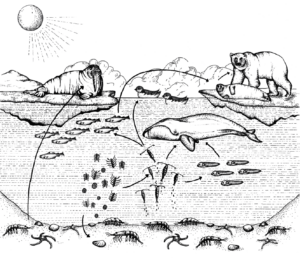
Model: Tina Damgaard, The Icefjord Centre
By following the arrows you can discuss in class which animals each of the other animals eat.
Find more knowledge here.
Sound recording and insertion of text: see instruction 1 and 3 her.
On pages 22 and 23 the students can make short sentences or small stories using the keywords and concepts that you have gone through. They can write them, record them as an audio file or make a drawing and insert the picture. Their products will be part of the further work with the podcast.
Sound recording and insertion of text: see instruction 1 and 3 here.
In the task the students are asked to make a promotion for Visit Greenland´s helicopter tours.
On page 24 they are invited to read about the case with the following invitation:
Dear students,
The Icefjord Centre has been asked to promote Visit Greenland´s helicopter trips to the Sermeq Kujalleq glacier.
For this we need your help.
We wish to make a flyer or a pamphlet that:
- describes the trip with the helicopter out to the glacier in words and pictures.
- informs about the price.
- makes it possible to book a trip.
We look forward to receiving a presentation from you.
Best regards,
The Icefjord Centre
The students are free to choose whether they want to do the task directly in the Book Creator book or whether they do the task using another digital tool or they can use an analogue solution.
If the task is solved totally or partially using another tool than Book Creator, pictures of the product must be inserted in the Book Creator book.
Sound recording and insertion of text: see instruction 1 and 3 here.
Find more knowledge here
The students present their products to the class.
Make sure that the framework for feedback is positive criticism. The students should be supported in assessing what is good – and what might be done better. Find more inspiration here.
Not specifically with a view to making new products, but foremost to let the students discover and work with this kind of constructive and positive criticism.
If you intend to work with some of the other podcasts from the Icefjord Centre, it might make sense to save the students’ Book Creator book so that the work, they have done with it, can be used again.
If you wish to let the students make use of the feedback they have received from the class, you could reserve time for them to continue their work with their products. So that they can use the feedback they have received from each other to change things in their product.
The students present their products to the class.
Make sure that the framework for feedback is positive criticism. The students should be supported in assessing what is good – and what might be done better. Find more inspiration here.
Not specifically with a view to making new products, but foremost to let the students discover and work with this kind of constructive and positive criticism.
If you intend to work with some of the other podcasts from the Icefjord Centre, it might make sense to save the students’ Book Creator book so that the work, they have done with it, can be used again.
If you wish to let the students make use of the feedback they have received from the class, you could reserve time for them to continue their work with their products. So that they can use the feedback they have received from each other to change things in their product.
Podcasten Gletsjeren der bringer liv er udviklet af Isfjordscenteret i Ilulissat.
Undervisningsmaterialet til Podcasten er udviklet af Lotte Brinkmann og Daniella Maria Manuel, Anholt Læringsværksted med sparring fra Leg med IT.
Elevbogen i Book Creator er udviklet som en del af projektet Nutaaliorta fra Kivitsisa. Skabelonen er udviklet af Rikke Falkenberg Kofoed og Daniella Maria Manuel, Leg med IT.
Undervisningsmaterialet Gletsjeren der bringer liv er udgivet under en Creative Commons kreditering-licens CC:BY.
Materialets tekster, opgaver og billeder må deles, gengives og bearbejdes, når blot man krediterer ophavet ‘Gletsjeren der bringer liv by Isfjordscenteret Ilulissat’.
The students meet the Icefjord Centre in two pictures, showing summer and winter respectively.
In class you can talk about:
- What the Icefjord Centre is.
- What the surroundings around the Centre look like.
- The difference between summer and winter.
- How summer and winter differ where you live.
Talk about the map and about how many people live in Ilulissat. And about how many people live in the town or the settlement where you live.
The students see part of a world map.
The task now is to move the red marker down into the map in order to show where each student lives.
The marker is found in the white box and can be drawn into the map.
In class you can talk about:
- Differences and similarities between Ilulissat and your own town or settlement.
On pages 12-13 the students see a map of Ilulissat Icefjord/Kangia: the area marked with a red line is the area that is on the UNESCO World Heritage List.
In class you can talk about:
- What is UNESCO? (United Nations Educational, Scientific and Cultural Organization is UN´s organization for education, culture, communication and science)
- That the Icefjord and the Sermeq Kujalleq glacier are a unique site and therefore on the UNESCO World Heritage List.
- What is required to make it possible for a site to become inscribed on the World Heritage List?
On pages 14-15 there is a link to an overview over the UNESCO World Heritage List.
The students are to click on the link and find out whether there are more sites in Greenland that are on the World Heritage List.
If there is time, you can let them examine the map and see which other sites are on the list.
Listen and talk, pages 16-17
Now it is time for the students to listen to the podcast The Life-giving Glacier.
They find the podcast by clicking on the picture on page 16.
Before listening to the podcast, you can give a short introduction to the contents of the podcast.
- It starts with the sound of the glacier calving.
- Katrine Nyland tells about
- The Icefjord (in Greenlandic called Kangia) that has been inscribed on the UNESCO World Heritage List.
- The enormous icebergs that float towards the mouth of the fjord and constantly change colours.
- The glacier that grows smaller in the winter. It almost stops moving, but then gets active again in the summer and pushes the great icebergs out into the Icefjord.
- Malik who is a helicopter pilot and for periods at a time flies over the glacier on a daily basis.
- Malik tells about how the tourists have difficulties quite grasping how gigantic the Icefjord and the glacier are. At first they think it is a long white line until they land three kilometers from the glacier front (also called the edge of the glacier in the podcast), then they understand how enormous it is.
- The glacier front that rises from 100 to 300 meters. When the glacier is calving it becomes high because the ice is pushed upwards. Then, when the ice breaks off, it becomes lower again. A repeated cycle.
- That he is still surprised by the dazzling sight that meets him, even though he has been out at the glacier more than 1000 times.
It is recommended that the students listen in pairs or small groups.
Let the students spend a few minutes discussing what they have heard in the podcast.
On page 17 the students are to make small sound recordings where they tell about the podcast. The pictures on the page will help them remember what they have heard.
Sound recording see instruction 1 here.
The recording will now be represented by a small sound icon. This icon can be placed wherever you wish on the page. You can listen to the recording over and over again.
Review in class
We recommend that you have a joint discussion in class when the work with pages 16-17 is finished.
We recommend that you support the discussion by writing concepts and keywords on the board.
In class you could talk about:
- What surprised the students when listening to the podcast.
- You could for example wonder why the title of the podcast is “The Life-giving glacier”, when life-giving aspects are not mentioned in the podcast. Find knowledge here.
- Concepts and keywords that the students encountered in the podcast.
In the text below you can find inspiration for the class discussion.
In the Book Creator book there are some pages with tasks connected to some of the concepts.
You can add more pages yourself for other topics, concepts and keywords you discuss.
Concepts and keywords
- Glacier – the word glacier means ”a river of ice”. A glacier is a large mass of slowly moving ice. When the weight of new snow becomes sufficiently heavy on the inland ice, the lowest section of ice is pressed out towards the coast. The stream of ice that is caused by this, you call a glacier.
In what way do you think a glacier gives life?
Why does Malik land 3 km away from the glacier front?
- Calving – when blocks of ice break off the glacier front and fall into the sea because of gravitation, it is called calving. You could say that the glacier is “giving birth” to icebergs and ice floes. The great calvings, where large parts of the glacier front is loosened, only happen during the summer, but smaller bits of ice break off the edge all the time and can be seen the whole year round.
Why does the glacier front vary from being 100 to 300 meters high? The attentive listener will hear Malik talk about it.
- A cycle – is characterised by something, that more or less regularly returns, repeating itself. The ice has a cycle. The movements of the ice are influenced by the seasons´ cold and heat.
When is the glacier active? What do you think is the reason for this?
When does the glacier almost stop moving? What do you think is the reason for this?
- Malik – even though he has been out by the glacier over 1000 times, he still gets surprised and dazzled every time he is there. He is still fascinated by the enormous forces that are out there.
What could it be that fascinates Malik out by the glacier?
- The wildlife – by the Icefjord the wildlife differs very much from most other places on Earth. This is because of the long periods without sunlight and with very low temperatures. Icebergs from the glacier create turbulence that lifts the nutrients in the sea up into the light. The wildlife benefits from this.
How is the wildlife in your area influenced by the changing seasons?
- How is it possible for a site to become inscribed on the World Heritage List?
On pages 18 and 19 the students can describe the keywords and concepts that you have gone through. They can write them, record them as an audio file or make a drawing and insert the picture. Their products will be part of the further work with the podcast.
Sound recording and insertion of pictures see instruction 1 and 2 here.
Now the students will work with what a glacier is and how it can give life.
On page 20 they can find knowledge about glaciers and the life by the Icefjord in which the glacier plays an important part.
First the students read the text on page 20. When they have done this, they click on the link “Glacier : What is a glacier”. After this they click on the PDF file “The abundant life of the Icefjord.pdf” and read pages 7, 10 and 11.
On page 21 the students will use the knowledge they have acquired from the text, the homepage and the PDF file to answer the questions in the black speech balloons. They insert their answers as audio files.
Sound recording see instruction 1 here.
On pages 22-23 the students will calculate how much the glacier moves. There are 3 calculation tasks on page 22 that the students are to answer. They insert their answer in the box with the question.
Correct answers to the tasks:
- If the glacier moves 19 meters a day, how fast does it move per hour?
- 19/24 = 0,79 meters/hour
- If the glacier moves 40 meters a day, how fast does it move per hour?
- 40/24 = 1,66 meters/hour
- If the glacier were to move 2 meters per hour, how fast would it move per day?
- 2 x 24 = 48 meters/day
On pages 24-27 the students will work with the wildlife by the Icefjord and other ecosystems.
On pages 24-25 there is a picture of a marinal food web. Talk about the picture in class so that the students obtain an understanding of what a food web is.
Here are some proposals for the class discussion:
- What is the difference between a food web and a food chain?
- You might try to draw a food chain on the board together
- What do the arrows on the picture indicate? Why do some animals have more arrows than others?
- What might happen if you remove one animal from the food web?
- What is an ecosystem?
On page 25 the students find the PDF file “The abundant life of the Icefjord.pdf” once more they know the file from page 20. They will work with pages 15-55 (information about all the animals is in Danish, Greenlandic and English, it is only the English part that is relevant).
The following animals and plants are described on the pages:
- The copepod, ice algae/plant plankton, deep-sea shrimp, crustacean, the Greenlandic crab, halibut, polar cod, Greenlandic shark, Greenlandic seal, ringed seal, bowhead whale, humpback whale and the narwhale
On pages 26-27 the students use their knowledge about the 13 different animals and plants to draw a food web. They can also search for more knowledge on the internet about the animals´ food intake. They insert their food web drawing on pages 26-27.
Insertion of pictures see instruction 1and 2 here.
The students “make believe” that they work for the podcast “Malik´s Marine P.O Box”.
They have received a lot of questions, pages 28-29, and the students answer the questions by inserting an audio file to each question. They use their knowledge from their work with the podcast The Life-giving glacier.
Sound recording see instruction 1 here.
The students present their products to the class.
Make sure that the framework for feedback is positive criticism. The students should be supported in assessing what is good – and what might be done better. Find more inspiration here.
Not specifically with a view to making new products, but foremost to let the students discover and work with this kind of constructive and positive criticism.
If you intend to work with some of the other podcasts from the Icefjord Centre, it might make sense to save the students’ Book Creator book so that the work, they have done with it, can be used again.
If you wish to let the students make use of the feedback they have received from the class, you could reserve time for them to continue their work with their products. So that they can use the feedback they have received from each other to change things in their product.
The podcast The Life-giving Glacier has been created by the Icefjord Centre in Ilulissat.
The teaching material for the podcast The Life-giving Glacier has been developed by Lotte Brinkmann and Daniella Maria Manuel, Anholt Læringsværksted with feedback from Leg med IT.
The student’s book in Book Creator has been developed as part of the project Nutaaliorta from Kivitsisa.
The template was designed by Rikke Falkenberg Kofoed and Daniella Maria Manuel, Leg med IT.
The teaching material The Life-giving Glacier is published under a Creative Commons crediting licence CC:BY.
The texts, assignments and pictures can be shared, reproduced and adapted, with the proviso that “The Life-giving Glacier by The Icefjord Centre Ilulissat” is credited as the source.
The students meet the Icefjord Centre in four pictures: summer and winter, the Kangia glacier front and the framework of the building. On page 6-7 there is a text and three videos (in Danish) showing the erection of the Icefjord Centre.
In class you can talk about:
- What the Icefjord Centre is.
- What the purpose of an institution like the Icefjord Centre is.
- What it looks like around the centre.
- The difference between summer and winter, where you live as well as in Greenland.
The students should clarify what they already know about Greenland before starting work on the podcast. In this podcast focus is on glaciers but you may have worked with some of the other podcasts or in other ways acquired knowledge that can be activated in advance.
On page 8 there is a link to Google Maps. Here the students can try to locate the Icefjord Centre on the map.
You can also experiment with letting them find the places mentioned in the podcast, so that they get an idea of where they are situated. These are the places:
- Ilulissat
- The Sermeq Kujalleq glacier
- The Icefjord
Furthermore, on page 8 there are four questions to help the students get going. Here are suggestions for a few more:
- How do you get around in Greenland?
- Which languages are spoken in Greenland?
Page 9 is intended for answers. The students are free to use whatever form of expression they prefer. Some possibilities in Book Creator:
- make a model/a drawing by hand, take a picture of it and insert
- find pictures in Book Creator about Greenland and insert them. The pictures can be complemented with explanations in words.
- record an audio file telling what you know about Greenland
- – or a combination of the above
On page 10-11 you find a map of Greenland, with six red markers. Let the students place the markers where they know towns or settlements in Greenland. They can write the name of the town or settlement in the field next to the marker.
Sound recording, insertion of pictures and text: see instructions 1, 2 and 3 here.
Now it is time for the students to listen to the podcast The life-giving glacier. On page 12 an introduction to the podcast is given followed by a short instruction. Clicking the picture on page 13 will start the podcast.
It is recommended that the students listen in pairs or small groups. After listening to the podcast, the students could spend some minutes talking about what they just heard.
On page 14-15 the students are to make a summary of what they heard in the podcast. They may do this in various ways:
- write a text
- record an audio file
- make a model/drawing
- something completely different that they are used to with note taking methods and summaries
- – or a combination of the above
Sound recording, insertion of pictures and text: see instructions 1, 2 and 3 here.
Now it is time for a joint review in class where the students’ work on pages 14 and 15 is discussed. The aim is to prepare the students for making their own reference books that they can revisit during work with the podcast. In this reference book the students should explain the meaning of the concepts and keywords from your discussion – by means of text, sound, pictures, drawings or a combination of these.
You could begin by asking the students to name the concepts and keywords they heard in the podcast. Then you can add those mentioned below, central to the podcast and important for further work.
- Glacier – the word means “stream of ice”. A glacier is a mass of slowly moving ice.
When new snow keeps piling on top of the inland ice, the pressure increases on the layers below, sheer gravity. This pressure will cause the lowest levels to be squeezed from under the middle of the ice sheet towards the coast, producing the flow of ice that is called a glacier.
How does a glacier bring life?
- Calving – when blocks of ice at the glacier front fall into the sea due to gravity this is called calving. You could say that the glacier “gives birth” to icebergs and ice floes. The big calvings when massive parts of the glacier front break off, only happens a few times during summer, but smaller pieces fall off the edge all the time.
Why is it only in summer that large parts of the glacier front break off?
- A cycle – is characterized by something returning more or less regularly, repeating itself. The ice has a cycle. The movements of the ice are affected by the cold and warmth of the seasons.
When is the glacier most active, and when does it almost come to a standstill? Why is this so?
- Wildlife – at the Icefjord the wildlife is very much different from other places in the world. This is due to long periods without sunlight and with very low temperatures.
How is wildlife seasonal where you live?
Sound recording, insertion of pictures and text: see instructions 1, 2 and 3 here.
The students will now work with professional reading and Ilulissat Icefjord where Malik flies tourists to see the glacier Sermeq Kujalleq.
On page 18 a link is given to Quick guide to Ilulissat Icefjord from GEUS with information in text and pictures about Ilulissat Icefjord, the first picture showing the glacier, Sermeq Kujalleq. In pairs or small groups the students are to read this text. There may be a number of words and concepts not familiar to them. These words they must look up and write down on page 19 as they meet them in the text. Make sure that the students remember to read the captions to the pictures.
On page 20-12 eight speech bubbles contain questions to the text; the students are to answer them by recording an audio file.
Sound recording: see instruction 1 here.
The students now work with the marine food web found at the Icefjord.
On page 22-23 a food web in Greenland is shown. The picture and the four questions could be subject for a joint discussion in class. If time allows, you might try to draw a food web from another ecosystem, like a wood, a desert or somewhere else. After working with page 22-23 the students should update their reference book with the concept food web.
In small groups work continues with pages 24-27. Page 24-25 holds eleven infoboxes about animals that are part of the marine food web at the Icefjord.
Page 26-27 has pictures of these animals. Here the task is to move the pictures around to set up a food web. Use the pen tool to draw arrows showing the relevant connections in the web.
Drawing with the pen tool: see instruction 4 here.
This process is the basis for all life on Earth. In the arctic marine food web the ice algae is the starting point as they are able to perform photosynthesis.
The students begin by reading the two texts on page 28-29, “Wildlife in the Icefjord” and “The importance of sea ice for the spring bloom”. Having done this, you conduct a joint review in class.
Here these questions might be useful:
- How is winter in Ilulissat?
- What is being produced in spring and summer?
- In the text the world under the ice is compared to another ecosystem, which one?
- What is the most important element of the arctic marine food web?
- Is ice algae the same thing as phytoplankton?
On page 30-31 photosynthesis is explained, using ice algae as an example. After reading the text, the students are to put the boxes and signs at the bottom of the page in the correct order for photosynthesis.
Photosynthesis:
6CO₂ + 6H₂O + Sunlight → 6O₂ + C₆H₁₂O₆
The students now can update their reference book with the concept photosynthesis.
The students must imagine they have been contacted by Malik from the podcast. He needs help to make an advertisement for his helicopter flights. The advertisement should inform tourists about the area and inspire them to book a flight with Malik. Students could work in small groups on this project.
A box for text and two picture frames are prepared on page 32-33, where the advertisement can be inserted. Boxes can be removed or added if necessary. The advertisement may be created on paper and pictures of it inserted. They can make it directly in Book Creator with shapes and pictures found there, or any combination.
The products of the groups are presented to the whole class.
Insertion of pictures and text: see instructions 2 and 3 here.
Make sure that the settings for feedback are positive criticism. The students should be supported in assessing: what is good – and what might be done better. Find more inspiration in Austin’s Butterfly. The idea with this is not necessarily to make new products but rather for the students to discover and work with this positive criticism. You could, though, choose to allocate time for further work with the products, so that the students might use the feedback for changes and improvements.
If you intend to work with some of the other podcasts from the Icefjord Centre it would make sense to save the students’ Book Creator books so that they may be reused.
The podcast The life-giving glacier was made for the Icefjord Centre in Ilulissat by Katrine Nyland.
Graphics by Oncotype.
Teaching material for the podcast has been produced by Lotte Brinkmann and Daniella Maria Manuel, Anholt Læringsværksted.
The teaching material The life-giving glacier is published under a Creative Commons crediting licence CC:BY. The texts, assignments and pictures can be shared, reproduced and adapted, with the proviso that “The life-giving glacier by the Icefjord Centre Ilulissat” is credited as the source.
Partners


