BOOK CREATOR AS A TEACHING TOOL
The Book Creator book The Treasures of a Greenlandic Freezer is a student’s book associated with the podcast The Treasures of a Greenlandic Freezer. The duration of the podcast is 3:37. The activities have been designed to focus on the students’ investigative, experimental and creative approach to learning. The process consists of three steps: Preparation before listening to the podcast. Listening to and working with the podcast. Further work with topics and insights from the podcast. We recommend that you listen to the podcast before presenting it to the students.
We recommend that students work in pairs or individually. Depending on what suits each student best and the competences to be developed. Keep in mind that your best friend is not necessarily the one you collaborate best with. Working together is about working together and not just being together.
Cross-curricular – biology, English and nature/culture.
- The students acquire knowledge about the rich wildlife and sealife in the Disko Bay that has filled the pantries of the Inuit with food from nature for thousands of years.
- The students acquire special knowledge about the plants that are gathered and animals that are hunted at different times of the year.
- The students practise their skills in communication and cooperation.
The students meet the Icefjord Centre in two pictures, showing summer and winter respectively.
In class you can talk about:
- What the Icefjord Centre is.
- What the surroundings around the Centre look like.
- The difference between summer and winter.
- How summer and winter differ where you live.
Have a look at the map and talk about where Ilulissat is situated. Talk about how many people live in Ilulissat. Also talk about how many people live in the town or settlement where you live.
The students see part of a world map.
The task now is to move the red marker down into the map in order to show where each student lives.
The marker is found in the white box and can be drawn into the map.
In class you can talk about:
- Differences and similarities between Ilulissat and your own town or settlement.
On page 12 there are three freezers with opened lids.
One freezer is for meat – another one is for fish – and yet another one (a smaller freezer) is for berries and herbs.
On page 13 there are pictures of a reindeer, a musk ox, a whale, a grouse, a codfish, a halibut, blueberries, crowberries, angelica and thyme.
The students place the pictures in the correct freezers. They do this by drawing the picture into the freezer they have chosen.
In class you can discuss:
- Why it is quite normal to have at least two freezers when living in Ilulissat.
- How you get hold of food in nature all by yourself.
- What kind of food is in the students’ own freezers at home.
- Have the students tried finding food in nature themselves?
Now it is time for the students to listen to the podcast The Treasures of a Greenlandic Freezer. They find the podcast by clicking on the picture on page 14.
Before the students listen to the podcast, you can give a short introduction to the contents of the podcast.
The contents of the podcast
”The rich wildlife and sealife of Ilulissat is the reason why all families have not just one, but many deep freezers”.
Malik’s, Elin’s og Vera’s narratives.
The thing most collect in Ilulissat are freezers. Two – three freezers per household is the standard. One for meat, one for fish and fowl and a small one for berries, mushrooms and herbs.
About 75% of what people eat, they gather and hunt themselves. This is why many Greenlanders have their own boat.
In one freezer they have for example:
- reindeer meat, meat from musk oxen, eider, grouse and dried reindeer meat.
In another freezer they may have:
- whale meat, seal meat, trout, codfish, halibut, dried capelan, dried whale, dried salmon, halibut, lumpfish roe, mussels, whale skin
In a smaller freezer they have:
- crowberries, blueberries, juniper, angelica, Greenlandic thyme, Rhododendron Groenlandicum and mushrooms
They prepare some of the catch before putting it in the freezer. Whale meat, halibut and trout are smoked, reindeer and capelan are dried and mussels boiled.
The herbs are used for tea, for baking and for cooking.
There is no food waste. When new food is put into the freezer, the oldest food is placed at the top of the freezer and is eaten first. If some of it has become too old, it is given to the dogs.
Because they have lived so close to nature for thousands of years, they also get to know the “taste of the landscape”. Elin and Vera can easily taste where in the Disko Bay an animal comes from. Elin says that the taste of reindeer and seal meat changes the further south you get.
At weekends many people sail out to fish and hunt. When the men go out hunting seals, the women are put ashore to gather herbs and berries.
Let the students spend a few minutes discussing what they have heard in the podcast.
On page 15 the students are to record small audio files where they tell about the podcast. The pictures on the page will help them remember what they have heard.
Sound recording see instruction 1 here.
The recording will now be represented by a small sound icon. This icon can be placed wherever you wish on the page. You can listen to the recording over and over again.
Review in class
We recommend that you have a joint discussion in class when the work with pages 14-15 is finished.
In class you could talk about:
- The picture(s) they have chosen for their audio story and the reason why they have chosen it/them.
- Concepts and keywords the students have heard about in the podcast.
In the text below you can find inspiration for the class discussion.
For some of the concepts there are pages with tasks in the Book Creator book.
If you wish, you can add more pages for other topics, concepts and keywords that you discuss.
Concepts and keywords
- The pantry of nature – For thousands of years the people of Greenland have lived off what they could gather, catch and hunt in nature. They still do this.
The tradition of getting most of your food from nature is deeply rooted in the Inuit. Even though you can buy food from all over the world in the Ilulissat super markets, the food from nature constitutes a big part of what Greenlanders eat.
What kind of food can you get hold of in nature by yourself at the Disko Bay?
What kind of food can you get hold of by yourself where you live?
- Musk ox – belongs to the land mammals and is herbivorous.
In Greenland the musk ox originally only lived in the northern and northeastern parts of the country and in Inglefield Land in the northwest. The musk ox first came to Western Greenland in 1962 and originates from animals that were moved there by man.
There are approximately 39.400 muskoxen in Greenland. This amounts to approximately 23% of the total muskoxen population in the whole world. The two largest stocks in Greenland live by Kangerlussuaq (appr. 20.000 animals) and Sisimiut (appr. 2.600 animals).
Has there always been muskoxen in Western Greenland?
Where in Greenland do the largest amount of muskoxen live?
- Reindeer – The original western Greenlandic reindeer has lived in Greenland for thousands of years. Until 100 years ago there were also reindeer in Eastern Greenland, but this subspecies has become extinct, probably because of catastrophically bad weather.
Today there are only reindeer along the western and northwestern coasts of Greenland. We distinguish between 11 wild reindeer stocks who most probably mingle very little with each other, due to the natural barriers in the landscape.
For how many years have the reindeer existed in Greenland?
Do reindeer live in other places in the world?
- Rock Grouse – breeds all over Greenland and you can see it in nearly all types of terrain. It is a popular edible bird and even though the population varies from one year to another, it is estimated that the ptarmigan exists in large numbers in Greenland. The ptarmigan changes plumage according to the season. The feathers are white in the winter and greyish in the summer.
Why does the ptarmigan change plumage according to the season?
- Food waste – is food that could have been eaten by man, but for some reason or other has been thrown away.
In Greenland there are very many dogs. Sled dogs in North Greenland and sheep dogs in South Greenland. If some food has become too old, the dogs get it. In this way you avoid food waste.
Why is it important to avoid food waste?
On page 16 there is a picture of a reindeer and of a musk ox. Both species are herbivores.
You are not allowed to hunt these animals until after they have calved in May/June.
The students read the text or have it read out loud:
In autumn Malik hunts reindeer and musk ox.
Some of the meat is frozen, some of it is dried and some of it is smoked.
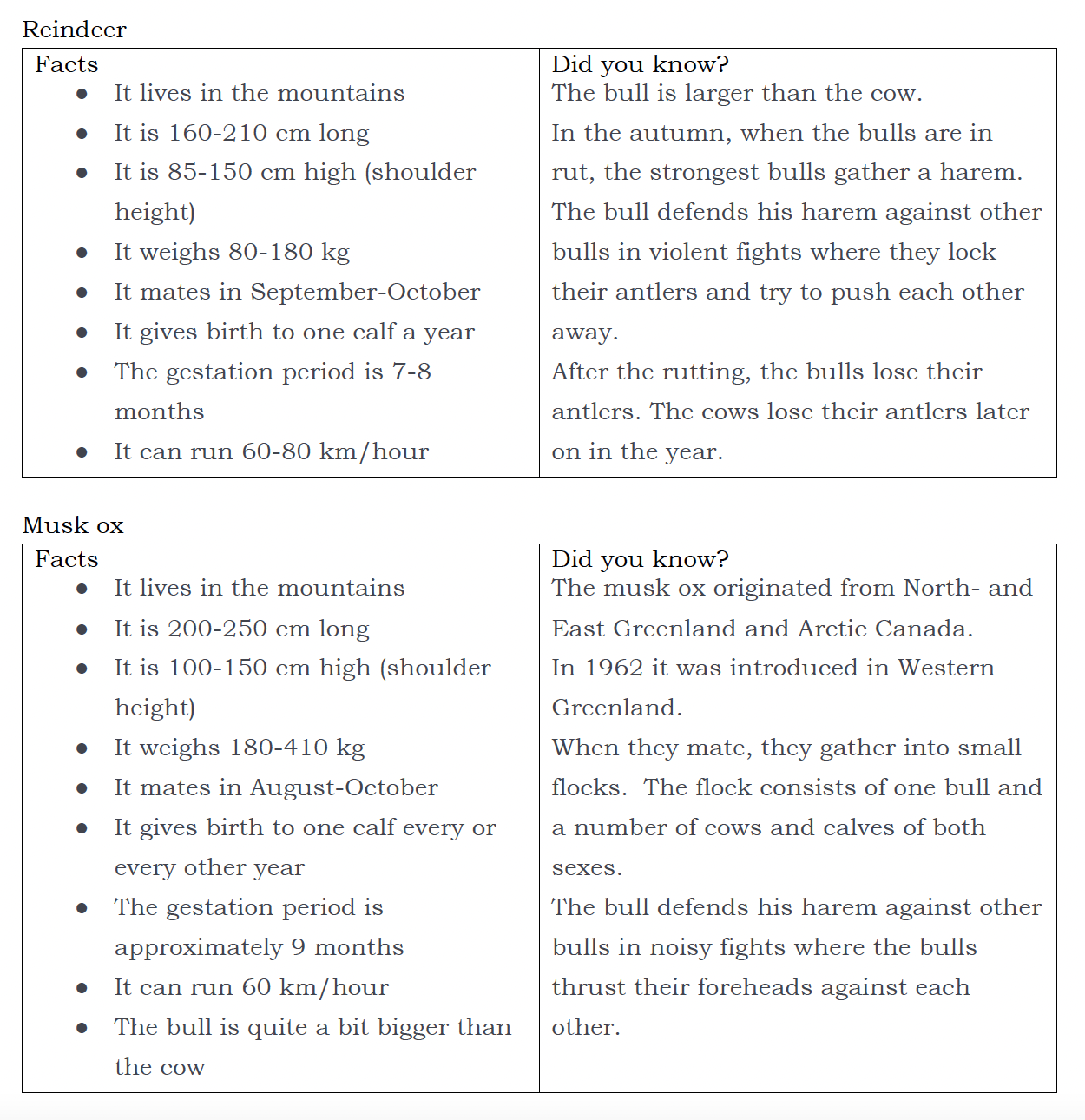
On page 20-21 there are six questions.
Which is the biggest? A reindeer or a musk ox?
At what time of the year do they calve?
How many calves do they get?
Why do you shoot reindeer and musk ox?
Can you use these animals for other things than food?
Has the musk ox always existed in Western Greenland?
The students present their answers as an audio file.
Recording of audio files: see instruction 1 here.
On pages 22-23 there is a picture of two eiders (a male and a female) and a picture of a ptarmigan.
The students read the text or have it read out loud:
In spring, Malik hunts grouse and eider.
He deep freezes them so that he has food supplies for the winter.
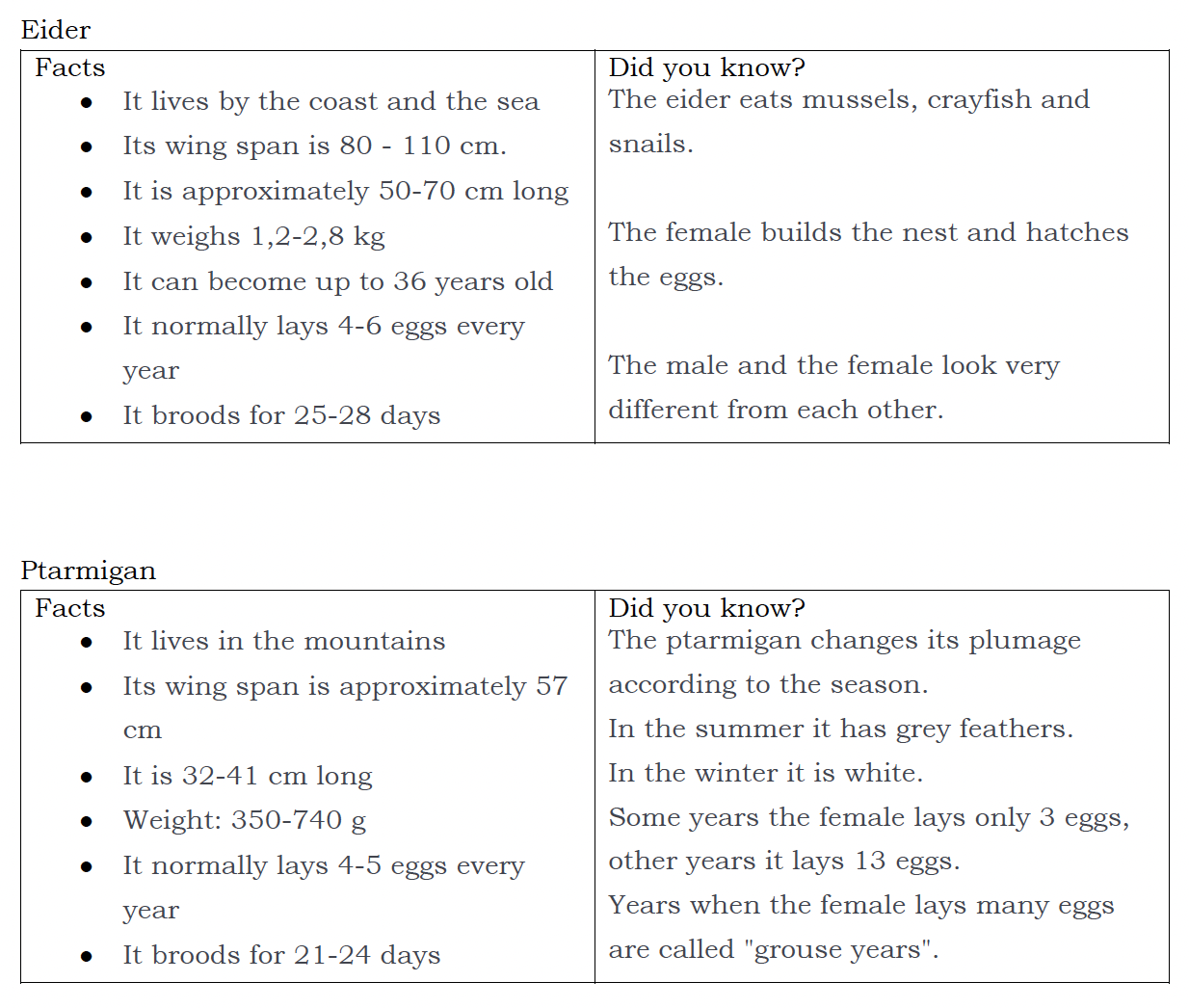
On pages 26-27 there are five questions:
Which bird is bigger?
Why is the ptarmigan white in the winter?
What is a “grouse year”?
What does the eider eat?
Why does Malik shoot grouse?
The students present their answers as an audio file.
On page 28 there are four links to some of the things that Elin and Vera gather in nature in the summer and make use of in their cooking.
- Angelica
- Thyme
- Rhododendron Groenlandicum
- Milk-cap
When you click on the link a text and a picture appear. The text is in Danish so make sure focus is on the pictures.
The students are to make a drawing of all four plants. Then they take a picture of their drawings and insert them on page 29.
On these pages the students make sentences or small stories using the keywords and concepts that you have been through. They can write them, record them as an audio file or make a drawing and insert the picture.
As a conclusion of their work with the podcast, the students now are to produce a story about a trip with their family as an audio file or as a visual story. They tell about a family trip that they have experienced in real life or a trip that they dream of experiencing.
The students show their products to the class.
Make sure that the framework for feedback is positive criticism. The students should be supported in assessing what is good – and what might be done better. Find more inspiration here.
Not specifically with a view to making new products, but foremost to let the students discover and work with this kind of constructive and positive criticism.
If you intend to work with some of the other podcasts from the Icefjord Centre, it might make sense to save the students’ Book Creator book, so the work they have done with it can be used again.
If you wish to let the students make use of the feedback they have received from the class, you could reserve time for them to continue their work with their products. So that they can use the feedback they have received from each other and change things in their product.
The podcast The Treasures of a Greenlandic Freezer has been created by the Icefjord Centre in Ilulissat.
The teaching material for the podcast The Treasures of a Greenlandic Freezer has been developed by Lotte Brinkmann and Daniella Maria Manuel, Anholt Læringsværksted with feedback from Leg med IT.
The student’s book in Book Creator has been developed by Rikke Falkenberg Kofoed from Leg med IT.
The teaching material The Treasures of a Greenlandic Freezer is published under a Creative Commons crediting licence CC:BY.
The texts, assignments and pictures can be shared, reproduced and adapted, with the proviso that “The Treasures of a Greenlandic Freezer by The Icefjord Centre Ilulissat” is credited as the source.
The students meet the Icefjord Centre in two pictures, showing summer and winter respectively.
In class you can talk about:
- What the Icefjord Centre is.
- What the surroundings around the Centre look like.
- The difference between summer and winter.
- How summer and winter differ where you live.
Have a look at the map and talk about where Ilulissat is situated. Talk about how many people live in Ilulissat. Also talk about how many people live in the town or settlement where you live.
The students see part of a world map.
The task now is to move the red marker down into the map in order to show where each student lives.
The marker is found in the white box and can be drawn into the map.
In class you can talk about:
- Differences and similarities between Ilulissat and your own town or settlement.
The students see a map of Greenland.
Which other towns and settlements in Greenland do you know about?
Place a red marker and write the name of the town/settlement.
On pages 14 and 15 the students see pictures of different edible animals and plants that you can find in nature in Greenland.
On page 15 there is a picture of a deep freezer. The students are to “fill” the freezer with food they know from page 14.
The students may add more pictures of food you can find in nature.
Let the students compare their answers in small groups or in pairs.
Now it is time for the students to listen to the podcast The Treasures of a Greenlandic Freezer. They find the podcast by clicking on the picture on page 16.
Before the students listen to the podcast, you can give a short introduction to the contents of the podcast.
The contents of the podcast
”The rich wildlife and sealife of Ilulissat is the reason why all families have not just one, but many deep freezers” says Katrine.
Malik’s, Elin’s og Vera’s narratives.
The thing most collect in Ilulissat are freezers. Two – three freezers per household is the standard. One for meat, one for fish and fowl and a small one for berries, mushrooms and herbs.
About 75 % of what people eat, they gather and hunt themselves. This is why many Greenlanders have their own boat.
In one freezer they have for example:
- reindeer meat, meat from musk oxen, eider, grouse and dried reindeer meat.
In another freezer they may have:
- whale meat, seal meat, trout, codfish, halibut, dried capelan, dried whale, dried salmon, halibut, lumpfish roe, mussels, whale skin
In a smaller freezer they have:
- crowberries, blueberries, juniper, angelica, Greenlandic thyme, Rhododendron Groenlandicum and mushrooms
They prepare some of the catch before storing it in the freezer. Whale meat, halibut and trout are smoked, reindeer and capelan are dried and mussels boiled.
The herbs are used for tea, for baking and for cooking.
There is no food waste. When new food is put into the freezer, the oldest food is placed at the top of the freezer and is eaten first. If some of it has become too old, it is given to the dogs.
Because they have lived so close to nature for thousands of years, they also get to know the “taste of the landscape”. Elin and Vera can easily taste where in the Disko Bay an animal comes from. Elin says that the taste of reindeer and seal meat changes the further south you get.
At weekends many people sail out to fish and hunt. When the men go out hunting seals, the women are put ashore to gather herbs and berries.
Let the students spend a few minutes discussing what they have heard in the podcast.
On page 17 the students are to record small audio files where they tell about the podcast. The pictures on the page will help them remember what they have heard.
Sound recording see instruction 1 here.
The recording will now be represented by a small sound icon. This icon can be placed wherever you wish on the page. You can listen to the recording over and over again.
Review in class
We recommend that you have a joint discussion in class when the work with pages 16-17 is finished.
In class you could talk about:
- The picture(s) they have chosen for their audio story and the reason why they have chosen it/them.
- Concepts and keywords the students have heard about in the podcast.
Below you can find inspiration for the class discussion.
For some of the concepts there are pages with tasks in the Book Creator book.
If you wish, you can add more pages for other topics, concepts and keywords that you discuss.
Concepts and keywords
- The larder of nature – For thousands of years the people of Greenland have lived off what they could gather, catch and hunt in nature. They still do this.
The tradition of getting most of your food from nature is deeply rooted in the Inuit. Even though you can buy food from all over the world in the Ilulissat super markets, the food from nature constitutes a big part of what Greenlanders eat.
What kind of food can you get hold of in nature by yourself at the Disko Bay?
What kind of food can you get hold of by yourself where you live?
- Musk ox – belongs to the land mammals and is herbivorous.
In Greenland the musk ox originally only lived in the northern and northeastern parts of the country and in Inglefield Land in the northwest. The musk ox first came to Western Greenland in 1962 and originates from animals that were moved there by man.
There are approximately 39.400 muskoxen in Greenland. This amounts to approximately 23% of the total muskoxen population in the whole world. The two largest stocks in Greenland live by Kangerlussuaq (appr. 20.000 animals) and Sisimiut (appr. 2.600 animals).
Has there always been muskoxen in Western Greenland?
Where in Greenland do the largest amount of muskoxen live?
- Reindeer – The original western Greenlandic reindeer has lived in Greenland for thousands of years. Until 100 years ago there were also reindeer in Eastern Greenland, but this subspecies has become extinct, probably because of catastrophically bad weather.
Today there are only reindeer along the western and northwestern coasts of Greenland. We distinguish between 11 wild reindeer stocks that probably mingle very little with each other, due to the natural barriers in the landscape.
For how many years have the reindeer existed in Greenland?
Do reindeer live in other places in the world?
- Rock grouse – breeds all over Greenland and you can see it in nearly all types of terrain. It is a popular edible bird and even though the population varies from one year to another, it is estimated that the ptarmigan exists in large numbers in Greenland. The ptarmigan changes plumage according to the season. The feathers are white in the winter and greyish in the summer.
Why does the ptarmigan change plumage according to the season?
- Preparation – in order to preserve meat and fish for a longer time, they smoke or dry it. In the past, before deep freezers existed, it was vital to have dried meat and fish in order to survive.
How do you smoke meat and fish?
How do you eat dried meat and fish?
- Food waste – is food that could have been eaten by man, but for some reason or other is thrown away.
In Greenland there are very many dogs. Sled dogs in North Greenland and sheep dogs in South Greenland. If some food has become too old, the dogs eat it. In this way you avoid food waste.
Why is it important to avoid food waste?
On page 18 the students read the text:
In spring Malik hunts grouse and eider and
in autumn he hunts reindeer and musk ox.
In the summer Elin and Vera gather berries and herbs.
In the winter they feast on all the good food.
They fish codfish and halibut all year round.
And solve the tasks:
Write, draw or find pictures of:
– things you do during spring, summer and autumn
– food you eat during spring, summer and autumn
– places you visit during spring, summer and autumn
On page 19, 20 and 21 they insert their answers in the four frames.
Now the students make a drawing of Malik, Elin and Vera feasting on the good food
in the winter. In the drawing you can see all the delicious dishes on their plates.
The students insert their drawing on pages 22-23.
On page 24 the students read the text:
When Elin fills new things into the freezer,
she removes the things in the bottom of the
freezer and places these things at the top.
Then the oldest food is eaten first.
If some of the food is too old, the dogs eat it.
In this way no food is wasted.
On page 25 there are five balloons. Here the students come up with ideas to avoid food waste. They insert their ideas in the form of audio files in the balloons.
On these pages the students make sentences or small stories using the keywords and concepts that you have been through. They can write them, record them as an audio file or make a drawing and insert the picture.
As a conclusion of their work with the podcast, the students now are to produce a visual story – a comic strip – about a weekend trip to the Disko Bay with Malik, Elin and Vera.
The students show their products to the class.
Make sure that the framework for feedback is positive criticism.The students should be supported in assessing what is good – and what might be done better. Find more inspiration here.
Not specifically with a view to making new products, but foremost to let the students discover and work with this kind of constructive and positive criticism.
If you intend to work with some of the other podcasts from the Icefjord Centre, it might make sense to save the students’ Book Creator book, so the work they have done with it can be used again.
If you wish to let the students make use of the feedback they have received from the class, you could reserve time for them to continue their work with their products. So that they can use the feedback they have received from each other and change things in their product.
The podcast The Treasures of a Greenlandic Freezer has been created by the Icefjord Centre in Ilulissat.
The teaching material for the podcast The Treasures of a Greenlandic Freezer has been developed by Lotte Brinkmann and Daniella Maria Manuel, Anholt Læringsværksted with feedback from Leg med IT.
The student’s book in Book Creator has been developed by Rikke Falkenberg Kofoed from Leg med IT.
The teaching material The Treasures of a Greenlandic Freezer is published under a Creative Commons crediting licence CC:BY.
The texts, assignments and pictures can be shared, reproduced and adapted, with the proviso that “The Treasures of a Greenlandic Freezer by The Icefjord Centre Ilulissat” is credited as the source.
The students meet the Icefjord Centre in two pictures, showing summer and winter respectively.
In class you can talk about:
- What the Icefjord Centre is.
- What the surroundings around the Centre look like.
- The difference between summer and winter.
- How summer and winter differ where you live.
Talk about the map and about how many people live in Ilulissat. Also talk about how many people live in the town or settlement where you live.
The students see part of a world map.
The task now is to move the red marker down into the map in order to show where each student lives.
The marker is found in the white box and can be drawn into the map.
In class you can talk about:
- Differences and similarities between Ilulissat and your own town or settlement.
The students are to explore the Greenlandic food culture.
On page 12 they first read the text that describes the tasks. Then they click on the PDF file and read about the Greenlandic food culture.
On pages 13-15 the students are to describe a dish that they think best characterises their own food culture. They can find recipes on the internet if they do not know them by heart.
On the pages there are boxes where the students can write about their own dish. They can find help in the few words written in the boxes:
- The name of the dish – here they write the name of the dish.
- Story behind the dish – if there exists a story about the dish they write it here. It can be a well known story or just a story from their own home about the dish.
- Reason for choice of dish – here they write why they think that this particular dish is characteristic for the food culture they have grown up in.
- Ingredients & recipe – are to be written in a way that makes it easy for others to cook this dish.
- A picture of the dish – it can be a picture they find on the internet or if it is possible while you work with the podcast, the students could cook the dish at home and take a picture of it.
The task is to be solved either singly or in small groups. When everyone is finished with the task, you mix the students and they present their dishes to each other.
Suggestion to further work with the task:
- if the students fancy, they can try cooking each others’ dishes
Now it is time for the students to listen to the podcast The Treasures of a Greenlandic Freezer. They find the podcast by clicking on the picture on page 16.
Before the students listen to the podcast, you can give a short introduction to the contents of the podcast.
”The rich wildlife and sealife of Ilulissat is the reason why all families have not just one, but many deep freezers” says Katrine.
Malik’s, Elin’s og Vera’s narratives.
The thing collect most in Ilulissat are freezers. Two – three freezers per household is the standard. One for meat, one for fish and fowl and a small one for berries, mushrooms and herbs.
About 75% of what people eat, they gather and hunt themselves. This is why many Greenlanders have their own boat.
In one freezer they have for example:
- reindeer meat, meat from musk oxen, eider, grouse and dried reindeer meat.
In another freezer they may have:
- whale meat, seal meat, trout, codfish, halibut, dried capelan, dried whale, dried salmon, halibut, lumpfish roe, mussels, whale skin
In a smaller freezer they have:
- crowberries, blueberries, juniper, angelica, Greenlandic thyme, Rhododendron Groenlandicum and mushrooms
They prepare some of the catch before storing it in the freezer. Whale meat, halibut and trout are smoked, reindeer and capelan are dried and mussels boiled.
The herbs are used for tea, for baking and for cooking.
There is no food waste. When new food is put into the freezer, the oldest food is placed at the top of the freezer and is eaten first. If some of it has become too old, it is given to the dogs.
Because they have lived so close to nature for thousands of years, they also get to know the “taste of the landscape”. Elin and Vera can easily taste where in the Disko Bay an animal comes from. Elin says that the taste of reindeer and seal meat changes the further south you get.
At weekends many people sail out to fish and hunt. When the men go out hunting seals, the women are put ashore to gather herbs and berries.
We recommend that the students listen to the podcast in pairs or in small groups.
Let the students spend a few minutes discussing what they have heard in the podcast.
On page 17 the students are to record small audio files where they tell about the podcast. The pictures on the page will help them remember what they have heard.
Sound recording see instruction 1 here.
The recording will now be represented by a small sound icon. This icon can be placed wherever you wish on the page. You can listen to the recording over and over again.
Review in class
We recommend that you have a joint discussion in class when the work with pages 16-17 is finished.
It would be a good idea that you, during the discussion, write keywords and concepts on the board.
In class you could talk about:
- How many freezers do you have at home?
- Have you tried eating food that you have caught yourself?
In the text below you can find inspiration for the class discussion.
In connection with some of the concepts there are tasks in the Book Creator book.
You might insert more pages for other topics, concepts and keywords.
Concepts and keywords.
- Deep freezer – there are different types of freezers: a freezer combined with the refrigerator, a chest freezer or an upright freezer. Often a chest freezer can hold more than the two other kinds, but it can be more difficult to get an overview over the contents.
What kind of freezer do you have at home?
Why is it a good idea to have a freezer?
- Food store – is food that you have collected and saved for later use. For example you can save your stores in a larder or a deep freezer.
Do you have a food stores at home?
Is there some food that cannot be preserved for a longer period of time?
- Disko Bay – is the largest bay in Greenland. Among other things you find Ilulissat at the bay, which is where the podcast takes place. Today it is one of the most popular tourist destinations in Greenland. It is an unbelievably beautiful area with the enormous floating icebergs, the rich wildlife and especially the many whales. This is also where you can experience the hunter life of the small settlements.
Even though hunting and fishing still are the main livelihood in the Disko Bay, the service professions are growing with the expanding tourism.
Why do you think it is called Disko Bay?
Here are some concepts that do not derive from the podcast, but are relevant in connection with solving the tasks.
- Food culture – is about the way a society construes food. Like which dishes are eaten, when the largest meal is served during the day or which ingredients are used the most. A country can have traditional dishes that you do not eat very often in other countries.
Are you familiar with food cultures from other countries?
- Food waste – is food that could have been eaten by man, but for some reason or other has been thrown away.
In Greenland there are very many dogs. Sled dogs in North Greenland and sheep dogs in South Greenland. If some food has become too old, the dogs get it. In this way you avoid food waste.
Why is it important to avoid food waste?
- Food web – shows the feeding relationship between different organisms in an ecosystem. It differs from a food chain that focuses on a certain type of food for a certain organism. Whereas a food web shows the relationship between a number of organisms at the same time.
What happens if you remove an organism from a food web?
On these pages the students make short descriptions of the keywords and concepts that you have gone through and worked with until now. They can write them, record them as an audio file or make a drawing and insert the picture. Their products will be part of the further work with the podcast. Give the students an opportunity to work on their reference book and add new knowledge as they go along with the next pages in the book.
The students imagine that they are going to invite Elin and Vera for dinner and they must make use of the food they have in their freezer. They could go back and listen to the podcast again to find out what kinds of food are mentioned.
On pages 20-21 there is a picture of “their freezer” filled with bags. On the bags there is a tag that tells what each bag contains.
On page 20 there is also a link to these homepages from greenland-travel.dk, where the students can find inspiration.
The students now are to compose a dinner and write an invitation to Elin and Vera. They write it on pages 22-23.
Requirements for the invitation:
- The guests must feel welcome.
- The names of the dishes must be mentioned and what ingredients they consist of.
- Place and time for the dinner must be mentioned
The students construct a food web that contains some of the animals and plants mentioned in the podcast.
On pages 24-25 there are 7 pictures of animals and plants: angelica, milk-cap, blueberries, arctic thyme, ptarmigan, reindeer and musk ox. The students move the pictures around and use the pencil tool to make arrows, so that you can see who lives off what.
When they have constructed their food web, you can have a class discussion about the three herbivores: the musk ox, the ptarmigan and the reindeer. Also talk about whether or not there are any carnivores and what the difference is between the two types of animals.
Next the students find a picture of a Greenlandic animal that is carnivorous unlike the three herbivores on the pages. The picture is inserted in the empty frame. Now this picture is to become part of the food web together with the rest of the pictures.
On page 25 there are 7 pictures of various edible items. Let the students search for information about all of them to find out what kind of food they prefer. If your school has access to a relevant online encyclopedia, use that one or else surf on the internet. In the empty box they may insert another edible item they especially like.
Suggestion to further work with this task:
- You could talk about photosynthesis and how all food webs or food chains need a phototrophic organism that can perform photosynthesis.
The students imagine that they have been hired to make a campaign that helps families reduce food waste.
Which form the campaign takes, the students decide themselves; it could be a song, a video, a poster or something quite different. The title of the campaign is: “Food Waste Campaign in (write their own country or town)”
On pages 26-27 there is information about food waste from the podcast and statistics from Denmark and the rest of the world.
On this homepage from stopwastingfoodmovement.org you can find more information about food waste.
On pages 28-29 the students insert their campaign. There are some boxes that can help the students. They are free to delete boxes they do not need or add more boxes. They can also add more pages if needed.
Let the students present their campaigns for the rest of the class or for one of the classes in a lower grade if possible.
The students show their products to the class.
Make sure that the framework for feedback is positive criticism. The students should be supported in assessing what is good – and what might be done better. Find more inspiration here.
Not specifically with a view to making new products, but foremost to let the students discover and work with this kind of constructive and positive criticism.
If you intend to work with some of the other podcasts from the Icefjord Centre, it might make sense to save the students’ Book Creator book, so the work they have done with it can be used again.
If you wish to let the students make use of the feedback they have received from the class, you could reserve time for them to continue their work with their products. So that they can use the feedback they have received from each other and change things in their product.
The podcast The Treasures of a Greenlandic Freezer has been created by the Icefjord Centre in Ilulissat.
The teaching material for the podcast The Treasures of a Greenlandic Freezer has been developed by Lotte Brinkmann and Daniella Maria Manuel, Anholt Læringsværksted with feedback from Leg med IT.
The student’s book in Book Creator has been developed as a part of the Nutaaliorta project from Kivitsisa. The template has been developed by Rikke Falkenberg Kofoed and Daniella Maria Manuel from Leg med IT.
The teaching material The Treasures of a Greenlandic Freezer is published under a Creative Commons crediting licence CC:BY.
The texts, assignments and pictures can be shared, reproduced and adapted, with the proviso that “The Treasures of a Greenlandic Freezer by The Icefjord Centre Ilulissat” is credited as the source.
The students meet the Icefjord Centre in four pictures: summer and winter, the Kangia glacier front and the framework of the building. On page 6-7 there is a text and three videos (in Danish) showing the erection of the Icefjord Centre.
In class you can talk about:
- What the Icefjord Centre is.
- What the purpose of an institution like the Icefjord Centre is.
- What it looks like around the centre.
- The difference between summer and winter, where you live as well as in Greenland.
The students should clarify what they already know about Greenland before starting work on the podcast. In this podcast focus is on nature’s larder in Greenland but you may have worked with some of the other podcasts or in other ways acquired knowledge that can be activated in advance.
On page 8 there is a link to Google Maps. Here the students can try to locate the Icefjord Centre on the map.
You can also experiment with letting them find the places mentioned in the podcast, so that they get an idea of where they are situated. These are the places:
- Ilulissat
- The Icefjord
Furthermore, on page 8 there are four questions to help the students get going. Here are suggestions for a few more:
- How many people live in Greenland?
- What is the area of Greenland?
- What do you know about the inland ice?
- Which languages are spoken in Greenland?
Page 9 is intended for answers. The students are free to use whatever form of expression they prefer. Some possibilities in Book Creator:
- make a model/a drawing by hand, take a picture of it and insert
- find pictures in Book Creator about Greenland and insert them. The pictures can be complemented with explanations in words.
- record an audio file telling what you know about Greenland
- – or a combination of the above
On page 10-11 you find a map of Greenland, with six red markers. Let the students place the markers where they know towns or settlements in Greenland. They can write the name of the town or settlement in the field next to the marker.
Now it is time for the students to listen to the podcast The treasures of a freezer. On page 12 an introduction to the podcast is given, followed by a short instruction. Clicking the picture on page 13 will start the podcast.
It is recommended that the students listen in pairs or small groups. After listening to the podcast, the students could spend some minutes talking about what they just heard.
On page 14-15 the students are to make a summary of what they heard in the podcast. They may do this in various ways:
- write a text
- record an audio file
- make a model/drawing
- something completely different that they are used to with note taking methods and summaries
- – or a combination of the above
Now it is time for a joint review in class where the students’ work on pages 14 and 15 is discussed. The aim is to prepare the students for making their own reference books that they can revisit during work with the podcast. In this reference book the students should explain the meaning of the concepts and keywords from your discussion – by means of text, sound, pictures, drawings or a combination of these.
You could begin by asking the students to name the concepts and keywords they heard in the podcast. Then you can add those mentioned below, central to the podcast and important for further work.
- Chest freezer – there are various kinds of freezers: one kind combined with the refrigerator, a chest freezer or an upright freezer. A chest freezer may contain more than the other two kinds, but it can be difficult to keep track of the contents.
What kind of freezer do you have at home?
Why is it good to have a freezer?
- Supply – is food you have gathered and stored for later use. You can store your supply in a larder or a freezer.
Do you have supplies at home?
Are there some kinds of food that cannot be stored for a longer period of time?
- The Disko Bay – the largest bay in Greenland. At the bay lies Ilulissat where the podcast takes place. Today this is one of Greenland’s most popular tourist destinations. It is an incredibly beautiful area with the enormous floating icebergs, the rich wildlife and especially the many whales. Here you can also experience small settlements with their hunting culture.
Even though hunting and especially fishing still is the basis for life in the Disko Bay, service trades gain more and more ground with the growing tourism.
Why is the bay called the Disko Bay?
Here is a concept not mentioned in the podcast, but relevant when solving the tasks.
- Food chain – shows the feeding relations between different organisms in an ecosystem. It differs from a food web by focusing on the type of food for a certain organism.
With what does a food chain always begin?
The students are to imagine that they invite Malik, Elin and Vera from the podcast to dinner. They have to put together a menu and write an invitation.
On page 18-19 their freezer is shown, with food they have caught or gathered. In addition to the contents of the freezer their cupboards are filled with basic ingredients like flour, sugar, oil etc.
On page 20-23 six Greenlandic recipes are presented, three suggestions for a main course and three for dessert. The students are to select which dishes they can prepare from the raw materials in the freezer.
They write their invitation on page 24-25. It must contain the following:
- Time and place for the dinner
- The menu
- Clearly identified recipient and sender
If there is time in the process, the students could try to prepare the dishes from their menu at home. If they cannot get the ingredients used in the recipes, they could replace them with available ingredients. Instead of reindeer meat they might use beef or pork.
Let the students read each other’s invitations. Hold a joint review over food culture in Greenland. Here some suggestions for this:
- Did you know any of the dishes?
- Have you tried any of them?
- Would you like to try some of them?
The subject is the animals and plants Malik mentions in the podcast. The task is introduced on page 26, and a link is given to a page about wildlife in Greenland.
Three food chains are shown on page 27, with reindeer, musk ox and ptarmigan at the top. The students’ task now is to find out if there are one or more carnivores above these animals in the food chain. If they find one, they place a picture of the animal in the empty box over their prey and write the name in the smaller box inside.
When the students have finished the search for a natural enemy of these animals, hold a joint review in class. You could talk about this:
- What is a food chain and a food web?
- What is the difference between a herbivore and a carnivore?
- With what does every food chain begin?
- Why can some animals only eat plants and some only meat?
- What is photosynthesis, and how does it fit into a food chain?
After the joint discussion the students should update their reference books with the concepts they have just learned.
The Greenlandic legend The Mother of the Sea is the starting point. Click on the picture on page 28 to watch a video about the Mother of the Sea. Afterwards the students are to answer the questions in the black speech bubbles, using an audio file as their medium – place it on page 29.
Hold a joint review in class where you listen to and discuss the answers.
On page 30-31 the students are to make their own legend, working together in small groups. They are free to find inspiration in the legend of the Mother of the Sea or other legends. On page 30 room is allocated for an illustration to the legend. The text of the legend is to be written on page 31. If they prefer recording the legend as an audio file, they could do that (and delete the text box).
Let the students present their legends to the rest of the class.
Make sure that the settings for feedback are positive criticism. The students should be supported in assessing: what is good – and what might be done better. Find more inspiration in Austin’s Butterfly. The idea with this is not necessarily to make new products but rather for the students to discover and work with this positive criticism. You could, though, choose to allocate time for further work with the products, so that the students might use the feedback for changes and improvements.
If you intend to work with some of the other podcasts from the Icefjord Centre it would make sense to save the students’ Book Creator books so that they may be reused.Evaluation
The podcast The treasures of a Greenlandic freezer was made for the Icefjord Centre in Ilulissat by Katrine Nyland.
Graphics by Oncotype.
Teaching material for the podcast has been produced by Lotte Brinkmann and Daniella Maria Manuel, Anholt Læringsværksted.
The teaching material The treasures of a Greenlandic freezer is published under a Creative Commons crediting licence CC:BY. The texts, assignments and pictures can be shared, reproduced and adapted, with the proviso that “The treasures of a Greenlandic freezer by the Icefjord Centre Ilulissat” is credited as the source.
Partners


