BOOK CREATOR AS A TEACHING TOOL
he Dog Lot is a student’s book associated with the podcast The Dog Lot. The duration of the podcast is 5:08 minutes. The activities have been designed to focus on the investigative, experimental, and creative approach of the students to learning. The process consists of three steps: Preparation before listening to the podcast Listening to and working with the podcast Further work with topics and insights from the podcast We recommend that you listen to the podcast before presenting it to the students.
We recommend that students work in pairs or individually. Depending on what suits each student best and the competences to be developed. Keep in mind that your best friend is not necessarily the one you collaborate best with. Working together is about working together and not just being together.
Nature/culture/technology
Cross-curricular – languages and science
- Students acquire a fundamental knowledge of the sled dog and its importance for humans at the Icefjord.
- They practise their skills in communication and collaboration.
- They obtain an understanding of the importance of ice for life around the Icefjord.
The students meet the Icefjord Centre in two pictures, showing respectively summer and winter.
In the classroom you can talk about:
- What the Icefjord Centre is.
- What it looks like around the centre.
- The difference between summer and winter.
- How summer and winter differs where you live.
The students see a map of Greenland. A marker indicates where Ilulissat is located.
In class you can talk about:
- What you see on the map.
- How many people are living in Ilulissat.
- What else you know about Greenland and Ilulissat.
- Do you know the names of other places on the map?
The students see part of a world map. The job now is to move the red marker down to the map to show where each student lives. The marker is found in the white box and can be drawn into the map.
In class you can talk about:
- Where your hometown is located.
- How many people are living there.
- Do you know the names of other places on the map?
Now it is time for the students to listen to the podcast The Dog Lot. They start the podcast by clicking on the icon in the middle of page 12.
It is recommended that they listen in pairs or small groups.
Let the students spend some minutes talking to the one next to them about what they just heard.
On page 13 the students will make short sound recordings, telling about the podcast. The pictures on the page may help them remember what they heard.
This is how to make a sound recording in Book Creator, web version. See instruction 1 here.
The recording will now be represented by a small sound icon. This icon can be placed where you wish on the page. You can listen to the recording over and over again.
Review in class
It is recommended to have a joint discussion in class when working with pages 12-13 is finished. We suggest that you support this with writing and maybe illustrating concepts and keywords on the blackboard. You could talk about:
- What surprised the students when listening to the podcast.
- Concepts and keywords that the students encountered in the podcast. You may find inspiration for the conversation below.
Concepts and keywords
- Culture
Culture consists of all the values, habits, traditions, knowledge and attitudes which characterize a society or an individual in their own historical and geographical context. - Hunting and fishing culture
Since the first immigrations at Thule about 4-5.000 years ago Greenland has been dependent on nature’s resources in the form of fish, birds and land and marine mammals. Hunting and especially fishing still are important as livelihood for Greenlanders and Greenlandic society. These natural conditions have led to the development of a unique culture, built upon proud traditions.
What do you know about the culture of Greenland?
What other cultures do you know?
- Cornerstone – the dogs are a cornerstone of the Greenlandic hunting and fishing culture
A cornerstone is part of the supporting foundation, an important precondition for or component of something. A house without a foundation tumbles down. Without frost ice becomes water; frost is a precondition for the formation of ice. The dogs transport the catch, fish and people across ice and mountains, where no other means are available.
Why are the dogs a cornerstone in this culture?
Could you be a hunter and fisher without having dogs?
- Lifeblood – in the community/ transportation of catch and humans
“The dogs are the lifeblood of the community where they in generation after generation have hauled the catch home to the settlement and transported people between settlements and continents,” the podcast states. Even though the dogs still play an important role, especially for tourism and the popular dog races, the snowmobile gains more and more ground.
Lifeblood is an element that is a critical condition for something being able to function. The dogs are a condition for transporting the catch back to the settlements and towns.
What does it mean that something is the lifeblood of a community?
What is the lifeblood of your everyday life?
- Cycle – the cycle of the game animals follows the seasonal cycle of the ice.
A cycle is characterized by something returning more or less regularly, repeating itself.
A calendar day has a known and fixed course. It is divided into day and night. The seasons come and go in a definite order. The ice has a cycle. The movements of the ice are influenced by cold and heat (the cycle of the seasons), which in turn influence the conditions of life for the game animals.
What are the four seasons called?
What is characteristic of the seasons where you live?
- Tradition – the sled dogs, hunting and fishing
The sled dogs are part of special Greenlandic traditions that granddad Niels would like to pass on to his grandchildren.
What is the difference between a working dog and a family dog?
What is a tradition, and what other traditions do you know?
- Missing – Granddad Niels lives in Ilulissat, and his grandchild William lives in Hjørring. Granddad Niels misses his grandchild and the time when they could seek adventure and go hunting together.
William and his granddad talk together on Messenger. Do you know Messenger?
How do you talk with those you miss, or who are far away?
William misses his dogs, granddad Niels misses William. What might the dogs be missing?
The students see a map with Greenland and Denmark. Markers show where Ilulissat and Hjørring are located.
In class you can talk about:
- How far away William and Granddad live from each other.
- That it takes almost ten hours to travel from Hjørring in Denmark to Ilulissat in Greenland
- Whether you know someone who lives far away.
- How and when you visit each other.
Now the students will make their own reference book using words from the blackboard. Text as well as pictures can be inserted.
Insertion of text, pictures and sound see instructions 1, 2 & 3 here.
The students may also draw their own pictures and place them on a page as described above.
The students are to take pictures of sled dogs or search for pictures of sled dogs in Greenland and insert these in the frames on the pages.
Insertion of pictures see instructions 1 & 2 here.
The students will make their own model of a dog sledge.
Find a template in appendix 1.

When the model is finished a picture of it is inserted in the book.
See picture for inspiration:
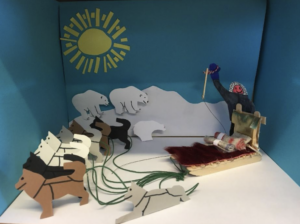
Model made by students from the settlement school in Qassiarsuk after template in Papirklip / Kalaallit Numaat, Qiortakkat by Søren Thaae.
The students’ task is to make a short story about their dog sledge. The story is made up of four pictures taken with the students’ iPads. These pictures will tell a small story about a dog sledge.
Insertion of pictures and sound see instructions 1& 2 here.
The recording will now be represented by a small sound icon. This icon can be placed where you wish on the page. You can listen to the recording over and over again.
Here you may read the book Qimmeq which is about the Greenland sled dog. On the following pages we have selected a small part of this book for our work. We recommend that you read the text together with the class.
If you want to, you may choose further topics in the book and learn even more about the Greenland sled dog.
Read pages 6-9 aloud to the students.
In class you may talk about:
- What makes the sled dog a special dog?
- What do you know about sled dogs from your own life?
Subsequently the student fill out the page with what they know about sled dogs. They can write text or tell in short sound recordings.
Insertion of sound see instruction 1 here.
At this point the students have learned a lot about sled dogs. To round off they will draw or paint their own sled dog.
The students must imagine that they have a sled dog. If they do in fact have a sled dog, this exercise can be adjusted so that they tell about their real sled dog.
When the drawing is finished, it is inserted in the book.
In class you can talk about:
- What the sled dog is called.
- How the relationship to the dog is.
- What to keep in mind when close to a sled dog.
- How a sled dog differs from a family dog.
In class you can talk about:
- How to take care of a sled dog.
- What a sled dog eats.
- Where a sled dog lives.
Insertion of pictures see instruction 2 here.
The students present their visual stories to the class.
Make sure that the framework for feedback is positive criticism. The students should be supported in assessing what is good – and what might be done better.
Not specifically with a view to making new visual stories, but rather to let students discover and work with such constructive and positive criticism.
If you intend to work with some of the other podcasts from the Icefjord Centre, it might make sense to save the students’ Book Creator book and dog sledge so that they may be used again.
If you want the students to make use of the feedback from the class, you could reserve time for further work with the visual stories.
The podcast The Dog Lot has been created for the Icefjord Centre in Ilulissat by Katrine Nyland.
Graphics were produced by Oncotype.
Teaching material for the podcast has been developed by Lotte Brinkmann from Anholt Læringsværksted with feedback from Leg med It.
The student’s book in Book Creator has been developed as part of the project Nutaaliorta from Kivitsisa. The template was designed by Rikke Falkenberg Kofoed and Daniella Manuel, Leg med It.
The teaching material The Dog Log is published under a Creative Commons crediting licens CC:BY.
The Qimmeq project has been developed by Ilisimatusarfik and the University of Copenhagen. The children’s non-fiction book “Qimmeq – kalaallit qimmiat qimuttoq – the Greenland sled dog” was produced by Anne Katrine Gjerløff, Ilisimatusarfik and the Natural History Museum of Denmark.
The texts, assignments and pictures can be shared, reproduced and adapted, with the proviso that “The Dog Lot by the Icefjord Centre Ilulissat” is credited as the source.
The students meet the Icefjord Centre in two pictures, showing respectively summer and winter.
In the classroom you can talk about:
- What the Icefjord Centre is.
- What it looks like around the centre.
- The difference between summer and winter.
- How summer and winter differs where you live.
The students see a map of Greenland. A marker indicates where Ilulissat is located.
In class you can talk about:
- What you see on the map.
- How many people are living in Ilulissat.
- What else you know about Greenland and Ilulissat.
- Do you know the names of other places on the map?
In class you can talk about:
- Where your hometown or settlement is located.
- How many people are living there?
- Do you know the names of other places on the map?
Now it is time for the students to listen to the podcast The Dog Lot. They start the podcast by clicking on the icon in the middle of page 12.
It is recommended that they listen in pairs or small groups.
Let the students spend some minutes talking to the one next to them about what they just heard.
On page 13 the students will make short sound recordings telling about the podcast. The pictures on the page may help them remember what they heard.
Insertion of sound see instruction 1 here
The recording will now be represented by a small sound icon. This icon can be placed where you wish on the page. You can listen to the recording over and over again.
Review in class
It is recommended to have a joint discussion in class when working with pages 12-13 is finished. We suggest that you support this with writing and maybe illustrating concepts and keywords on the blackboard.
In class you could talk about:
- What surprised the students when listening to the podcast.
- Concepts and keywords that the students encountered in the podcast.
You may find inspiration for the conversation below.
Concepts and keywords
- Culture
Culture consists of all the values, habits, traditions, knowledge and attitudes which characterize a society or an individual in their own historical and geographical context. - Hunting and fishing culture
Since the first immigrations at Thule about 4-5.000 years ago Greenland has been dependent on nature’s resources in the form of fish, birds and land and marine mammals. Hunting and fishing are still the most important livelihood for Greenlanders and Greenlandic society. These natural conditions have led to the development of a unique culture, built upon proud traditions.
What do you know about the culture of Greenland?
What other cultures do you know?
- Cornerstone – the dogs are a cornerstone of the Greenlandic hunting and fishing culture
A cornerstone is part of the supporting foundation, an important precondition for or component of something. A house without a foundation tumbles down. Without frost ice becomes water; frost is a precondition for the formation of ice. The dogs transport the catch, fish and people across ice and mountains, where no other means are available. The dogs are the cornerstone of transport.
Why are the dogs a cornerstone in this culture?
Could you be a hunter and fisher without having dogs?
- Lifeblood – in the community/ transportation of catch and humans
The dogs are the lifeblood of the community where they in generation after generation have hauled the catch home to the settlement and transported people between settlements and continents.
Lifeblood is an element that is a critical condition for something being able to function. The dogs are a condition for transporting the catch back to the settlements and towns.
What does it mean that something is the lifeblood of a community?
What is the lifeblood of your everyday life?
- Cycle – the cycle of the game animals follows the seasonal cycle of the ice
A cycle is characterized by something returning more or less regularly, repeating itself.
A calendar day has a known and fixed course. It is divided into day and night. The seasons come and go in a definite order. The ice has a cycle. The movements of the ice are influenced by cold and heat (the cycle of the seasons), which in turn influence the conditions of life for the game animals.
What are the four seasons called?
What is characteristic of each season?
Do you know the cycle of water?
How does the cycle of the ice affect working with dog sledges?
- Tradition – the sled dogs, hunting and fishing
The sled dogs are part of special Greenlandic traditions that granddad Niels would like to pass on to his grandchildren.
What is the difference between a working dog and a family dog?
What is a tradition, and what other traditions do you know?
- Missing – Granddad Niels lives in Ilulissat, and his grandchild William lives in Hjørring. Granddad Niels misses his grandchild and the time when they could seek adventure and go hunting together.
William and his granddad talk together on Messenger. Do you know Messenger?
How do you talk with those you miss, or who are far away?
William misses his dogs, granddad Niels misses William. What might the dogs be missing?
Now the students will make their own reference book using words from the blackboard. Text as well as pictures can be inserted.
Insertion of sound, pictures & text see instructions 1,2 & 3 here
The students may also draw their own pictures and place them on a page as described above.
Now the students will watch films about the sled dog in modern Greenland.
The Natural History Museum of Denmark in five videos zooms in on five people who all have the sled dog as part of their existence and everyday life in modern Greenland. The five films can be found on the home page of the museum.
In the book we have chosen three of the five films. The videos are in Greenlandic with English subtitles.
It may be a good idea to watch the videos together in class and pause when needed to talk about them.
With the videos you find a description of them and a question that may help the students to reflect on what they see in the film.
Here you read the book Qimmeq which is about the Greenland sled dog. On the following pages we have selected a small part of this book for our work.
The topics are:
- The origin of the sled dog, pages 7, 8, 11 and 13
- The life of a sled dog, page 16
- The significance of the sled dog, page 23
We recommend that you read the text together with the class.
If you want to, you may choose further topics in the book and learn even more about the Greenland sled dog.
In class you could talk about:
- Why the sled dog has to be so strong and enduring.
- What makes the sled dog capable of coping with very low temperatures.
- Why it is necessary for the dog to be able to handle those low temperatures.
- The size of the sled dog.
- The difference between sled dogs and family dogs.
- The appearance of the sled dogs
Let the students read or listen to the text.
In class you can talk about:
- Why the sea around Disko no longer freezes to ice.
- What the future will be like for Willams’s dogs and the other dogs in the dog lots.
The students could reread or listen to page 16 in the book Qimmeq.
Here the students can move the boxes around to make them match.
Now the students must answer the question: Where do sled dogs come from?
The students could reread or listen to pages 7, 8, 11 and 13 in the book Qimmeq.
Insertion of pictures & text see instructions 2 & 3 here
The students may also draw their own pictures and place them on a page as described above.
Here the students will answer these questions:
- Which role did sled dogs play through history?
- Which role do they play today?
The students could reread or listen to page 23 in the book Qimmeq.
Insertion of sound, pictures & text see instructions 1,2 & 3 here
The students may also draw their own pictures and place them on a page as described above.
The students now must work with their knowledge about the sled dog.
They will make an interview or an audio story describing the significance of sled dogs for the Greenlandic community.
If the students want to make an interview, they can contact the Icefjord Centre here. They can help finding a sledge driver (“musher”) to interview. Or the students can assume the roles of e.g., a sledge driver and his/her talking dog.
Or they can make their own audio story from the perspective of the dog or a human – which could be William. Their product can contain real dog sounds or just sounds of silence.
Several pages have been placed in the Book Creator book. The students can choose one or more of these or make their own.
The students can work with the sound recorder, images, text and video.
Insertion of sound, pictures & text see instructions 1,2 & 3 here
The recording will now be represented by a small sound icon. This icon can be placed where you wish on the page. You can listen to the recording over and over again.
As conclusion of the process the students will present their work to the rest of the class. Focus will be on the communicative and presentational abilities.
The podcast The Dog Lot has been created for the Icefjord Centre in Ilulissat by Katrine Nyland.
Graphics were produced by Oncotype.
Teaching material for the podcast has been developed by Lotte Brinkmann from Anholt Læringsværksted with feedback from Leg med It.
The student’s book in Book Creator has been developed as part of the project Nutaaliorta from Kivitsisa. The template was designed by Rikke Falkenberg Kofoed and Daniella Manuel, Leg med It.
The teaching material The Dog Log is published under a Creative Commons crediting licens CC:BY.
The Qimmeq project has been developed by Ilisimatusarfik and the University of Copenhagen. The children’s non-fiction book “Qimmeq – kalaallit qimmiat qimuttoq – the Greenland sled dog” was produced by Anne Katrine Gjerløff, Ilisimatusarfik and the Natural History Museum of Denmark.
The texts, assignments and pictures can be shared, reproduced and adapted, with the proviso that “The Dog Lot by the Icefjord Centre Ilulissat” is credited as the source.
The students meet the Icefjord Centre in two pictures, showing respectively summer and winter.
In the classroom you can talk about:
- What the Icefjord Centre is.
- What it looks like around the centre.
- The difference between summer and winter.
- How summer and winter differs where you live.
Talk about the map, how many people are living in Ilulissat, and how many people are living in the town where you live?
The students see part of a world map. The job now is to move the red marker down to the map to show where each student lives. The marker is found in the white box and can be drawn into the map.
In class you can talk about:
- Differences and similarities between Ilulissat and your town or settlement
Now it is time for the students to listen to the podcast The Dog Lot. They start the podcast by clicking on the icon in the middle of page 12.
It is recommended that they listen in pairs or small groups.
Let the students make a Walk and Talk, where they discuss the podcast.
On page 13 the students will tell about the podcast. In the speech bubbles they can choose to insert text, images or sound recordings.
Insertion of sound, pictures & text see instructions 1, 2 & 3 here
Review in class
It is recommended to have a joint discussion in class when working with pages 12-13 is finished. We suggest that you support this with writing and maybe illustrating concepts and keywords on the blackboard.
In class you could talk about:
- What surprised the students when listening to the podcast.
- Concepts and keywords that the students encountered in the podcast.
You may find inspiration for the conversation below.
Concepts and keywords
- Culture
Culture consists of all the values, habits, traditions, knowledge and attitudes which characterize a society or an individual in their own historical and geographical context. - Hunting and fishing culture
Since the first immigrations at Thule about 4-5.000 years ago Greenland has been dependent on nature’s resources in the form of fish, birds and land and marine mammals. Hunting and fishing are still the most important livelihood for Greenlanders and Greenlandic society. These natural conditions have led to the development of a unique culture, built upon proud traditions.
What do you know about the culture of Greenland?
What other cultures are you acquainted with?
- Cornerstone – the dogs are a cornerstone of the Greenlandic hunting and fishing culture
A cornerstone is part of the supporting foundation, an important precondition for or component of something. A house without a foundation tumbles down. Without frost ice becomes water; frost is a precondition for the formation of ice. The dogs transport the catch, fish and people across ice and mountains, where no other means are available. The dogs are the cornerstone of transport.
Why are the dogs a cornerstone in this culture?
Could you be a hunter and fisher without having dogs?
- Lifeblood – in the community/ transportation of catch and humans
The dogs are the lifeblood of the community where they in generation after generation have hauled the catch home to the settlement and transported people between settlements and continents.
Lifeblood is an element that is a critical condition for something being able to function. The dogs are the condition for transporting the catch back to the settlements and towns.
What does it mean that something is the lifeblood of a community?
What is the lifeblood of your everyday life?
- Cycle – the cycle of the game animals follows the seasonal cycle of the ice
A cycle is characterized by something returning more or less regularly, repeating itself.
A calendar day has a known and fixed course. It is divided into day and night. The seasons come and go in a definite order. The ice has a cycle. The movements of the ice are influenced by cold and heat (the cycle of the seasons), which in turn influence the conditions of life for the game animals.
What is characteristic of the four seasons?
What is characteristic of the cycle of water?
How does the cycle of the ice affect working with dog sledges?
Which factors can affect the seasons and thus the cycle of the ice?
- Adaptation – to survive all living beings must adapt to the environment surrounding them
Adaptation implies that when an animal has to live in a certain environment, it needs to adjust to the prevailing conditions of life to survive.
An animal may adapt to its environment in several ways. Through natural selection the animal will adjust its anatomy and behaviour to suit changing conditions of life.
An example of natural selection is the gradual development of fur suited for extreme weather as has been the case with the Greenland sled dog. Dogs that have not developed a fur to protect them, will die. In this way the genetic advantages will be passed on to the offspring of the animal, and the fittest will survive. See further Qimmeq p. 13
How, do you imagine, did the Greenland sled dog adapt to a life in Greenland?
How did we humans adapt to the life we have now?
Do you know other examples of animals adjusting to their environment?
- Energy – an animal needs nourishment in the form of carbohydrates, lipids and protein to survive.
Living organisms are divided into two groups, autotrophic and heterotrophic Autotrophs can produce nourishment in the form of carbohydrates; plants do this by making glucose through photosynthesis. Heterotrophs get nourishment by eating other living organisms and so obtaining lipids, carbohydrates as well as protein.
Lipids, carbohydrates and protein, also known as nutrients, are used to maintain a variety of processes in our cells that keep us alive.
We use these nutrients as a source of energy in our combustion (respiration) and as building blocks in the cells of the body. See further here: See further Qimmeq p. 42
What do you know about the food pyramid?
Do we need more lipids, carbohydrates or protein?
Do you think that dogs and human need the same proportions of these nutrients?
Now the students will make a reference book with their knowledge from their work with the podcast.
Assist the students by writing technical concepts from the discussion on the blackboard. The students may work with audio, images and text.
Insertion of sound, pictures & text see instructions 1, 2 & 3 here
The students may also draw their own pictures and place them on a page as described above.
The reference work may be revisited any time during the programme.
Now the students will watch films about the sled dog in modern Greenland.
The Natural History Museum of Denmark in five videos zooms in on five people who all have the sled dog as part of their existence and everyday life in modern Greenland. The five films can be found on the home page of the museum.
In the book we have chosen three of the five films. The videos are in Greenlandic with English subtitles.
It may be a good idea to watch the videos together in class and pause when needed to talk about them.
With the videos you find a description of them and a question that may help the students to reflect on what they see in the film.
Now the students must apply their knowledge of sled dogs in the production of a podcast.
You are going to assist The Icefjord Centre in producing a new podcast about The Greenland Sled Dog. In this podcast the students will describe and explain the sled dogs’
- importance for life around the Icefjord
- biology
- origin
- function as a working dog
The podcast will be inserted on page 24-25. The students may add images/models or other elements.
Suggestions for other activities
- Let the students arrange a lecture about the Greenland sled dog. This could be for other classes, parents, the local centre for elderly or others
- Let the students publish their podcast on a real podcast service
The podcast The Dog Lot has been created for the Icefjord Centre in Ilulissat by Katrine Nyland.
Graphics were produced by Oncotype.
Teaching material for the podcast has been developed by Lotte Brinkmann from Anholt Læringsværksted with feedback from Leg med It.
The student’s book in Book Creator has been developed as part of the project Nutaaliorta from Kivitsisa. The template was designed by Rikke Falkenberg Kofoed and Daniella Manuel, Leg med It.
The teaching material The Dog Log is published under a Creative Commons crediting licens CC:BY.
The Qimmeq project has been developed by Ilisimatusarfik and the University of Copenhagen. The children’s non-fiction book “Qimmeq – kalaallit qimmiat qimuttoq – the Greenland sled dog” was produced by Anne Katrine Gjerløff, Ilisimatusarfik and the Natural History Museum of Denmark.
The texts, assignments and pictures can be shared, reproduced and adapted, with the proviso that “The Dog Lot by the Icefjord Centre Ilulissat” is credited as the source.
The students meet the Icefjord Centre in four pictures: summer and winter, the Kangia glacier front and the framework of the building. On page 6-7 there is a text and three videos showing the erection of the Icefjord Centre.
In class you can talk about:
- What the Icefjord Centre is.
- What the purpose of an institution like the Icefjord Centre is.
- What it looks like around the centre.
- The difference between summer and winter, where you live as well as in Greenland.
The students should clarify what they already know about Greenland before starting work on the podcast. In this podcast focus is on sled dogs but you may have worked with some of the other podcasts or in other ways acquired knowledge that can be activated in advance.
On page 8 there is a link to Google Maps. Here the students can try to locate the Icefjord Centre on the map.
You can also experiment with letting them find the places mentioned in the podcast, so that they get an idea of where they are situated. These are the places:
- Ilulissat
- The Icefjord
- Northern Greenland
- Hjørring
Furthermore, on page 8 there are four questions to help the students get going. Here are suggestions for a few more:
- How many people live in Greenland?
- What are sled dogs used for?
- How big an area does the inland ice cover?
Page 9 is intended for answers. The students are free to use whatever form of expression they prefer. Some possibilities in Book Creator:
- make a model/a drawing by hand, take a picture of it and insert
- find pictures in Book Creator about Greenland and insert them. The pictures can be complemented with explanations in words.
- record an audio file telling what you know about Greenland
- – or a combination of the above
On page 10-11 you find a map of Greenland, with six red markers. Let the students place the markers where they know towns or settlements in Greenland. They can write the name of the town or settlement in the field next to the marker.
Sound recording, insertion of pictures and text: see instructions 1, 2 and 3 here.
Now it is time for the students to listen to the podcast The Dog Lot. On page 12 an introduction to the podcast is given followed by a short instruction. Clicking the picture on page 13 will start the podcast.
It is recommended that the students listen in pairs or small groups. After listening to the podcast, the students could spend some minutes talking about what they just heard.
On page 14-15 the students are to make a summary of what they heard in the podcast. They may do this in various ways:
- write a text
- record an audio file
- make a model/drawing
- something completely different that they are used to with note taking methods and summaries
- – or a combination of the above
Sound recording, insertion of pictures and text: see instructions 1, 2 and 3 here.
Now it is time for a joint review in class where the students’ work on pages 14 and 15 is discussed. The aim is to prepare the students for making their own reference books that they can revisit during work with the podcast. In this reference book the students should explain the meaning of the concepts and keywords from your discussion – by means of text, sound, pictures, drawings or a combination of these.
You could begin by asking the students to name the concepts and keywords they heard in the podcast. Then you can add those mentioned below, central to the podcast and important for further work.
- Culture – consists of the sum of values, habits, traditions, knowledge and attitudes which characterize a society or an individual in their own historical and geographical context.
In the podcast the students are introduced to a hunting and fishing culture. Since the first immigrations at Thule about 4-5.000 years ago Greenland has been dependent on nature’s resources in the form of land and marine mammals, birds and fish. Hunting and fishing are still the most important livelihood for Inuit and Greenlandic society. These natural conditions have led to the development of a unique culture, built upon proud traditions.
What do you know about the culture of Greenland?
What other cultures are you acquainted with?
- Cornerstone – a cornerstone is part of the supporting foundation, an important precondition for or component of something. The dogs are a cornerstone of the Greenlandic hunting and fishing culture. The dogs transport the catch, fish and people across ice and mountains, where no other means are available. The dogs are a cornerstone of transport.
Why are the dogs a cornerstone in this culture?
Could you be a hunter and fisher without having dogs?
- Lifeblood – is an element that is a critical condition for something being able to function. The dogs are the lifeblood of the community where they in generation after generation have hauled the catch home to the settlement and transported people between settlements and continents: the dogs are the condition for getting the catch back home. And they are vital for transporting people between settlements and continents.
What does it mean that something is the lifeblood of a community?
What is the lifeblood of your everyday life?
- Cycle – a cycle is characterized by something returning more or less regularly, repeating itself. A calendar day has a known and fixed course. It is divided into day and night. The seasons come and go in a certain order. The ice has a cycle. The movements of the ice are influenced by cold and heat (the cycle of the seasons), which in turn influence the conditions of life for the game animals. The cycle of the game animals follows the seasonal cycle of the ice.
How does the cycle of the ice affect working with dog sledges?
Which factors can affect the seasons and thus the cycle of the ice?
- Adaptation – to survive all living beings must adapt to the environment surrounding them. When an animal has to live in a certain environment, it needs to adjust to the given conditions of life to survive.
An animal may adapt to its environment in several ways. Through natural selection the animal will develop its anatomy and behaviour to become optimal for the prevailing conditions of life.
An example of natural selection is the gradual development of fur suited for extreme weather as has been the case with the Greenland sled dog. Dogs that have not developed a fur able to protect them, will die. In this way the genetic advantages will be passed on to the offspring of the animal, and only the fittest will survive. See further Qimmeq, The Greenland Sled Dog, p. 13.
How, do you imagine, did the Greenland sled dog adapt to a life in Greenland?
How did we humans adapt to the life we have now?
Do you know other examples of animals adjusting to their environment?
- Energy – an animal needs nourishment in the form of carbohydrates, lipids and protein to survive.
Living organisms are divided into two groups, autotrophic and heterotrophic. Autotrophs are able to produce nourishment in the form of carbohydrates; plants do this by making glucose through photosynthesis. Heterotrophs get nourishment by eating other living organisms, thus obtaining lipids, carbohydrates as well as protein.
Lipids, carbohydrates and protein, also known as nutrients, are used to maintain a variety of processes in our cells, keeping us alive.
We use these nutrients as a source of energy in our combustion (respiration) and as building blocks in the cells of the body. See further Qimmeq, The Greenland Sled Dog, p. 42.
What do you know about the food pyramid?
What do we need most of: lipids, carbohydrates or protein?
Do dogs and humans need the same proportions of these nutrients?
Sound recording, insertion of pictures and text: see instructions 1, 2 and 3 here.
Now the students will watch three films about the sled dog in modern Greenland. The videos on page 18-23 are borrowed from the research project QIMMEQ; they zoom in on people who all have the sled dog as part of their everyday life. Two more videos can be found at the home page of the project. They are in Greenlandic language with English subtitles.
The pages contain a short description of the videos and some questions to help the students reflect on what they see.
After the students have seen the videos and reflected on the questions it is time for a joint review in class.
To finish work with the videos, time should be allocated so that the students can update their reference books on page 16-17 with new knowledge.
Now the students must imagine that they are employed at the Icefjord Centre and have been given the task to create a new exhibition informing about the Greenland sled dog. They must deal with its biology and origin, while the rest is their choice.
On page 24 you find a link to Qimmeq, the above mentioned book about the Greenland sled dog, where the students can gather information.
The students choose which form and which medium they will use for the production and communication of their product. The sole requirement is that it should be suitable for forming part of an exhibition at the Icefjord Centre. Examples could be: a podcast/audio story, a video, a photo report, an animated movie. Only the imagination of the students sets limits.
Organize the students in pairs or small groups. Depending on what suits each student best and the competences to be developed.
During work with the exhibition the teacher should allocate some time to let the students give each other positive criticism. This consists in assessing: what is good – and what might be done better. The teacher will support and guide this process. In Austin’s Butterfly you can find inspiration for constructive and positive criticism; the video is about students at the youngest level, but its points may be transposed to all levels.
When work is finished, the students will present their products in a joint “exhibition at the Icefjord Centre”. This may be in digital form or arranged as a kind of exhibition preview. If the exhibition is presented physically at the school, it could be open to anyone that might be a target group.
Make a video of the exhibition so that students in Greenland and around the world may learn something about the Greenland sled dog.
Review in class the collected knowledge about Greenland. Update the reference books with new concepts.
The creations of the students are saved so that they may continue working on them with the next podcasts.
The podcast The Dog Lot was made for the Icefjord Centre in Ilulissat by Katrine Nyland.
Graphics by Oncotype.
Teaching material for the podcast has been produced by Lotte Brinkmann and Daniella Maria Manuel, Anholt Læringsværksted.
The teaching material The Dog Lot is published under a Creative Commons crediting licence CC:BY. The texts, assignments and pictures can be shared, reproduced and adapted, with the proviso that “The Dog Lot by the Icefjord Centre Ilulissat” is credited as the source.
The children’s non-fiction book “Qimmeq – kalaallit qimmiat qimuttoq – the Greenland sled dog” was produced by Anne Katrine Gjerløff, Ilisimatusarfik and the Natural History Museum of Denmark.
Partners


