
THE TOWN OF THE GREENLAND HALIBUT
BOOK CREATOR AS A TEACHING TOOL
The Book Creator book The Town of the Greenland Halibut is a student’s book associated with the podcast The Town of the Greenland Halibut. The duration of the podcast is 4:23. The activities have been designed to focus on the students’ investigative, experimental and creative approach to learning. The process consists of three steps: Preparation before listening to the podcast. Listening to and working with the podcast. Further work with topics and insights from the podcast. We recommend that you listen to the podcast before presenting it to the students.
We recommend that students work in pairs or individually. Depending on what suits each student best and the competences to be developed. Keep in mind that your best friend is not necessarily the one you collaborate best with. Working together is about working together and not just being together.
- The students acquire fundamental knowledge about the Greenland halibut and its importance for Ilulissat and the settlements around the fjords, in the past and today.
- The students acquire special knowledge about the Inuit culture from the Stone Age till the vibrant life of Ilulissat today.
- The students practise their skills in communication and cooperation.
The students meet the Icefjord Centre in two pictures, showing summer and winter respectively.
In class you can talk about:
- What the Icefjord Centre is. For example, it is a centre for dissemination of information and the permanent exhibition is The Story of
- What the surroundings around the Centre look like.
- The difference between summer and winter.
- How summer and winter differ where you live.
Have a look at the map and talk about where Ilulissat is situated. Talk about how many people live in Ilulissat. Also about how many people live in the town or settlement where you live.
The students see part of a world map.
The task now is to move the red marker down into the map in order to show where each student lives. The marker is found in the white box and can be drawn into the map.
In class you can talk about:
- Differences and similarities between Ilulissat and your own town or settlement.
In the book the students see a map over the sea and the fjords around Ilulissat. They read the text:
The sea and the fjords function as a main road.
In winter you drive with sled dogs on the ice.
In summer you sail with boats.
Most of the time, the halibut is the reason for all of this activity.
On the map there is marked a route between the two settlements Eqi and Sermermiut. The students draw a line between the two red marks. The distance between the two settlements is approximately 10 km. The students make use of the pencil tool in Book Creator.
Drawing with the pencil tool: see instruction 4 here.
In class you can talk about:
- That the two settlements are placed on either side of the mouth of the Icefjord and the “main road” goes straight across the fjord.
- How people in the old days visited each other by crossing the ice by foot.
- That the mouth of the Icefjord no longer freezes into ice in the winter and therefore you have to cross by boat.
Now it is time for the students to listen to the podcast The Town of the Greenland Halibut. They find the podcast by clicking on the picture on page 14.
Before the students listen to the podcast, you can give a short introduction to the contents of the podcast.
The contents of the podcast
- The story starts with the sound of water and the distant buzzing of a motorboat.
- Katrine Nyland tells about
- that you can hear the distant sound of motorboats on their way out fishing or going somewhere else both night and day.
- that it is especially the halibut that makes Ilulissat a thriving fishing town that never sleeps.
- that the first Stone Age peoples settled by the Icefjord 4400 years ago and that hunting and fishing has always been the basis of life.
- the missionary Poul Egede, who in his diary in 1737 wrote about how proud the inhabitants of Sermermiut (at that time the largest settlement in Greenland) were of their settlement and their good catch; that they could thank their shaman for this.
- the legend about the shaman that fell on his bum and, when he got up again, said: you must make a hole in the ice here and fish.
- that because of the nutritious melting water from the glacier, the halibut are larger and have firmer meat than those caught in other places
- Palle, the mayor of Ilulissat, tells about
- meeting another Greenlander in New York who said: ”There are only two places in the world where the city never sleeps. New York and Ilulissat.”
- the Poul Egede quotation
- Here I found the largest group of people I have ever seen anywhere in Greenland, about 20 quite big houses, like a small village. They bragged about this and asked whether I had ever seen so many people in one place anywhere else in Greenland. I immediately sensed, from the way they talked and from their behaviour, that they were proud of being so many and of the good catch they were making.
- Lisa tells about
- once when she at the “Brædtet” in Nuuk asked a fisherman what kind of small fish he was selling and whether you could eat them. To think that capelan could be so small in Southern Greenland.
It is recommended that the students listen in pairs or small groups.
Let the students spend a few minutes discussing what they have heard in the podcast.
On page 15 the students are to record small audio files where they tell about the podcast. The pictures on the page will help them remember what they have heard.
The recording will now be represented by a small sound icon. This icon can be placed wherever you wish on the page. You can listen to the recording over and over again.
Review in class
We recommend that you have a joint discussion in class when the work with pages 14-15 is finished.
While doing this, it would be a good idea to support the discussion by writing concepts and keywords on the board.
In class you could talk about:
- Why is Ilulissat called the town of the Greenland halibut?
- For how many thousands of years have people lived by the Icefjord?
- What is a shaman?
- Who was Poul Egede and why did he travel around in Greenland?
In the text below you can find inspiration for the class discussion.
For some of the concepts there are pages with tasks in the Book Creator book.
If you wish, you can add more pages for other topics, concepts and keywords that you discuss.
Concepts and keywords
- The halibut – is an arctic fish from the North Atlantic. It has a big mouth and quite large teeth. Its maximum size and weight are 120-130 cm and 45-50 kg.
The halibut does not just live at the bottom of the ocean like other flatfish. It lives in the depths of 200 to 2000 metres in the arctic oceans.
The halibut spawns from May till August in depths of about 700 to 2000 metres. When it is 9 to 10 years old it starts spawning. When the young fish are about 20 cm long, they become coloured on their underside and are ready to move towards deeper water.
The halibut eats fish, for example small codfish and shrimps.
The halibut is a flatfish. Are there other flatfish?
- Stone Age – The first people in Greenland belonged to the Saqqaq and Independence cultures, who came to the country about 4500 years ago. While the Saqqaq people mainly lived from fishing, the musk ox was the most important hunting animal for the Independence people.
- It was the Saqqaq people who in the arctic area invented the blubber lamp 1900 years bce in Western Greenland and during the following centuries the invention spread from Greenland to the rest of the Arctic.
- Humans cannot hibernate and they cannot manage an Arctic winter in darkness. Therefore it was a vital prerequisite for survival that people in the Arctic could supply themselves with light and heat. Even the first people in the Arctic knew how to heat with blubber, but they did not know about the portable blubber lamps. They had open fireplaces in their dwellings where they used driftwood and blubber as fuel, or placed a big stone hollowed in the surface as a stationary blubber lamp in the middle of their dwelling.
From where did they get the blubber?
Humans can not hibernate; who can?
- The shaman (click on the Danish flag and choose the English flag) – also called Angakok, had to go through many years of training. The teacher was normally an older, skilled shaman. To become a shaman you would need special gifts. You had to be able to get in contact with different spirits and with the souls of the dead when you made spiritual incantations, when you conjured the spirits up.
- Conjure – using magic to call upon a spirit
- Find more knowledge here (click on the Danish flag and choose the English flag)
Are there still shamans in Greenland today?
- Missionary – A missionary works to propagate a religion by converting people who are not part of the missionary’s religious group. You see missionaries in connection with the missionizing religions that have as an ideal that their followers should recruit others to become followers.
Poul Egede was a Christian missionary. Which settlement did he visit in 1737?
- “Brædtet” – is a place where hunters and fishermen can sell their catch. Everyone is allowed to buy Greenlandic raw materials at “Brædtet”.
What other “raw materials” can you buy at “Brædtet”?
- New York – the city that never sleeps. It is the largest city in the USA and it has more than 8 million citizens. In Ilulissat a little less than 5 thousand people live; but the two cities have one thing in common: they both work around the clock.
When you say about New York that the city never sleeps, does that mean that the people living there never sleep?
On page 16 the students read the text about the shaman from Sermermiut who fell on his bum.
Many years ago, when the people of Sermermiut went to visit the inhabitants of Eqi, their shaman fell on his bum.
When he got up again, he said, “You must cut a hole here and fish!” They then made a fishing rod of whalebard and a hook of seal, cut a hole in the ice and caught a huge halibut.
The students now make a model of the shaman falling on his bum, when he together with the Sermermiut inhabitants is on his way over the ice to visit Eqi.


Pictures: “Grønland, papirklip” by Søren Thaaes, published by Milik Publishing
Find the template here.
When the model is finished you take a picture and insert it in the book on page 17.
On page 18 the students read the text.
Here I found the largest group of people I have ever seen anywhere in Greenland, about 20 quite big houses, like a small village. They bragged about this and asked whether I had ever seen so many people in one place anywhere else in Greenland. I immediately sensed, from the way they talked and from their behaviour, that they were proud of being so many and of the good catch they were making.
On page 19 the students write their own diary. They are to imagine that they live in Sermermiut and that Poul Egede visits them one day in 1737. They could for example tell about:
- What clothes did he wear?
- What clothes did they wear themselves?
- What did they get to eat?
- What language did he speak?
On page 20 the students see a picture of a halibut and find a facts box.
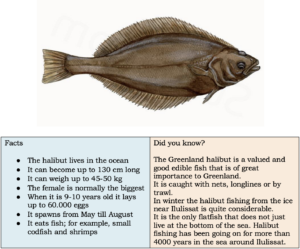
On page 21 the students record answers to the questions in the speech bubbles. In the empty bubbles they can add their own questions.
- When does the female lay her eggs?
- Is the male bigger than the female?
- How old is the female before she spawns?
- What does the halibut eat?
- How do you catch halibut?
On these pages the students write sentences or small stories using the keywords and concepts that you have been through. They can write them, record them as an audio file or make a drawing and insert the picture. Their products will be used in the further work with the podcast.
As a conclusion of the work with the podcast, the students now create a gallery of pictures. The gallery must consist of 6 selected pictures that for the students describe what they have worked with in the podcast. The students search for pictures and insert them in the frames. Hereafter the students record small audio files, where they tell about why they have selected these particular pictures.
The students show their products to the class.
Make sure that the framework for feedback is positive criticism.The students should be supported in assessing what is good – and what might be done better. Find more inspiration here.
Not specifically with a view to making new products, but foremost to let the students discover and work with this kind of constructive and positive criticism.
If you intend to work with some of the other podcasts from the Icefjord Centre, it might make sense to save the students’ Book Creator book, so the work they have done with it can be used again.
If you wish to let the students make use of the feedback they have received from the class, you could reserve time for them to continue their work with their products. So that they can use the feedback they have received from each other to change things in their product.
The podcast The Town of the Greenland Halibut has been created by the Icefjord Centre in Ilulissat.
The teaching material for the podcast The Town of the Greenland Halibut has been developed by Lotte Brinkmann and Daniella Maria Manuel, Anholt Læringsværksted with feedback from Leg med IT.
The student’s book in Book Creator has been developed by Rikke Falkenberg Kofoed from Leg med IT.
The teaching material The Town of the Greenland Halibut is published under a Creative Commons crediting licence CC:BY.
The texts, assignments and pictures can be shared, reproduced and adapted, with the proviso that “The Town of the Greenland Halibut by The Icefjord Centre Ilulissat” is credited as the source.
The students meet the Icefjord Centre in two pictures, showing summer and winter respectively.
In class you can talk about:
- What the Icefjord Centre is. For example, it is a centre for dissemination of information and the permanent exhibition is The Story of Ice.
- What the surroundings around the Centre look like.
- The difference between summer and winter.
- How summer and winter differ where you live.
Talk about the map:
- How many people live in Ilulissat and how many people live in the town or settlement where you live?
Which other towns and settlements do you know in Greenland?
Place a red marker and write the name of the town/settlement.
The students see part of a world map.
The task now is to move the red marker down into the map in order to show where each student lives.
The marker is found in the white box and can be drawn into the map.
In class you can talk about:
- Differences and similarities between Ilulissat and your own town or settlement.
In the book the students see a map over the sea and the fjords around Ilulissat. They read the text:
The sea and the fjords function as a main road.
In winter you drive with sled dogs on the ice.
In summer you sail with boats.
Most of the time, the halibut is the reason for all of this activity.
On the map on page 15 the two settlements are marked. The distance between the two settlements is approximately 10 km.
In class you can talk about:
- That the two settlements are placed on either side of the mouth of the Icefjord. In the old days, the inhabitants in the settlements could in wintertime cross the ice by foot if they wished to visit each other.
- That the mouth of the Icefjord no longer freezes into ice in the winter and therefore you have to cross by boat both summer and winter.
- How long it took to cross the ice by foot.
Now it is time for the students to listen to the podcast The Town of the Greenland Halibut. They find the podcast by clicking on the picture on page 16.
Before the students listen to the podcast, you can give a short introduction to the contents of the podcast.
The contents of the podcast
- The story starts with the sound of water and the distant buzzing of a motorboat.
- Katrine Nyland tells about
- that you can hear the distant sound of motorboats on their way out fishing or going somewhere else both night and day.
- that it is especially the halibut that makes Ilulissat a thriving fishing town that never sleeps.
- that the first Stone Age peoples settled by the Icefjord 4400 years ago and that hunting and fishing has always been the basis of life.
- the missionary Poul Egede, who in his diary in 1737 wrote about how proud the inhabitants of Sermermiut (at that time the largest settlement in Greenland) were of their settlement and their good catch; that they could thank their shaman for this.
- the legend about the shaman that fell on his bum, and when he got up again said: you must make a hole in the ice here and fish.
- that because of the nutritious melting water from the glacier, the halibut are larger and have firmer meat than those caught in other places
- Palle, the mayor of Ilulissat, tells about
- meeting another Greenlander in New York who said: ”There are only two places in the world where the city never sleeps. New York and Ilulissat.”
- the Poul Egede quotation
- Here I found the largest group of people I have ever seen anywhere in Greenland, about 20 quite big houses, like a small village. They bragged about this and asked whether I had ever seen so many people in one place anywhere else in Greenland. I immediately sensed, from the way they talked and from their behaviour, that they were proud of being so many and of the good catch they were making.
- Lisa tells about
- once when she at the “Brædtet” in Nuuk asked a fisherman what kind of small fish he was selling and whether you could eat them. To think that capelan could be so small in Southern Greenland.
It is recommended that the students listen in pairs or small groups.
Let the students spend a few minutes discussing what they have heard in the podcast.
On page 17 the students are to make small audio files where they tell about the podcast. The pictures on the page will help them remember what they have heard.
Sound recording see instruction 1 here.
The recording will now be represented by a small sound icon. This icon can be placed wherever you wish on the page. You can listen to the recording over and over again.
Review in class
We recommend that you have a joint discussion in class when the work with pages 16-17 is finished.
While doing this, it would be a good idea to support the discussion by writing concepts and keywords on the board.
In class you could talk about:
- Why is Ilulissat called the town of the Greenland halibut?
- For how many thousands of years have people lived by the Icefjord?
- What is a shaman?
- Who was Poul Egede and why did he travel around in Greenland?
In the text below you can find inspiration for the class discussion.
For some of the concepts there are pages with tasks in the Book Creator book.
You can add more pages for other topics, concepts and keywords that you discuss.
Concepts and keywords
- The halibut – is an arctic fish from the North Atlantic. It has a big mouth and quite large teeth. Its maximum size and weight are 120-130 cm and 45-50
The halibut does not just live at the bottom of the ocean like other flatfish. It lives in the depths of 200 to 2000 metres in the arctic oceans.
The halibut spawns from May till August in depths of about 700 to 2000 metres. When it is 9 to 10 years old it starts spawning. When the young fish are about 20 cm long, they become coloured on their underside and are ready to move towards deeper water.
The halibut eats fish, for example small codfish and shrimps.
How does the halibut differ from other flatfish?
- Stone Age – The først people in Greenland belonged to the Saqqaq and Independence cultures, who came to the country about 4500 years ago. While the Saqqaq people mainly lived from fishing, the musk ox was the most important hunting animal for the Independence people.
It was the Saqqaq people who in the arctic area invented the blubber lamp 1900 years bce in Western Greenland and during the following centuries the invention spread from Greenland to the rest of the Arctic.
Humans cannot hibernate and they cannot manage an Arctic winter in darkness. Therefore it was a vital prerequisite for survival that people in the Arctic could supply themselves with light and heat. Even the first people in the Arctic knew how to heat with blubber, but they did not know about the portable blubber lamps. They had open fireplaces in their dwellings where they used driftwood and blubber as fuel, or placed a big stone hollowed in the surface as a stationary blubber lamp in the middle of their dwelling.
Why is it dark in the winter in the Arctic?
Which other natural sources of light are there in the winter darkness of the Arctic?
- The shaman (click on the Danish flag and choose the English flag) – also called Angakok, was a very powerful person in Greenlandic society because he was the one to interpret the will of the higher powers. The shaman had to go through many years of training. The teacher was normally an older, skilled shaman.
To become a shaman you would need special gifts. You had to be able to get in contact with different spirits and with the souls of the dead when you made spiritual incantations, when you conjured the spirits up. Find more knowledge here (click on the Danish flag and choose the English flag)
Are there still shamans in Greenland today?
- Missionary – A missionary works to propagate a religion by converting people who are not part of the missionary’s religious group. You see missionaries in connection with the missionizing religions that have as an ideal that their followers should recruit others to become followers.
Christianity is a missionizing religion. Do you know of other religions that are also missionizing?
- “Brædtet” – is a place where hunters and fishermen can sell their catch. Everyone is allowed to buy Greenlandic raw materials at “Brædtet”.
What does “raw materials” mean?
- New York – the city that never sleeps. It is the largest city in the USA and it has more than 8 million citizens. In Ilulissat a little less than 5 thousand people live; but the two cities have one thing in common: they both work around the clock.
How do the two cities, New York and Ilulissat, differ?
On page 18 the students read the text about the shaman from Sermermiut who fell on his bum.
Many years ago, when the people of Sermermiut went to visit the inhabitants of Eqi, their shaman fell on his bum.
When he got up again, he said, “You must cut a hole here and fish!” They then made a fishing rod of whalebard and a hook of seal, cut a hole in the ice and caught a huge halibut.
The students now make a small role play where they show how the shaman fell on his bum, when he, together with the Sermermiut inhabitants, was on his way over the ice to visit Eqi. You film the role play with the camera and insert it into the book on page 19.
On page 20 the students read the text.
Here I found the largest group of people I have ever seen any place in Greenland, about 20 quite big houses, like a small village. They bragged about this and asked whether I had ever seen so many people in one place anywhere else in Greenland. I immediately sensed, from the way they talked and from their behaviour, that they were proud of being so many and of the good catch they were making.

On page 21 the students write their own diary. They are to imagine that they live in Sermermiut and that Poul Egede visits them one day in 1737. They could for example tell about:
-
- What did they talk about?
- What did they get to eat?
- Do they believe in the shaman?
- Do they believe in Jesus?
På side 22 kan eleverne læse om hellefisken og se et billede af en hellefisk.
På side 23 finder eleverne en faktaboks med flere informationer om hellefisken.
On page 23 the students draw a picture of a halibut and insert it in the book.
On page 24 the students are to search for pictures of:
- a plaice
- a sole
- a halibut
The pictures are inserted into the three empty frames.
For each picture the students record an audio file where they tell a little about the fish and where you can catch it.
Let the students find pictures of more flatfish and perhaps tell more about them if they wish to do so.
On these pages the students write sentences or small stories using the keywords and concepts that you have been through. They can write them, record them as an audio file or make a drawing and insert the picture. Their products will be used in the further work with the podcast.
As a conclusion, the students now create a visual story where they make use of the knowledge they have acquired in their work with the podcast. They can choose to draw their story, search for pictures or mix the two. Maybe they have other ideas themselves.
The students show their products to the class.
Make sure that the framework for feedback is positive criticism.The students should be supported in assessing what is good – and what might be done better. Find more inspiration here.
Not specifically with a view to making new products, but foremost to let the students discover and work with this kind of constructive and positive criticism.
If you intend to work with some of the other podcasts from the Icefjord Centre, it might make sense to save the students’ Book Creator book, so the work they have done with it can be used again.
If you wish to let the students make use of the feedback they have received from the class, you could reserve time for them to continue their work with their products. So that they can use the feedback they have received from each other to change things in their product.
The podcast The Town of the Greenland Halibut has been created by the Icefjord Centre in Ilulissat. The teaching material for the podcast The Town of the Greenland Halibut has been developed by Lotte Brinkmann and Daniella Maria Manuel, Anholt Læringsværksted with feedback from Leg med IT.
The student’s book in Book Creator has been developed by Rikke Falkenberg Kofoed and Daniella Maria Manuel, Leg med IT.
The teaching material The Town of the Greenland Halibut is published under a Creative Commons crediting licence CC:BY.
The texts, assignments and pictures can be shared, reproduced and adapted, with the proviso that “The Town of the Greenland Halibut by The Icefjord Centre Ilulissat” is credited as the source.
The students meet the Icefjord Centre in two pictures, showing summer and winter respectively.
In class you can talk about:
- What the Icefjord Centre is.
- What the surroundings around the Centre look like.
- The difference between summer and winter.
- How summer and winter differ where you live.
Talk about the map and about how many people live in Ilulissat. And about how many people live in the town or settlement where you live.
The students see part of a world map.
The task now is to move the red marker down into the map in order to show where each student lives.
The marker is found in the white box and can be drawn into the map.
In class you can talk about:
- Differences and similarities between Ilulissat and your own town or settlement.
The students are to investigate the different immigrations that went on in Greenland during the Stone Age. They can search for knowledge on this website from visitgreenland.com.
Afterwards they answer the questions in the black speech balloons on page 13. They insert their answers as audio files.
Sound recording see instruction 1here.
Now it is time for the students to listen to the podcast The Town of the Greenland Halibut. They find the podcast by clicking on the picture on page 14.
Before listening to the podcast, you can give a short introduction to the contents of the podcast.
- The story starts with the sound of water and the distant buzzing of a motorboat.
- Katrine Nyland tells about
- that you can hear the distant sound of motorboats on their way out fishing or going somewhere else both day and night.
- that it is especially the halibut that makes Ilulissat a thriving fishing town that never sleeps.
- that the first Stone Age peoples settled by the Icefjord 4400 years ago and that hunting and fishing has always been the basis of life.
- the missionary Poul Egede, who in his diary in 1737 wrote about how proud the inhabitants of Sermermiut (at that time the largest settlement in Greenland) were of their settlement and their good catch; that they could thank their shaman for this.
- the legend about the shaman that fell on his bum, and when he got up again said: you must make a hole in the ice here and fish.
- that because of the nutritious melting water from the glacier, the halibut are larger and have firmer meat than those caught in other places
- Palle, the mayor of Ilulissat, tells about
- meeting another Greenlander in New York who said: ”There are only two places in the world where the city never sleeps. New York and Ilulissat.”
- the Poul Egede quotation
- Here I found the largest group of people I have ever seen anywhere in Greenland, about 20 quite big houses, like a small village. They bragged about this and asked whether I had ever seen so many people in one place anywhere else in Greenland. I immediately sensed, from the way they talked and from their behaviour, that they were proud of being so many and of the good catch they were making.
- Lisa tells about
- once when she at the “Brædtet” in Nuuk asked a fisherman what kind of small fish he was selling and whether you could eat them. To think that capelan could be so small in Southern Greenland.
It is recommended that the students listen in pairs or small groups.
Let the students spend a few minutes discussing what they have heard in the podcast.
On page 15 the students are to record small audio files where they tell about the podcast. The pictures on the page will help them remember what they have heard.
The recording will now be represented by a small sound icon. This icon can be placed wherever you wish on the page. You can listen to the recording over and over again.
Review in class
We recommend that you have a joint discussion in class when the work with pages 14-15 is finished.
While doing this, it would be a good idea to support the discussion by writing concepts and keywords on the board.
In class you could talk about:
- Why is Ilulissat called the town of the Greenland halibut?
- For how many thousands of years have people lived by the Icefjord?
- What is a shaman?
- Who was Poul Egede and why did he travel around in Greenland?
In the text below you can find inspiration for the class discussion.
For some of the concepts there are pages with tasks in the Book Creator book.
You can add more pages for other topics, concepts and keywords that you discuss.
Concepts and keywords
- The Shaman– also called Angakok, was a very powerful person in Greenlandic society because he was the one to interpret the will of the higher powers. The shaman had to go through many years of training. The teacher was normally an older, skilled shaman.
To become a shaman you would need special gifts. You had to be able to get in contact with different spirits and with the souls of the dead when you made spiritual incantations, when you conjured the spirits up. Find more knowledge here
Are there still shamans in Greenland today?
- Wildlife by the Icefjord – the wildlife of the Icefjord is different from the wildlife of Southern Greenland. This is because the icebergs from the glacier create turbulence that brings the nutrients up into the light for the benefit of the wildlife. All animals need nutrition to live and grow and by the Icefjord there is plenty of nutrition.
How can you know the difference between fish from Southern and Northern Greenland?
- The halibut – is an arctic fish from the North Atlantic. It has a big mouth and quite large teeth. Its maximum size and weight are 120-130 cm and 45-50 kg.
The halibut does not just live at the bottom of the ocean like other flatfish. It lives in the depths of 200 to 2000 metres in the arctic oceans.
The halibut spawns from May till August in depths of about 700 to 2000 metres. When it is 9 to 10 years old it starts spawning. When the young fish are about 20 cm long, they become coloured on their underside and are ready to move towards deeper water.
The halibut eats fish, for example small codfish and shrimps.
How does the halibut differ from other flatfish?
- Missionary – A missionary works to propagate a religion by converting people who are not part of the missionary’s own religious group. You see missionaries in connection with the missionizing religions that have as an ideal that their followers should recruit others to become followers. Poul Egede was a missionary.
Christianity is a missionizing religion. Do you know of other religions that are also missionizing?
On these pages the students write sentences or small stories using the keywords and concepts that you have been through. They can write them, record them as an audio file or make a drawing and insert the picture. Their products will be used in the further work with the podcast.
The students read the texts on the pages. On page 18 there is a text about the shaman and on page 19 there is a text about Poul Egede.
They are now to record a conversation between a group of Greenlanders that are together with their shaman and Poul Egede. The conversation is about Poul Egede’s attempt at missioning, in other words his telling them about Christianity and why they should convert. The shaman and the Greenlanders want to continue with their own religion, the Inuit religion.
If you need to know more about Christianity or the Inuit religion you can find more knowledge on these websites: The Inuit religion and What is Christianity?.
The students record their conversation and insert it into the Book Creator book.
The students are to imagine that they have been contacted by a restaurant that would like them to create 3 posters to exhibit in the restaurant. Here is the text that the students see in the Book Creator book:
You have been contacted by the restaurant “Halibut”. It is a newly opened restaurant that would like to specialise in serving halibut from Greenland.
They would like to get three posters to display in their restaurant. But they have some requirements for the posters:
- The three posters must contain knowledge about:
halibut as food
its food and habitat
its life cycle
- All three posters must contain facts and pictures.
On pages 20-21 there is information about the task. On page 20 there are links to two websites: royalgreenland.com and natur.gl.On page 21 there is an image of a halibut with a speech balloon and two pictures of halibuts. These are meant as inspiration for the students.
On pages 22-27 you find the titles for the three different posters. A frame has been inserted that the students can use and adapt as they wish. The students decide for themselves how the posters are to be designed.
Here are some suggestions for frameworking if the students are having difficulties:
- The halibut as food
- In what dishes do you use halibut?
- Which colour is the meat of the halibut?
- Does it contain important fatty acids?
- How much of the fish can you use for food?
- The halibut and its food and habitat
- What does the halibut eat?
- Where in Greenland does it live?
- How deep in the ocean does it live?
- The halibut and its life cycle
- How old can the halibut become?
- Where and when does it spawn?
- Does it wander?
Tip: if you search on “greenland halibut” in Book Creator, more pictures emerge than if you search just on “halibut”.
The students show their products to the class.
Make sure that the framework for feedback is positive criticism.The students should be supported in assessing what is good – and what might be done better. Find more inspiration here.
Not specifically with a view to making new products, but foremost to let the students discover and work with this kind of constructive and positive criticism.
If you intend to work with some of the other podcasts from the Icefjord Centre, it might make sense to save the students’ Book Creator book, so the work they have done with it can be used again.
If you wish to let the students make use of the feedback they have received from the class, you could reserve time for them to continue their work with their products. So that they can use the feedback they have received from each other to change things in their product.
The podcast The Town of the Greenland Halibut has been created by the Icefjord Centre in Ilulissat.The teaching material for the podcast The Town of the Greenland Halibut has been developed by Lotte Brinkmann and Daniella Maria Manuel, Anholt Læringsværksted with feedback from Leg med IT.
The student’s book in Book Creator has been developed as part of the project Nutaaliorta from Kivitsisa.The template was designed by Rikke Falkenberg Kofoed and Daniella Maria Manuel, Leg med IT.
The teaching material The Town of the Greenland Halibut is published under a Creative Commons crediting licence CC:BY.
The texts, assignments and pictures can be shared, reproduced and adapted, with the proviso that “The Town of the Greenland Halibut by The Icefjord Centre Ilulissat” is credited as the source.
The students meet the Icefjord Centre in four pictures: summer and winter, the Kangia glacier front and the framework of the building. On page 6-7 there is a text and three videos (in Danish) showing the erection of the Icefjord Centre.
In class you can talk about:
- What the Icefjord Centre is.
- What the purpose of an institution like the Icefjord Centre is.
- What it looks like around the centre.
- The difference between summer and winter, where you live as well as in Greenland.
The students should clarify what they already know about Greenland before starting work on the podcast. In this podcast focus is on the Greenland halibut and its significance to Ilulissat but you may have worked with some of the other podcasts or in other ways acquired knowledge that can be activated in advance.
On page 8 there is a link to Google Maps. Here the students can try to locate the Icefjord Centre on the map.
You can also experiment with letting them find the places mentioned in the podcast, so that they get an idea of where they are situated. These are the places:
- Ilulissat
- The Sermeq Kujalleq glacier
- The Icefjord
Furthermore, on page 8 there are four questions to help the students get going. Here are suggestions for a few more:
- For how long have people been living in Greenland?
- Do you know the missionary Poul Egede?
- What do you know about the inland ice?
- Which languages are spoken in Greenland?
- What do you know about education in Greenland?
Page 9 is intended for answers. The students are free to use whatever form of expression they prefer. Some possibilities in Book Creator:
- make a model/a drawing by hand, take a picture of it and insert
- find pictures in Book Creator about Greenland and insert them. The pictures can be complemented with explanations in words.
- record an audio file telling what you know about Greenland
- – or a combination of the above
On page 10-11 you find a map of Greenland, with six red markers. Let the students place the markers where they know towns or settlements in Greenland. They can write the name of the town or settlement in the field next to the marker.
Sound recording, insertion of pictures and text: see instructions 1, 2 and 3 here.
Now it is time for the students to listen to the podcast The town of the Greenland halibut. On page 12 an introduction to the podcast is given, followed by a short instruction. Clicking the picture on page 13 will start the podcast.
It is recommended that the students listen in pairs or small groups. After listening to the podcast, the students could spend some minutes talking about what they just heard.
On page 14-15 the students are to make a summary of what they heard in the podcast. They may do this in various ways:
- write a text
- record an audio file
- make a model/drawing
- something completely different that they are used to with note taking methods and summaries
- – or a combination of the above
Sound recording, insertion of pictures and text: see instructions 1, 2 and 3 here
Now it is time for a joint review in class where the students’ work on pages 14 and 15 is discussed. The aim is to prepare the students for making their own reference books that they can revisit during work with the podcast. In this reference book the students should explain the meaning of the concepts and keywords from your discussion – by means of text, sound, pictures, drawings or a combination of these.
You could begin by asking the students to name the concepts and keywords they heard in the podcast. Then you can add those mentioned below, central to the podcast and important for further work.
- Shaman – also called Angakok, a very powerful figure in the Greenlandic community as he was the one who interpreted the will of the higher powers. The shaman had to undergo many years of training. The master usually was an older, skilled shaman.
To become a shaman you needed special powers. You should be able to contact spirits and the souls of the dead when performing the rituals, calling forward spirit helpers.
Find more information here: Greenland myths and legends
Are there still shamans in Greenland?
- Wildlife – at the Icefjord is different from wildlife in southern Greenland where fish are smaller. The reason being that icebergs from the glacier create turbulence in the water, stirring up nutrients to the benefit of animal life. Animals need nourishment to grow, and at the Icefjord there is plenty of that.
How do you tell the difference between fish from northern and southern Greenland?
- The Greenland halibut – is an arctic fish from the northern Atlantic. It has a big mouth and rather large teeth. Maximum size and weight are 120-130 cm and 45-50 kg.
The halibut lives at 200 to 2000 meters depth but does not move exclusively at the bottom of the sea like most other flatfish.
When it is nine to ten years old, it starts spawning. This takes place in May to August at 700 to 2.000 meters. When the larvae are about 20 cm, they obtain colour on the underside and are ready to seek deeper waters.
The adult halibut feed on fish, like small cod, and shrimps.
How does the Greenland halibut differ from other flatfish?
- Missionary – a person working to propagate a religion and convert people from other religions. Some religions want others to adopt their faith and employ missionaries for that purpose. Poul Egede was such a person.
Christianity is a missionary religion. Do you know any other missionary religions?
Sound recording, insertion of pictures and text: see instructions 1, 2 and 3 here
The subject is the waves of immigration in Greenland through history. The four waves of immigration are described on page 18-19, illustrated with a picture of the ulo (the woman’s knife), introduced with the third wave.
Using this information the students on page 20-21 are to place the seven peoples on a timeline. The sticks on the timeline must be moved around to hit the right year of immigration.
Conduct a joint review in class after working with this task. Discuss how these immigrations have influenced Inuit culture.
Suggestions for the discussion:
- What did those peoples hunt, compared to what Greenlanders do today?
- Which tools from the immigration waves are still in use today in Greenland?
- Which means of transport are still used today?
Next subject is the Greenland halibut.
On page 22 you find a quotation from Poul Egede’s diary which you can hear in the podcast. Mentioned is the good catch of halibut that can be made at the Icefjord. On page 23 a short introduction about the Greenland halibut is given, and the task of the students is defined.
A fact box on page 24-25 presents 12 bits of information about the Greenland halibut. To each of these a speech bubble is pointed with a question. To find answers to these the students can search the Internet. The answers also can be found here.
The students are to give their answers in an audio file. Hold a joint review of all the answers.
Now the students shall work with the shaman’s significance in the community, and with the legend of the Mother of the Sea.
The shaman’s role according to the podcast is described on page 26, illustrated with a picture of the Mother of the Sea and a shaman. The legend is retold on page 27, and the students are set a task. Both pages should be read before starting on the task.
In small groups the students are to write a story about the Mother of the Sea, intended for a person who has never before heard the legend. While reading the story aloud, they should record it, and afterwards insert the resulting audio file on page 29. An illustration should accompany the story; it goes in the frame on page 28-29.
This task can be used as introduction to a topic about fishing in the future. It may be skipped if you are short on time.
Page 30 gives an introduction and a description of the exercise.
The focus is on actual and future problems or dilemmas of fishing in Greenland. Let the students search for material on this subject on the Internet and reflect on these problems. The dilemmas should be discussed in small groups; in doing this the students should practise viewing cases from both sides and give arguments for each of them.
Make sure that the settings for feedback are positive criticism. The students should be supported in assessing: what is good – and what might be done better. Find more inspiration in Austin’s Butterfly. The idea with this is not necessarily to make new products but rather for the students to discover and work with this positive criticism. You could, though, choose to allocate time for further work with the products, so that the students might use the feedback for changes and improvements.
If you intend to work with some of the other podcasts from the Icefjord Centre it would make sense to save the students’ Book Creator books so that they may be reused.
The podcast The town of the Greenland halibut was made for the Icefjord Centre in Ilulissat by Katrine Nyland.
Graphics by Oncotype.
Teaching material for the podcast has been produced by Lotte Brinkmann and Daniella Maria Manuel, Anholt Læringsværksted.
The teaching material The town of the Greenland halibut is published under a Creative Commons crediting licence CC:BY. The texts, assignments and pictures can be shared, reproduced and adapted, with the proviso that “The town of the Greenland halibut by the Icefjord Centre Ilulissat” is credited as the source.
Partners


