THE SPRING BLOOM
Trace the white arrows that show how the water whirls nutrients up to the surface of the sea.
The water running under the iceberg is meltwater. What comes from the sea is salt water.
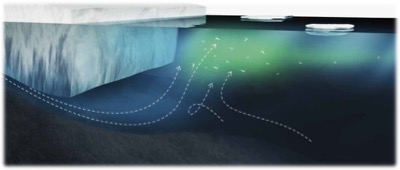
When the sun appears in springtime the ice breaks. The ice algae caught just below it start to bloom.
When this happens, the copepods rise up from the bottom and eat themselves fat in the nutritious plankton.
- Where do the ice algae grow?
- Where does the meltwater come from?
- What do copepods eat?
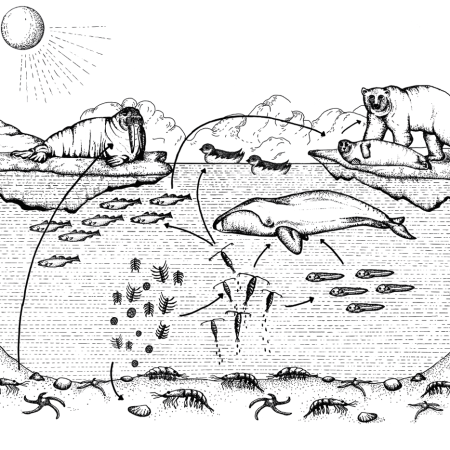
Marint fødenet
- Write or record the names of the animals you know in the picture.
- What do they eat?
- What is a food web?
In winter there is no or very little sunlight at Ilulissat. In spring the sun returns.
Some years the ice breaks early or there is no ice at all. Then the algae begin to bloom early.
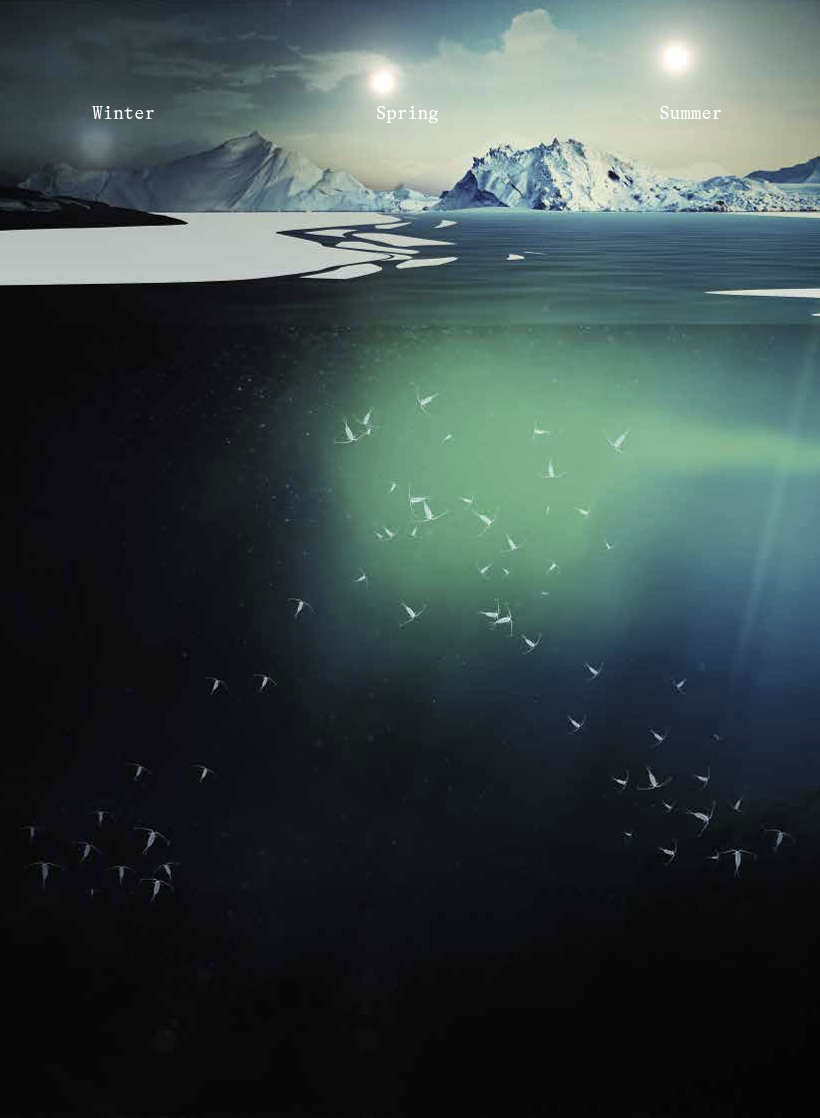
The copepods having spent the winter at the bottom of the sea risk to rise up when the bloom is over. Then they are not in time to eat themselves fat.
- What happens when the ice breaks, and the sun shines on the algae?
- Where do copepods live in winter?
- What does a copepod look like?
- Where do the ice algae grow?
- Where does the meltwater come from?
- What do copepods eat?
Here you see a marine food web. A food web is a model showing the mutual feeding relations between animals in a certain ecosystem.
A food web always contains an organism that can conduct photosynthesis, a plant that uses the energy from sunlight to produce nourishment.
- Write or record the names of the animals you know in the picture.
- What do they eat?
- What is a food web?
In winter there is no or very little sunlight at Ilulissat. In spring the sun returns.
Some years the ice breaks early or there is no ice at all. Then the algae begin to bloom early.
The copepods having spent the winter at the bottom of the sea risk to rise up when the bloom is over. Then they are not in time to eat themselves fat.
- What happens when the ice breaks, and the sun shines on the algae?
- Where do copepods live in winter?
- What does a copepod look like?
When spring and summer come, the light from the sun causes the production of phytoplankton to increase. The ice algae which have been caught in the ice all winter, start to bloom.
Smeltevandet fra gletsjeren løber ud i fjorden og hvirvler det næringsrige bundvand op i lyset.
Vandlopperne der har overvintret på bunden af havet, vandrer op og æder sig fede i den næringsrige plankton.
Why are there most nutrients and plankton near the glacier front?
Why is the fresh water from the glacier lighter than the salt water from the Icefjord?
Why does the production of phytoplankton increase in spring and summer?
Here you see a marine food web. A food web is a model showing the mutual feeding relations between animals in a certain ecosystem.
A food web always contains an organism that can conduct photosynthesis, a plant that uses the energy from sunlight to produce nourishment.
-
Why is it important that the copepods eat themselves fat?
-
Which organism in this food web can conduct photosynthesis?
-
Who eats whom? And why do some not get eaten?
The copepods having spent the winter at the bottom of the sea, rise up towards the surface to eat themselves fat in phytoplankton. If the ice breaks earlier than usual or there is no ice at all, the bloom of phytoplankton will occur too early.
This means that the copepods will rise too late and not get enough food during the bloom. This may have disastrous consequences for the entire food web.
- What could be the causes of the ice breaking too early or being completely missing?
- How does it affect the marine food web if the bloom occurs too early?
- When the copepods rise towards the surface, will they be close to or far from the glacier front?
When spring and summer come, the light from the sun causes the production of phytoplankton to increase. The ice algae which have been caught in the ice all winter, start to bloom.
Smeltevandet fra gletsjeren løber ud i fjorden og hvirvler det næringsrige bundvand op i lyset.
Vandlopperne der har overvintret på bunden af havet, vandrer op og æder sig fede i den næringsrige plankton.
Why are there most nutrients and plankton near the glacier front?
Why is the fresh water from the glacier lighter than the salt water from the Icefjord?
Why does the production of phytoplankton increase in spring and summer?
Here you see a marine food web. A food web is a model showing the mutual feeding relations between animals in a certain ecosystem.
A food web always contains an organism that can conduct photosynthesis, a plant that uses the energy from sunlight to produce nourishment.
- Why is it important that the copepods eat themselves fat?
- Which organism in this food web can conduct photosynthesis?
- Who eats whom? And why do some not get eaten?
The copepods having spent the winter at the bottom of the sea, rise up towards the surface to eat themselves fat in phytoplankton. If the ice breaks earlier than usual or there is no ice at all, the bloom of phytoplankton will occur too early.
This means that the copepods will rise too late and not get enough food during the bloom. This may have disastrous consequences for the entire food web.
- What could be the causes of the ice breaking too early or being completely missing?
- How does it affect the marine food web if the bloom occurs too early?
- When the copepods rise towards the surface, will they be close to or far from the glacier front?
Partners


